Every great competitive swimmer started exactly the same way your child did — learning to float, kick, and breathe in the shallow end. But there comes a point when the basics are no longer enough, and a young swimmer's natural enthusiasm, strength, or sheer love of the water signals that it might be time for something more. Transitioning from learn-to-swim to competitive swimming is one of the most exciting milestones in a young athlete's life, and it can shape their confidence, discipline, and physical development for years to come.
In Singapore, where swimming is both a national priority and a popular sport, the pathway from recreational lessons to competitive squads is well-structured — but it can still feel overwhelming for parents who are new to the process. What level should your child reach before making the switch? How do you find the right programme? What will the training look like, and how much does it cost? This guide answers all of those questions, drawing on over 25 years of aquatic coaching expertise to help you make an informed, confident decision for your child.
Not every child who enjoys swimming is immediately ready for competitive training, and that is perfectly fine. Readiness is about more than physical ability — it also involves attitude, focus, and a genuine desire to improve. Pushing a child into competitive swimming before they are ready can dampen enthusiasm rather than ignite it, so it is worth taking time to observe a few key indicators before making the move.
The most obvious sign is technical proficiency. A child who can confidently swim all four competitive strokes — freestyle, backstroke, breaststroke, and butterfly — with reasonable form is in a strong position to begin squad training. They should be comfortable swimming continuous laps without stopping and able to follow instructions in a group setting. Equally important is the child's own attitude: are they asking to swim more often? Do they watch competitive swimming with curiosity or excitement? These emotional signals often matter just as much as their lap times.
Other signs to watch for include:
If your child ticks most of these boxes, it may be time to have a conversation with their current swim coach about readiness for competitive pathways.
Before any competitive ambitions come into play, water safety must be the bedrock. In Singapore, the SwimSafer 2.0 programme — developed by the National Water Safety Council in collaboration with Sport Singapore — provides exactly that foundation. Refreshed from the original SwimSafer initiative that launched in 2010, SwimSafer 2.0 was reviewed and updated between 2016 and 2017 to place greater emphasis on skill development alongside water safety and personal water survival education. The programme is designed for people of all ages and varying abilities, making it the national benchmark for swimming competence.
Completing the SwimSafer 2.0 stages does more than tick a certification box. It builds the kind of well-rounded swimmer who enters competitive training with strong survival instincts, sound technique across multiple strokes, and genuine confidence in and around water. For parents, it also provides peace of mind that their child is not just fast but fundamentally safe. SPEEDISWIM offers a structured SwimSafer programme taught by professionally qualified coaches, aligned with national certification standards and delivered across multiple venues in Singapore.
Competitive coaches consistently note that swimmers who have completed a thorough learn-to-swim programme — rather than rushing into squad training — tend to have better stroke mechanics, fewer injuries, and a more sustainable love of the sport over the long term.
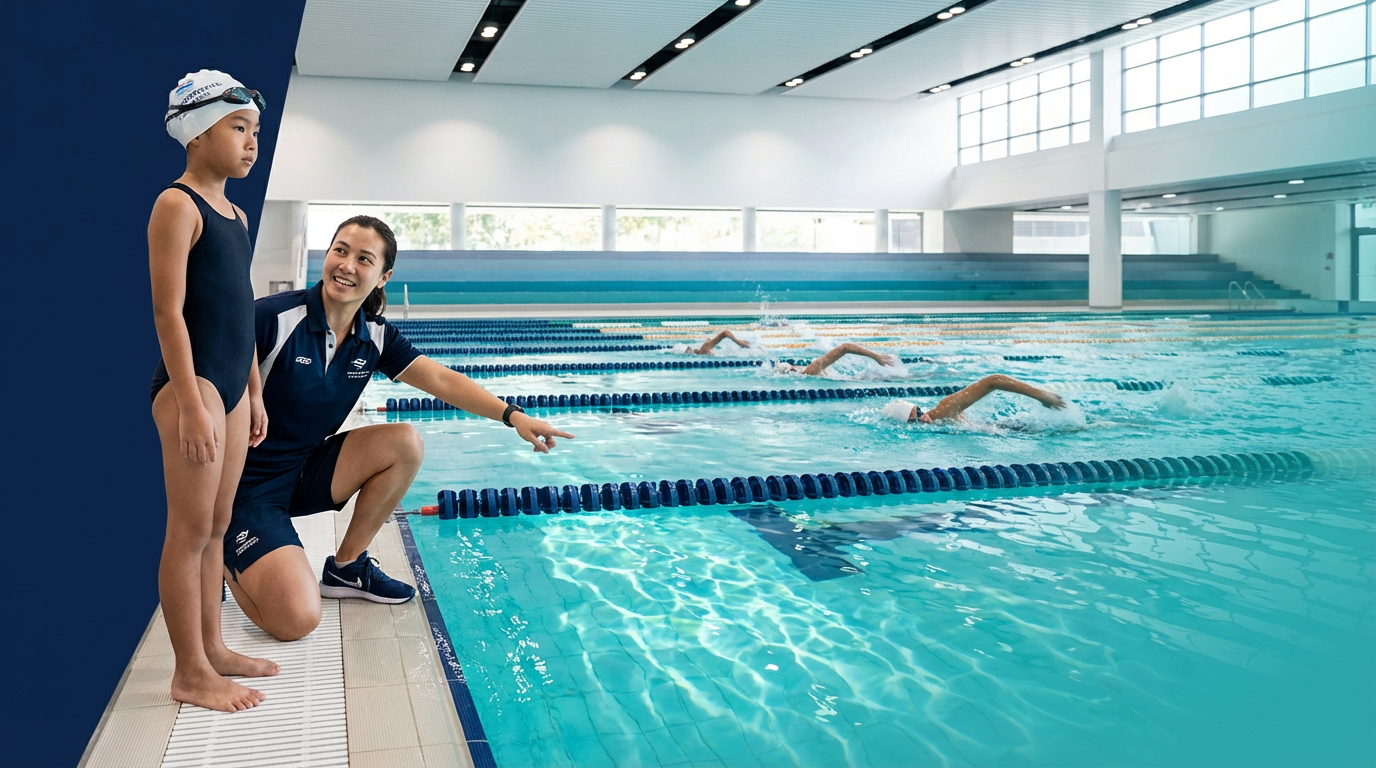
Many parents picture competitive swimming as simply swimming faster. In reality, it is a highly technical, structured discipline that demands as much mental toughness as it does physical ability. Competitive swimmers train across all four strokes and learn to race individual medley events, which combine all four in a single race. They also develop racing starts, flip turns, and underwater dolphin kicks — skills that are rarely covered in recreational lessons.
Training sessions in a competitive squad typically run between one and two hours and may occur three to five times per week depending on the swimmer's age and level. Dryland training — exercises done on land to build strength, flexibility, and core stability — is also a common component of serious competitive programmes. Young swimmers learn to track their times, set personal bests, and compete at galas and inter-school meets. Over time, the most talented swimmers may be identified for national development pathways or Direct School Admission (DSA) programmes, which allow academically-eligible student-athletes to gain school entry based on their sporting achievements.
It is worth being realistic with your child about what this commitment means. Competitive swimming asks for early mornings, consistent attendance, and the resilience to accept slower-than-expected progress at times. But for the right child, it also delivers extraordinary rewards in discipline, teamwork, physical fitness, and self-belief.
The transition from learn-to-swim to competitive swimming does not happen overnight, but following a clear process makes it far less daunting for both parents and young swimmers.
Following these steps helps ensure the transition feels like a natural next chapter rather than a sudden leap into the unknown.
Singapore's competitive swimming landscape offers a range of pathways, from school-based programmes to club squads affiliated with Swimming Singapore (formerly the Singapore Swimming Association). The key is to find a programme where qualified coaches prioritise age-appropriate development, not just results. A programme that pushes young swimmers too hard, too soon, risks burnout and injury — so look for coaches with formal qualifications, a track record of athlete development, and a philosophy that balances competitive ambition with long-term wellbeing.
SPEEDISWIM's competitive swimming programme has been developing athletes since 1998, with over 50 swimmers going on to represent Singapore at the National Youth and National Team levels. The programme is aligned with the Singapore Swimming Proficiency Awards (SSPA), giving swimmers a recognised benchmark for their progress. With training venues at international schools and country clubs across Singapore, SPEEDISWIM offers accessible, high-quality competitive coaching that bridges the gap between recreational swimming and elite performance.
When evaluating any competitive programme, consider the following factors:
Competitive lap swimming is just one of many exciting directions a young swimmer can take once they have mastered the fundamentals. Singapore's aquatic community is rich and diverse, and some children discover that their strengths and passions lead them toward alternative disciplines that are equally rewarding and competitive in their own right.
Artistic swimming (formerly synchronized swimming) combines athleticism, music, and creative expression in a demanding team or solo format. SPEEDISWIM offers a dedicated artistic swimming programme that has produced nationally competitive athletes. For children who love team dynamics, physical contact, and strategic play, water polo is an outstanding option that builds both swimming ability and game intelligence. Meanwhile, underwater hockey offers something truly unique — a fast-paced, breath-hold sport played entirely below the surface that demands extraordinary fitness and coordination.
Exposing your child to these options — even briefly — can help them discover where their real passion lies. Many elite aquatic athletes began as recreational swimmers who stumbled onto a niche sport and never looked back.
Being financially and logistically prepared for competitive swimming makes the transition much smoother for the whole family. Swimming in Singapore spans a wide range of price points depending on the type and frequency of training. Group swimming lessons — including structured squad sessions — typically range from $35 to $55 per session, while private or semi-private coaching commands premium pricing, generally between $60 to $120 per session. For competitive swimmers who train multiple times a week, monthly costs can add up, so it is important to factor this into your planning early.
Beyond session fees, competitive swimming involves additional costs such as competition entry fees, swimwear and equipment (goggles, caps, fins, kickboards), and occasionally travel if your child qualifies for higher-level meets. Many families find that joining a club with a comprehensive competitive programme offers better value than piecing together individual sessions, as structured squads often include coaching continuity, team support, and competition coordination as part of the overall package.
On the time commitment side, families should plan for three to five training sessions per week at the serious competitive level, with additional time for travel, warm-up, and cool-down. Early morning sessions before school are common in Singapore's competitive swimming calendar. Clear communication within the family about schedules, priorities, and the child's own enthusiasm is essential to making this commitment sustainable and enjoyable.
Most children begin competitive squad training between the ages of 7 and 10, once they have completed a foundational learn-to-swim programme. However, age is less important than technical readiness. A well-coached 8-year-old with strong stroke mechanics and focus will thrive in a competitive environment, while a child of the same age who is still developing water confidence may benefit from another year or two of structured lessons first.
While it is not always a strict prerequisite for every competitive programme, completing SwimSafer 2.0 is strongly recommended. The programme ensures your child has the water safety knowledge and multi-stroke competency that underpins safe, effective competitive training. Coaches at reputable squads will assess your child's ability regardless, but a strong SwimSafer foundation almost always translates to a smoother, more confident start in competitive swimming.
Competitive swimming does not have to mean Olympic ambitions. Many children participate in club squads, school galas, and local competitions purely for the joy of racing, the camaraderie of a team, and the fitness benefits — without any pressure to pursue national-level performance. A good programme will cater to swimmers at all points of the competitive spectrum, helping each child reach their personal best on their own terms.
The transition from learn-to-swim to competitive swimming is one of the most meaningful steps a young swimmer can take. It is where the water stops being just a safe environment and becomes a stage for personal growth, athletic achievement, and lifelong passion. With the right foundation — built through programmes like SwimSafer 2.0 — and the right coaching environment, this transition can be seamless, exciting, and deeply rewarding for your child and your whole family.
Singapore is fortunate to have a well-developed aquatic ecosystem, and organisations like SPEEDISWIM have spent more than two decades refining the pathway from first splash to national squad. Whether your child is showing early signs of competitive promise or simply wants to swim faster and with greater purpose, the important thing is to start the conversation, seek the right guidance, and let their natural love of the water lead the way.
SPEEDISWIM has been developing Singapore's aquatic talent for over 25 years. Whether your child is completing their SwimSafer 2.0 journey or ready to join a competitive squad, our professionally qualified coaches are here to guide every step of the transition.