Whether you've been swimming for years or just completed your first lap without stopping, there comes a point where swimming harder simply stops making you faster. The real gains — the ones that shave seconds off your time and make every length feel easier — come from refining your technique. And the most effective way to do that is through targeted drills.
At SPEEDISWIM, we've been coaching swimmers of all levels since 1998. In that time, we've helped more than 25,000 students develop their skills, from beginners working through the SwimSafer 2.0 programme to competitive athletes who've gone on to represent Singapore at the national level. One thing holds true across every level: consistent drill work is what separates swimmers who plateau from those who keep improving.
This guide covers 15 drills that our coaches actually use — drills designed to fix the most common technical faults, build better body awareness in the water, and make good technique feel natural rather than forced. We've organised them by stroke, with clear instructions and coaching cues for each one.
Water is approximately 800 times denser than air, which means even small inefficiencies in your stroke create significant drag. A swimmer with poor body position, a wide arm recovery, or a collapsing kick has to work considerably harder to travel the same distance as someone with clean, efficient mechanics. This is why two swimmers with identical fitness levels can produce very different race times — and why drilling is so valuable at every stage of development.
Drills isolate specific elements of a stroke so you can feel what correct movement looks and feels like without the cognitive overload of coordinating everything at once. Done consistently, they build the muscle memory that allows good technique to persist under fatigue — which is ultimately what competitive swimming demands. Even recreational swimmers benefit enormously, since better technique means less strain on the shoulders, neck, and lower back over time.
Before diving into specific drills, it helps to understand the key principles that underpin efficient swimming across all four strokes. These are the benchmarks your drills are working toward:
Keep these principles in mind as you work through the drills below. The goal is always to connect what you're feeling during the drill to what your full stroke should feel like.
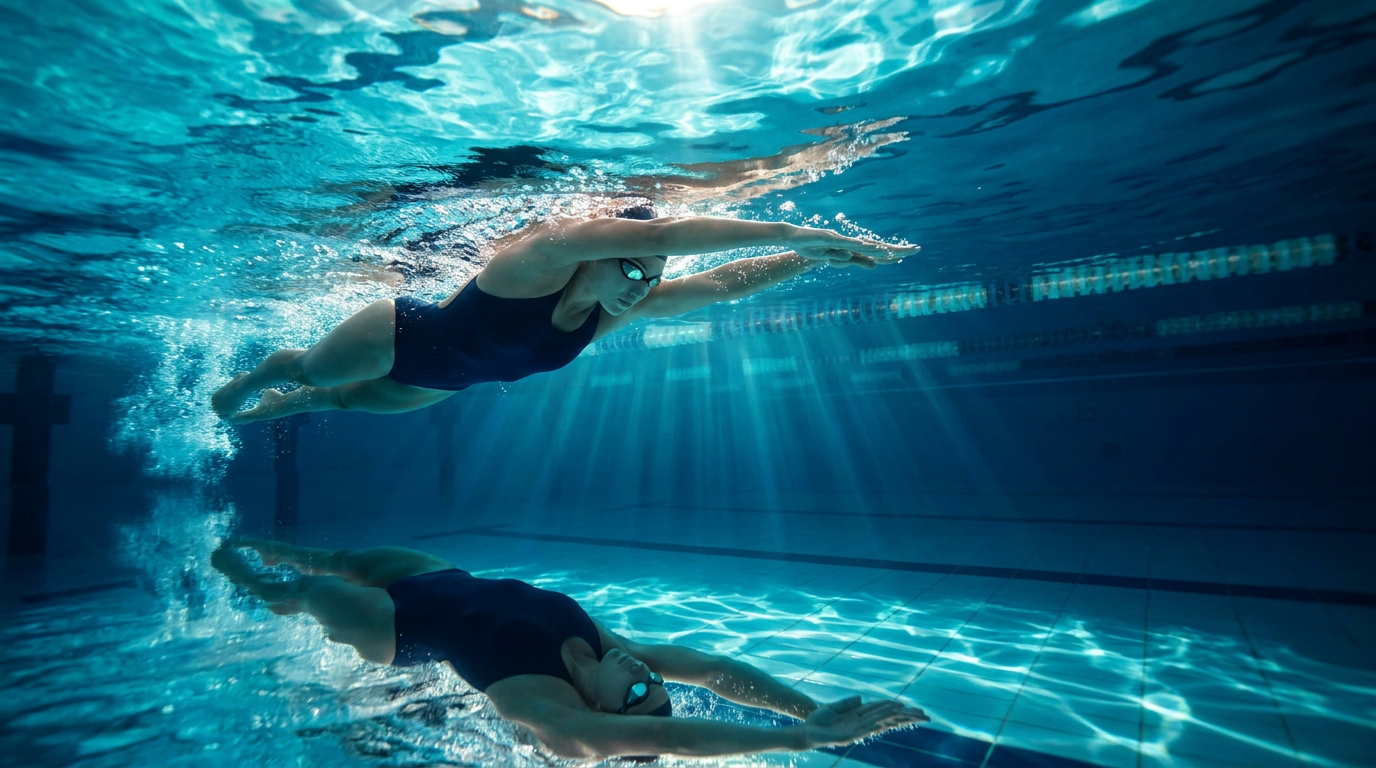
Freestyle is the stroke most swimmers spend the most time in, and it's also the one where small technical improvements have the biggest cumulative impact. These five drills address the most common freestyle faults our coaches see.
In this drill, one hand waits at full extension in front of you while the other completes its entire pull cycle and "catches up" before the next stroke begins. This slows the stroke down and forces you to feel a clean, extended catch before pulling. It corrects the habit of crossing over the centre line and encourages a long, high-elbow entry. Swim 25 metres focusing entirely on the moment of catch rather than rushing into the pull.
During the recovery phase, drag your fingertips lightly along the water's surface as your arm moves forward. This physically prevents a wide, swinging arm recovery and trains the elbow to lead the hand — which is the correct movement pattern. Swimmers who notice their fingertips leaving the water during this drill are recovering too high and wide. Use this drill to build the habit of a compact, low-profile recovery.
Roll to one side with your lower arm extended in front and your upper arm resting along your body. Kick continuously in this side-lying position, holding it for a full length before rotating to the other side. This drill develops hip-driven rotation, builds core stability, and teaches swimmers to maintain a streamlined body line even when rotated — a position that should occur with every stroke cycle in freestyle. Breathe upward naturally rather than lifting your head.
Close both hands into fists and swim freestyle normally. With your palms unable to catch water, your forearm becomes the primary propulsive surface, which trains the high-elbow underwater pull that coaches call the "early vertical forearm." After 25 metres of fist drill, open your hands and swim normally — most swimmers immediately feel a dramatically improved catch. Repeat the contrast sets two to three times per session.
Kick on your side for six kicks, take three full freestyle strokes, then pause on your side again for six more kicks. This drill links the side-kick position to the full stroke, helping swimmers transfer the feeling of good body rotation into their normal freestyle rhythm. It is one of the most effective freestyle drills for intermediate swimmers because it makes rotation active rather than passive.
Breaststroke is technically the most complex of the four strokes and the one where poor mechanics most frequently cause injury — particularly to the knees. These drills focus on the two areas that matter most: the pull and the kick timing.
Perform two breaststroke kicks for every one arm pull. This exaggerates the glide phase and forces swimmers to feel how momentum is generated and maintained. It also highlights whether the kick is actually propulsive — if you don't feel yourself moving forward during the kick, something in the foot position or knee alignment needs correction. This is a particularly useful drill for swimmers who rush through the glide.
Replace the breaststroke kick entirely with a single dolphin kick during the pull cycle. This allows you to isolate the arm action — the outsweep, insweep, and recovery — without worrying about kick timing. Focus on keeping the pull narrow and powerful, with elbows staying in front of the shoulders throughout. When you return to a full breaststroke, the improved arm pattern is usually immediately noticeable.
Swim breaststroke with your head continuously above water, looking forward. This forces a stronger, more scooping pull to keep you elevated and reveals whether your arm pull is providing enough lift. While not a position you'd use in racing, it is excellent for building pull strength and correcting a flat, weak arm cycle. Keep sessions short — two to three lengths — as this drill is physically demanding on the neck and core.
The biggest challenge in backstroke is the inability to see where you're going, which leads many swimmers to tilt their head, collapse their hips, or over-rotate. These drills address all three issues.
Keep one arm stationary at your side while the other completes the full backstroke cycle. This drill slows everything down so you can feel the entry (little finger first, arm fully extended), the catch, the pull through, and the exit. Alternating arms each length allows you to identify asymmetries — most swimmers have a noticeably weaker side that they compensate for unconsciously in full stroke. Correct the weaker arm first before returning to bilateral swimming.
Place a kickboard flat on your stomach and kick backstroke while keeping the board balanced. This instantly reveals any hip dropping or excessive rotation — if the board slides off, your hips are not staying level. It also trains awareness of head position, since looking upward (rather than slightly toward your feet) is essential for maintaining a flat, streamlined body line on your back.
Butterfly is the most physically demanding stroke and the one where fatigue most quickly corrupts technique. These drills build the undulation pattern and timing that make butterfly feel fluid rather than forced.
Push off the wall and dolphin kick on your side just beneath the surface. Alternate which side faces up each length. Kicking on your side makes it much easier to feel the wave-like motion travelling from your chest through your hips and into your feet — the undulation that powers butterfly. Many swimmers over-kick with the knees rather than driving from the core; this position makes the difference immediately obvious.
Swim butterfly using only one arm at a time while the other extends forward. This reduces the coordinative demand significantly and lets you focus on the timing between the arm pull and the second kick (the kick that occurs as your hands push through at the back of the stroke). The second kick is the power kick in butterfly, and most swimmers who struggle with timing will find this drill immediately clarifying. Switch arms every 25 metres.
Take two full dolphin kicks for every one arm pull, pausing in the extended position between each stroke. Like the breaststroke version, this exaggerates the glide and forces awareness of momentum. It also gives tired swimmers a chance to practice butterfly mechanics at reduced intensity, making it an excellent drill for the early stages of butterfly learning — particularly relevant for athletes progressing through structured competitive programmes.
Push off the wall in a tight streamline — arms locked overhead, hands overlapping, ears squeezed between your biceps, toes pointed — and glide as far as possible without kicking. This is the single most underrated drill in swimming because it teaches the body position that all strokes should return to on every stroke cycle. Time how long you can hold the streamline before beginning to decelerate, and work to extend that distance over time. A strong streamline can add half a second to every turn and start in competitive racing.
In the deep end, hold your arms crossed over your chest and kick to keep your head above water. This drill works for all strokes — use freestyle flutter kick, breaststroke kick, or dolphin kick depending on your focus. Because there is no forward movement to compensate for a weak kick, every inefficiency becomes immediately apparent. Aim for 30-second sets with 15 seconds of rest, and increase duration as your kick strength and efficiency improve. Coaches at SPEEDISWIM use this drill extensively during competitive swimming training to build kick endurance and correct knee-driven technique.
For recreational swimmers and those working through a learn-to-swim programme, dedicating 20 to 30 percent of each session to drill work is a practical and effective ratio. That means roughly 500 to 800 metres of drilling in a 2,000-metre workout. For competitive swimmers in structured programmes, drill sets are typically embedded into warm-up and technique sets, with the proportion varying based on the phase of the training cycle.
Consistency matters more than volume. Fifteen minutes of focused drill work three times a week will produce more improvement than an occasional long drill session. It also helps to drill with a purpose — choose one or two drills per session that target a specific fault rather than rotating through everything on this list at once. Over four to six weeks, you'll begin to feel those improvements carry over into your full stroke.
If you're involved in disciplines beyond competitive freestyle — such as artistic swimming or water polo — many of these drills translate directly. Body position, kick efficiency, and underwater movement are foundational across all aquatic sports. Even underwater hockey players benefit from improved breath control and dolphin kick technique developed through regular drill work.
Drills are powerful, but they work best alongside qualified coaching feedback. Video analysis, in-water correction, and a structured progression plan accelerate improvement in ways that solo practice cannot replicate. This is especially true for younger swimmers developing technique during the critical early years — habits formed now, good or bad, tend to persist for a long time.
For swimmers in Singapore looking to build on a solid foundation, the SwimSafer 2.0 programme provides nationally recognised certification across progressive stages, covering both stroke development and essential water safety skills. Swimmers ready to pursue competitive pathways can explore SPEEDISWIM's competitive swimming programme, which has produced more than 50 national-level athletes over the past two decades.
Improving your swimming technique is not about swimming more — it's about swimming smarter. The 15 drills in this guide cover every major stroke and address the technical faults that hold most swimmers back, regardless of their current level. Start with two or three drills that target your weakest areas, practice them consistently, and give yourself time to feel the changes carry over into your full stroke. Progress in technique is rarely instant, but it is reliable when you put in the focused work.
With over 25 years of experience developing swimmers from beginner to elite level, SPEEDISWIM's coaches understand what it takes to make lasting technical improvement — and we're here to help you do exactly that.
Whether you're just starting out or looking to sharpen your competitive edge, SPEEDISWIM's professionally qualified coaches can help you identify the technique faults holding you back and build a training plan that actually works.