When parents in Singapore begin searching for structured swimming lessons for their children, they quickly encounter the SwimSafer programme, a nationally recognized water safety and swimming certification system. At the foundation of this progressive framework sits SwimSafer Bronze, the essential first certification level that introduces young swimmers to fundamental water skills while establishing critical safety awareness.
For many families, understanding what SwimSafer Bronze entails represents the first step in a longer journey toward water competency and safety. This certification isn't merely about learning to swim; it's a comprehensive introduction to being safe in and around water, combining practical swimming techniques with survival skills and safety knowledge. As Singapore is surrounded by water and features numerous swimming facilities, equipping children with these foundational skills has become increasingly important for families across the island.
This guide examines everything parents need to know about SwimSafer Bronze, from specific assessment requirements to practical preparation strategies, helping you make informed decisions about your child's aquatic education journey.
SwimSafer Bronze is the first of six progressive certification levels within Singapore's national SwimSafer programme. Designed for beginners with little to no swimming experience, this foundational stage focuses on building basic water confidence while introducing essential swimming strokes and safety concepts. Unlike informal swimming lessons, Bronze certification follows standardized criteria established by the National Water Safety Council in collaboration with Sport Singapore (SportSG), ensuring consistent quality and skill development across all providers.
The certification represents more than just learning to float or paddle. It marks a child's first formal achievement in aquatic competency, validating that they've mastered specific water entry and exit techniques, can perform basic propulsion movements, and understand fundamental safety principles. For children, earning their Bronze badge provides a sense of accomplishment and motivation to continue developing their swimming abilities. For parents, it offers reassurance that their child has achieved recognized, standardized skills taught by qualified instructors.
At SPEEDISWIM's SwimSafer Programme, Bronze-level students benefit from over two decades of teaching experience, with instructors who understand how to make this foundational stage both effective and enjoyable. Having trained more than 25,000 students since 1998, SPEEDISWIM has refined its approach to introducing young swimmers to the water in ways that build genuine confidence rather than just checking boxes on an assessment sheet.
To fully appreciate what SwimSafer Bronze entails, it's helpful to understand the broader programme structure. The SwimSafer 2.0 initiative, launched after a comprehensive review in 2016-2017, refined the original 2010 programme to better address evolving water safety needs. This updated framework teaches people of all ages and varying abilities to swim and be safe in and around water, with a renewed emphasis on skill development in conjunction with water safety and personal water survival education.
The six progressive stages of SwimSafer 2.0 are designed to take complete beginners through to competent swimmers capable of handling various aquatic environments. Bronze sits at the entry level, followed by Silver, Gold, Platinum, Diamond, and Star levels, each building upon skills mastered in the previous stage. This systematic progression ensures that swimmers develop capabilities gradually, with each certification representing measurable advancement in technique, endurance, and safety knowledge.
What distinguishes SwimSafer 2.0 from traditional swimming lessons is its holistic approach. Rather than focusing exclusively on stroke technique, the programme integrates three essential components at every level: swimming skills, water safety knowledge, and personal survival techniques. This comprehensive methodology prepares swimmers not just for recreational swimming but for real-world water safety scenarios they might encounter at beaches, pools, or during water activities.
The SwimSafer Bronze certification evaluates students across multiple dimensions, ensuring they've developed well-rounded foundational capabilities. Understanding these specific requirements helps parents set appropriate expectations and support their children's learning journey effectively.
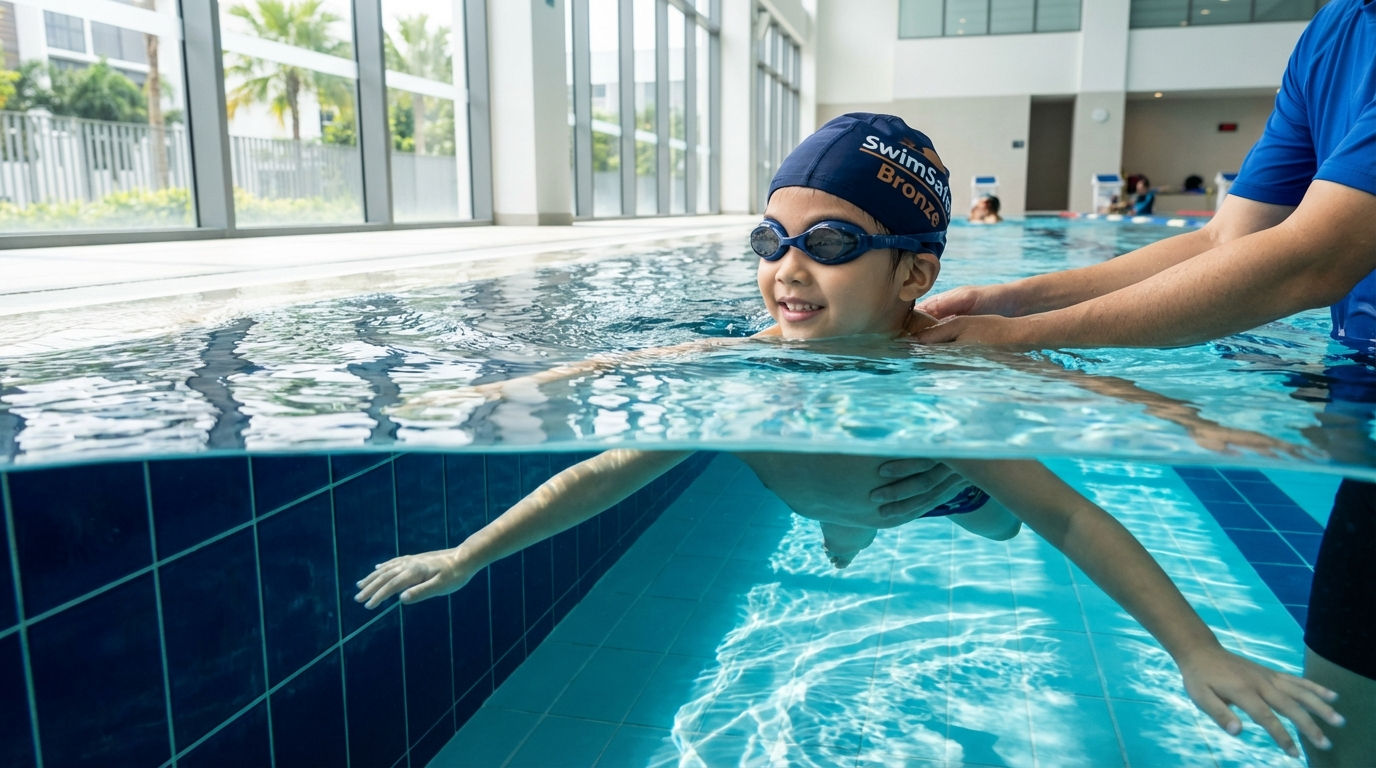
The swimming technique component of Bronze certification focuses on introducing fundamental movements that form the basis for more advanced strokes. Students must demonstrate the ability to enter water safely using various methods, including stepping in from pool edges and entering from sitting positions. These seemingly simple skills actually teach important body control and spatial awareness in aquatic environments.
Forward movement skills at the Bronze level include basic front crawl (freestyle) and breaststroke movements. Students aren't expected to perform these strokes with competitive precision, but they must show coordinated arm and leg actions that produce forward propulsion over specified distances. Typically, Bronze candidates need to swim 10 meters using these techniques, demonstrating that they can sustain the movements independently.
Additionally, Bronze certification requires students to perform backward movement using elementary backstroke or sculling actions. This skill develops all-around water competency and introduces the concept that swimmers can move efficiently in multiple directions, an important foundation for more complex skills at higher levels.
Water safety education distinguishes SwimSafer from purely technique-focused swimming programmes. At the Bronze level, students learn to identify safe and unsafe water environments, recognize basic pool safety equipment, and understand fundamental rules for behavior around water. This knowledge component often includes classroom-style learning alongside practical pool sessions.
Students must demonstrate understanding of concepts like pool depth markers, the importance of adult supervision, and appropriate swimming areas. They learn to recognize potential hazards such as slippery surfaces, deep water zones, and crowded pool conditions. These lessons might seem basic, but they establish critical thinking patterns that mature into sophisticated risk assessment abilities as children progress through higher SwimSafer levels.
Many quality programmes, including those offered by SPEEDISWIM, integrate safety discussions naturally into lesson time rather than treating them as separate theoretical components. When students practice safe water entry, instructors simultaneously explain why these methods reduce injury risk. This integrated approach helps knowledge retention and makes safety principles feel practical rather than abstract.
The personal survival component of SwimSafer Bronze introduces students to life-saving skills appropriate for their developmental level. At this foundational stage, survival skills focus primarily on self-preservation rather than rescuing others. Students learn techniques such as floating on their backs, treading water for short durations, and recovering to a standing position from floating.
Submersion and breath control form another critical survival element. Bronze students must demonstrate comfort with getting their faces wet and opening their eyes underwater, skills that seem simple but are essential for water safety. They practice controlled breathing patterns and learn to resurface calmly after submerging, reducing panic responses that can lead to dangerous situations.
The programme also introduces basic rescue concepts at an age-appropriate level. Bronze students learn about reaching assists using pool equipment and understand the principle of "reach or throw, don't go" – the fundamental safety concept that untrained swimmers should never enter water to attempt rescues. This early introduction to rescue awareness plants seeds for more advanced lifesaving training in later SwimSafer levels.
While SwimSafer Bronze doesn't impose strict age restrictions, most children who pursue this certification fall between ages five and seven. This age range typically corresponds with developmental readiness for structured swimming instruction, though every child develops at their own pace. Physical factors such as motor skill coordination, cognitive factors like ability to follow multi-step instructions, and emotional factors including comfort in new environments all influence readiness.
Parents sometimes wonder whether their child is "too young" or "too old" for Bronze certification. In reality, SwimSafer levels are competency-based rather than age-based. A confident seven-year-old with some informal swimming experience might progress through Bronze relatively quickly, while a cautious five-year-old might need additional time to build water confidence. Both scenarios are perfectly normal and acceptable within the SwimSafer framework.
Readiness indicators parents can observe include willingness to participate in water play, ability to follow instructor directions in group settings, and basic body control on land (such as balancing on one foot or jumping with coordination). Children who demonstrate these capabilities typically adapt well to Bronze-level instruction. However, quality swimming programmes like those at SPEEDISWIM assess each child individually and may recommend preparatory classes for students who need additional confidence-building before formal Bronze training.
Parents play a crucial role in preparing children for successful SwimSafer Bronze experiences. While formal instruction happens during lessons, reinforcement at home and positive attitudes toward swimming significantly impact learning outcomes. Creating enthusiasm about swimming without creating pressure represents an important balance.
Water exposure outside formal lessons helps tremendously with comfort and skill retention. Family swimming sessions at public pools allow children to practice emerging skills in relaxed environments. During these recreational swims, parents can encourage face submersion during play, practice floating while providing support, or simply allow children to experiment with movements they're learning in class. These informal practice sessions shouldn't become additional lessons but rather fun reinforcement opportunities.
Setting appropriate expectations also contributes to positive experiences. Children should understand that learning to swim takes time and that not every skill will be mastered immediately. Celebrating effort and progress rather than only achievement helps maintain motivation through challenges. When children struggle with particular skills (such as breath control or coordinated arm movements), acknowledging the difficulty while expressing confidence in their ability to improve creates resilience.
Practical preparation matters too. Ensuring children have properly fitting swimwear and goggles, arriving at lessons well-rested and fed, and maintaining consistent attendance all support learning. Irregular attendance particularly impacts skill development, as swimming proficiency requires repeated practice to build muscle memory and confidence.
When instructors determine that students have developed the necessary skills, they register them for formal SwimSafer Bronze assessment. At official assessment centres like SPEEDISWIM at Orchid Country Club (one of the Non-ActiveSG Pool CAMS Centres), trained assessors evaluate students against standardized criteria to ensure consistency across all SwimSafer certifications in Singapore.
The assessment format typically involves demonstrating various required skills in sequence while assessors observe and record performance. Students might enter the water, perform specified swimming strokes over required distances, demonstrate survival skills like floating and treading water, and answer safety knowledge questions. The entire assessment usually takes 30-45 minutes, depending on group size and specific testing protocols.
Parents often worry about assessment pressure affecting their children's performance. Quality programmes prepare students thoroughly before registration, ensuring they've successfully demonstrated all required skills multiple times during regular lessons. This preparation means assessment becomes more of a validation process than a high-stakes test. At SPEEDISWIM, instructors register students for assessment only when confident in their readiness, resulting in high success rates and positive assessment experiences.
Following successful assessment, students receive their SwimSafer Bronze certification, which includes a certificate and achievement badge. This tangible recognition provides motivation and marks an important milestone in their aquatic journey. The certification also serves as official documentation of their skill level, useful for school swimming programmes, holiday camps, or other activities requiring water safety credentials.
Earning Bronze certification represents the beginning rather than the end of aquatic development. The immediate next step in the SwimSafer progression is SwimSafer Silver, which builds upon Bronze foundations by introducing longer swimming distances, refined stroke techniques, and more advanced safety concepts. Silver certification requires swimming 15 meters instead of 10, demonstrates improved coordination and endurance, and expands survival skill repertoires.
Beyond the sequential SwimSafer levels, Bronze certification can open doors to specialized aquatic activities. Children who develop passion for swimming might explore competitive opportunities, with programmes like SPEEDISWIM's Competitive Swimming providing pathways for talented young swimmers. Over 50 swimmers from SPEEDISWIM have been selected for National Youth and National Teams, demonstrating how foundational skills developed at Bronze level can evolve into elite athletic achievement.
Other aquatic disciplines become accessible as swimming competency develops. Artistic Swimming, Water Polo, and even Underwater Hockey all require the fundamental water confidence and basic swimming skills that Bronze certification validates. These specialized sports offer variety and can sustain long-term engagement with aquatic activities beyond traditional swimming lessons.
For families focused primarily on safety rather than competitive or specialized pursuits, continuing through the remaining SwimSafer levels (Gold, Platinum, Diamond, and Star) ensures comprehensive water competency. Completing the full progression equips swimmers with skills for various aquatic environments, from calm pools to open water, and develops genuine water safety capabilities that last a lifetime.
Not all SwimSafer programmes deliver equivalent experiences, despite teaching to the same certification standards. The quality of instruction, class sizes, facility conditions, and organizational philosophy significantly impact learning outcomes and overall experience. Parents researching options should consider several factors beyond basic programme availability and pricing.
Instructor qualifications and experience represent perhaps the most critical selection factor. Quality programmes employ instructors with recognized teaching certifications, ongoing professional development, and substantial experience working with children at various skill levels. At SPEEDISWIM, instructors benefit from the organization's 20+ years of teaching methodology refinement, ensuring they understand not just what to teach but how to teach it effectively to diverse learners.
Class sizes and student-to-instructor ratios directly affect the attention each child receives. While group swimming lessons in Singapore typically range from $35 to $55 per session, lower prices sometimes reflect larger class sizes that reduce individual feedback opportunities. Smaller groups allow instructors to observe each student more closely, provide personalized corrections, and ensure safety through better supervision. Parents should inquire about maximum class sizes and typical ratios when evaluating programmes.
Facility quality and accessibility matter too. Well-maintained pools with appropriate depths for beginner swimmers, comfortable water temperatures, and clean changing facilities all contribute to positive learning experiences. Programmes operating across multiple venues, like SPEEDISWIM's presence at international schools and country clubs, often provide location convenience that reduces logistical stress for busy families.
Finally, consider the organization's broader capabilities and track record. Established programmes with demonstrated success in student development (like SPEEDISWIM's record of training over 25,000 students and grooming more than 1,000 athletes) typically have refined teaching systems and troubleshooting protocols. Their experience managing diverse student needs, from anxious beginners to talented swimmers, means they can adapt instruction to your child's specific requirements rather than applying one-size-fits-all approaches.
SwimSafer Bronze certification marks an important milestone in children's aquatic development, validating foundational swimming skills while establishing critical water safety awareness. This first certification level does more than teach basic strokes; it introduces young swimmers to comprehensive water competency that combines technique, knowledge, and survival skills within a nationally recognized framework.
For parents, understanding what Bronze certification entails, how to prepare children effectively, and what comes after this initial achievement helps you support your child's swimming journey with appropriate expectations and enthusiasm. Whether your goal is basic water safety, competitive swimming excellence, or simply providing your child with an essential life skill, SwimSafer Bronze provides the solid foundation upon which all these possibilities build.
Choosing a quality programme with experienced instructors, proven methodologies, and appropriate class structures ensures that your child's introduction to formal swimming education is both effective and enjoyable. The investment in proper SwimSafer instruction pays dividends throughout life, equipping children with capabilities that enhance safety, open recreational opportunities, and potentially develop into serious athletic pursuits.
With over 20 years of experience and more than 25,000 students trained, SPEEDISWIM offers expert SwimSafer Bronze instruction at official CAMS Centres across Singapore. Our professionally qualified coaches provide the perfect foundation for your child's aquatic development.