When it comes to swimming lessons in Singapore, most parents focus on location, pricing, and pool facilities. These are all reasonable considerations, but they can distract from the single most important factor in whether your child actually learns to swim safely: the instructor standing at the pool's edge. Specifically, whether that instructor holds a recognised SwimSafer certification and understands what that standard truly demands of them.
Singapore has one of the most structured national water safety education frameworks in Southeast Asia, built around the SwimSafer 2.0 programme administered by Sport Singapore. Yet despite this framework, many parents enrol their children with instructors whose qualifications are unclear, or with academies that use the SwimSafer name without full accreditation. Understanding what a SwimSafer certified instructor is, what their training involves, and why it genuinely changes outcomes for learners is knowledge every parent deserves to have before signing up.
This guide breaks down the certification landscape clearly, explains what to look for in a qualified instructor, and helps you ask the right questions so your child's swimming journey is built on a foundation of safety, skill, and trust.
SwimSafer was first launched in 2010 as a national initiative by the National Water Safety Council in collaboration with Sport Singapore (then known as the Singapore Sports Council). The goal was straightforward but vital: to give Singaporeans of all ages a structured, progressive pathway to learn not just how to swim, but how to be genuinely safe in, on, and around water. The programme was comprehensively reviewed between 2016 and 2017, leading to the current SwimSafer 2.0 framework that is in use today.
What distinguishes SwimSafer 2.0 from a standard learn-to-swim programme is its emphasis on water survival skills and personal safety education, not just stroke technique. Students progress through six structured stages, from foundational water familiarisation all the way through to the SwimSafer Gold standard, which includes open-water survival competencies. Each stage has clearly defined skills and assessments, which means both instructors and parents always know exactly where a learner stands and what they need to achieve next. This staged, skills-based approach is what makes the quality of the instructor so central to the experience.
The title "swim coach" or "swim instructor" in Singapore is not automatically regulated, which is why understanding what a Sport Singapore accredited SwimSafer instructor actually is becomes so important. To be authorised to teach and assess students under the SwimSafer 2.0 programme, an instructor must complete an accreditation process governed by Sport Singapore. This is not a short weekend course; it involves both theoretical knowledge of water safety principles and demonstrated practical competency in the water.
Crucially, only accredited SwimSafer instructors are permitted to officially record and submit student assessment results through the national system. This matters enormously because it means that the SwimSafer stages your child completes are only officially recognised when assessed by a properly accredited instructor. If an instructor or academy cannot confirm their SportSG accreditation, any certificates issued may not be valid under the national framework, which affects school recognition and national programmes your child may participate in later.
Key markers of a legitimate SwimSafer certified instructor include:
Any instructor who cannot clearly confirm these credentials warrants further scrutiny before you commit to lessons.
Some instructors go beyond the baseline SwimSafer accreditation and register with the National Registry of Coaches (NROC), administered by Sport Singapore. NROC registration is not a mandatory requirement for learn-to-swim instruction, but it signals a higher level of professional commitment. Coaches on the NROC registry have undergone background checks, adhere to a code of ethics, and typically pursue continuing education to maintain their registration status. For parents looking at academies that bridge the gap between learn-to-swim and competitive pathways, NROC-registered coaches offer an added layer of credibility.
CPR and AED certification is another non-negotiable that should never be treated as a formality. An instructor who holds a current certification has been trained to respond in the critical minutes following a pool incident, before emergency services arrive. This is not a theoretical concern: drowning incidents can happen even in supervised environments, and the difference between a trained response and an untrained one is genuinely life-altering. Always verify that an instructor's CPR certification is current, not expired, and preferably issued by a recognised body such as the Singapore Red Cross or an equivalent organisation.
From 2025, all SwimSafer assessments are managed through the Centralised Assessment Management System (CAMS), a digital platform that makes student progress transparent, portable, and verifiable. A certified instructor who is properly accredited will be familiar with CAMS and able to explain how to access your child's digital certificate and assessment history. This system eliminates the ambiguity that once existed around printed certificates and ensures that records are tied to a national database rather than a single academy's files.
What this means practically is that a legitimate SwimSafer instructor does not just teach and pass students based on their own informal judgement. They assess students against defined criteria and submit results through an official channel that generates a traceable record. If you are ever uncertain about whether your child has genuinely achieved a SwimSafer stage, you should be able to verify it through the official portal. An instructor or academy that is vague about this process, or that promises to "sort out certificates later," should be treated with caution.
SPEEDISWIM at Orchid Country Club (OCC) is one of the official non-ActiveSG Pool CAMS Centres in Singapore, meaning students assessed there receive fully accredited, nationally recognised SwimSafer certifications with complete digital traceability.
It is tempting to assume that a well-maintained pool at a prestigious venue automatically guarantees quality instruction. In practice, the two are entirely separate. A beautiful facility with an under-qualified instructor is significantly less valuable than a well-run programme in a standard pool with a skilled, accredited coach. The reason is simple: swimming is a technical skill that requires precise correction to develop safely. Poor technique that goes uncorrected does not just slow progress; it can create habits that make water survival genuinely harder and increase injury risk over time.
For younger learners especially, the instructor's approach shapes far more than stroke technique. Children who feel safe, supported, and appropriately challenged develop water confidence that stays with them for life. Those who experience rushed progression, large chaotic classes, or instructors who rely on fear-based motivation often develop water anxiety that takes years to overcome. This is why certification, experience, and genuine pedagogical skill are inseparable when evaluating where to enrol.
For families interested in more than foundational water safety, a certified and experienced instructor can also identify whether a child has potential for pathways such as competitive swimming, artistic swimming, or water polo. These pathways require coaches who understand both the SwimSafer foundations and what it takes to develop athletic potential beyond them.
Certification alone does not guarantee quality; the conditions under which an instructor teaches matter significantly. SwimSafer guidelines include recommended student-to-instructor ratios that exist specifically to protect learner safety. In beginner stages where students are not yet independent in the water, smaller ratios are not just preferable but necessary for adequate supervision and skill development.
As a general guide, appropriate ratios by stage look like this:
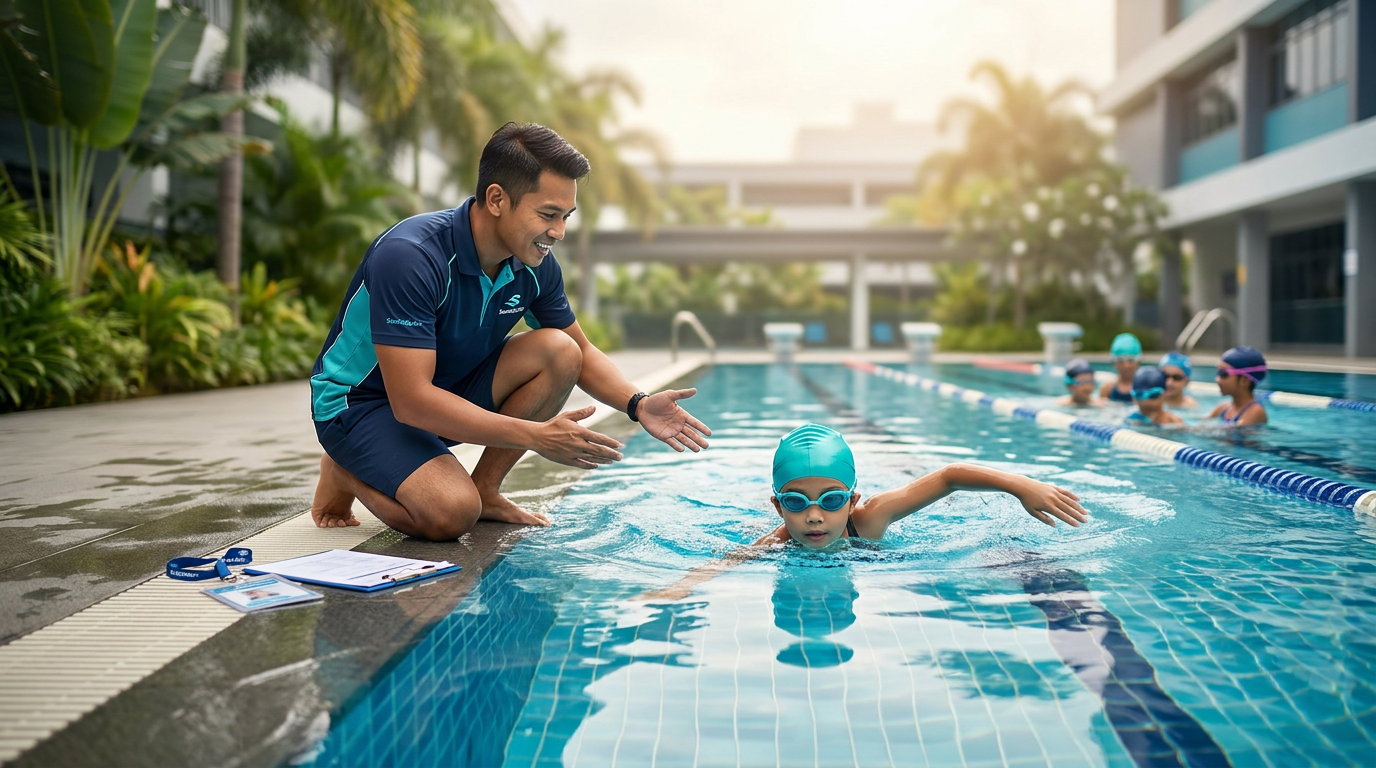
If you observe a beginner class where a single instructor is managing 15 or more young children alone, that is not a sign of efficiency; it is a safety concern. Beyond the numbers, observe whether the instructor is actively moving around the pool, giving individual feedback, and correcting technique in real time, not simply watching from poolside. Effective instruction is active, specific, and consistent across every student in the water, not just the most capable ones.
Group swimming lessons in Singapore typically range from $35 to $55 per session, while private or semi-private lessons generally command $60 to $120 per session. Programmes that price significantly below the market average sometimes compensate through overcrowded classes or less experienced instructors, so understanding what you are paying for is always worthwhile.
Before committing to any SwimSafer programme, a short conversation with the academy or instructor can reveal a great deal about their professionalism and preparedness. The following questions are worth asking directly:
These are not difficult questions for a reputable academy to answer. Hesitation, vagueness, or deflection on any of these points is useful information in itself.
SPEEDISWIM has been teaching swimming in Singapore since 1998, and in that time has trained more than 25,000 students across all ages and ability levels. The organisation's coaches are professionally qualified and deliver the SwimSafer 2.0 programme across multiple venues including international schools and country clubs, with SPEEDISWIM at Orchid Country Club holding official CAMS Centre status for non-ActiveSG pools.
What sets SPEEDISWIM apart is not just the credentials on paper, but the depth of experience behind them. The organisation has developed more than 1,000 athletes across competitive swimming, artistic swimming, water polo, and other aquatic disciplines, with over 50 swimmers selected for National Youth and National Teams. Coaches who operate within this kind of environment understand both the SwimSafer framework and what genuine athletic development beyond it looks like, which makes them exceptionally well-placed to support learners at every stage of their swimming journey.
For families looking for a programme where certification is verified, classes are properly structured, and progression is taken seriously, SPEEDISWIM's track record provides a level of assurance that simply cannot be replicated by a newer or less accountable provider.
SwimSafer certification is not a marketing badge; it is a nationally administered quality standard that protects your child and ensures their progress is real, traceable, and recognised. An accredited instructor brings structured curriculum knowledge, verified assessment authority through CAMS, and the emergency preparedness to act if anything goes wrong in the water. These are not optional extras; they are the baseline for responsible swimming instruction in Singapore.
When you are evaluating programmes, look past the pool and the price. Ask about accreditation, understand the ratios, and observe how the instructor actually teaches. The right programme, delivered by a genuinely certified and experienced coach, is one of the most valuable investments you can make in your child's safety and confidence for life.
SPEEDISWIM's professionally qualified coaches have been building water confidence and developing swimmers in Singapore since 1998. Whether your child is just starting out or ready to advance through the SwimSafer stages, our structured programmes deliver real, nationally recognised results.