Standing at the pool's edge, heart racing, palms sweating—if this describes your relationship with water, you're far from alone. Thousands of adults in Singapore live with a fear of water that prevents them from enjoying beaches, pools, and water activities with friends and family. Perhaps you've avoided pool parties for years, felt embarrassed declining boat trips, or worried about your safety near water. The good news? Your fear is valid, understandable, and absolutely conquerable.
Learning to swim as a fearful adult requires more than just technique—it demands patience, empathy, and a specialized approach that respects your emotional journey alongside your physical progress. Whether your fear stems from a childhood incident, lack of early exposure, or simply an unexplained anxiety around water, it's never too late to transform your relationship with aquatic environments. This comprehensive guide will walk you through understanding your fear, practical strategies for overcoming it, and how to find the right support system for your unique learning journey.
At SPEEDISWIM, we've spent over two decades helping swimmers of all ages and abilities discover water confidence. With more than 25,000 students trained since 1998, we understand that adult learners face distinct challenges that require compassionate, professional guidance. Let's explore how you can finally overcome your fear and develop swimming as a life-saving skill.
Fear of water, clinically known as aquaphobia, affects millions of adults worldwide and manifests in various intensities. For some, it's a mild discomfort that makes swimming lessons slightly stressful. For others, it's a paralyzing terror that triggers panic attacks at the mere thought of submerging their face. Understanding the root of your fear is the essential first step toward conquering it, and recognizing that your feelings are legitimate helps remove the shame many adults carry about their aquaphobia.
Most adult water fears originate from one of several common sources. A traumatic childhood experience—perhaps nearly drowning, being pushed into water unexpectedly, or having an overly aggressive swimming instructor—can create lasting psychological impacts that persist for decades. Others develop water fear simply from never having proper exposure during the critical learning years of childhood, when water familiarity is most easily established. Cultural factors, family anxieties passed down through generations, or simply growing up without access to pools can all contribute to adult aquaphobia.
The physiological response to water fear is real and measurable. When you approach water, your amygdala—the brain's fear center—may activate your fight-or-flight response, flooding your system with adrenaline and cortisol. Your heart rate increases, breathing becomes shallow, muscles tense, and rational thinking becomes difficult. This isn't weakness or overreaction; it's your nervous system genuinely perceiving threat. Recognizing these responses as normal brain function rather than personal failure is crucial for your learning journey.
Common manifestations of water fear include:
The belief that swimming must be learned in childhood is one of the most persistent myths in aquatic education. While children may learn certain motor skills more quickly, adults possess significant advantages that often make them excellent swimming students. Your adult brain brings sophisticated understanding, self-awareness, patience, and determination that children simply haven't developed yet. These cognitive strengths can actually accelerate your progress once the initial fear barriers are addressed.
Adults excel at understanding complex explanations about body positioning, buoyancy principles, and breathing techniques. Where a child might struggle to comprehend why tilting their head a certain way improves breathing efficiency, you can grasp these concepts immediately and apply them consciously. Your ability to communicate clearly with instructors about what feels uncomfortable or confusing allows for personalized adjustments that optimize your learning experience. You can also set realistic goals, track your progress methodically, and celebrate incremental achievements with mature perspective.
From a purely physiological standpoint, healthy adults of any age can learn to swim competently. Your body naturally floats when you relax—a fact that surprises many fearful learners who assumed they would sink. Swimming is actually a low-impact activity that's easier on joints than running or high-intensity sports, making it ideal for adults who may have mobility concerns or previous injuries. The cardiovascular and muscular benefits of swimming are accessible regardless of when you start, with studies showing that adults who begin swimming later in life still gain significant health improvements.
Consider that water safety is a critical life skill, not merely a recreational activity. Singapore's island geography means water is omnipresent—from Marina Bay to Sentosa beaches to the countless residential pools throughout the country. Learning to swim as an adult isn't just about overcoming fear; it's about ensuring your safety and that of any children or family members in your care. Many adults find that conquering their water fear becomes one of their most empowering personal achievements, building confidence that extends far beyond the pool.
Neuroscience research has thoroughly debunked the notion that adult brains can't learn new physical skills. Neuroplasticity—your brain's ability to form new neural pathways—continues throughout life, though the mechanisms differ from childhood learning. When you practice swimming movements repeatedly, your brain creates and strengthens neural connections that make these movements increasingly automatic. Adults actually benefit from more sophisticated mental rehearsal capabilities, allowing you to visualize techniques and mentally practice between lessons, which accelerates physical learning.
Adult swimming students face distinct obstacles that children rarely encounter, and acknowledging these challenges openly helps develop appropriate strategies. Unlike children who often approach water with natural curiosity and limited self-consciousness, adults bring years of accumulated fears, social anxieties, and practical constraints that complicate the learning process. Understanding these unique challenges validates your experience and helps you prepare mentally for the journey ahead.
Psychological barriers represent perhaps the most significant challenge. As an adult, you're acutely aware of danger, possess vivid imagination that can conjure worst-case scenarios, and may feel embarrassed about being a beginner in a skill many perceive as basic. The fear of judgment from others—imagining children or other adults watching you struggle—can be paralyzing. You might also carry shame about not having learned earlier, or frustration with yourself for having this fear at all. These emotional layers add complexity beyond the physical skill acquisition.
Practical scheduling constraints affect many adult learners. Between work commitments, family responsibilities, and limited leisure time, finding consistent lesson times can be challenging. The sporadic practice schedule that results from these constraints can slow progress, as swimming skills require regular reinforcement to become automatic. Additionally, adult swimming lessons in Singapore typically range from $35 to $55 per session for group classes, or $60 to $120 for private instruction, representing a financial commitment that must fit within household budgets.
Physical considerations also differ for adults. Years of sedentary habits may mean lower baseline fitness or flexibility compared to children. Previous injuries, joint concerns, or health conditions require accommodations that pediatric programs don't address. Body self-consciousness about wearing swimwear can create significant anxiety, particularly in group lesson environments. Respiratory control and breath-holding feel more challenging when you're hyperaware of every sensation and your nervous system is primed for threat detection.
However, these challenges are far from insurmountable. Professional swimming programs that specialize in adult learners—like those developed over SPEEDISWIM's 20+ years of experience—specifically address these obstacles through tailored teaching methodologies, flexible scheduling options, and emotionally intelligent instruction that prioritizes psychological safety alongside skill development.
Conquering water fear is a gradual process that requires patience, self-compassion, and systematic desensitization. Rather than forcing yourself into panic-inducing situations, effective aquaphobia treatment follows a careful progression that respects your comfort boundaries while gently expanding them. This evidence-based approach, refined through decades of swimming instruction, allows your nervous system to recalibrate its threat assessment of water gradually and sustainably.
Mental preparation begins before you ever touch water. Visualization exercises where you imagine yourself calmly in water, practicing controlled breathing techniques on dry land, and positive self-talk all help reprogram your automatic fear responses. Consider working with the concept of "exposure hierarchy"—creating a list of water-related scenarios ranked from least to most anxiety-producing, then systematically working through them. Your list might start with watching swimming videos, progress to visiting a pool fully clothed, then sitting poolside with feet in water, and continue step by step toward full immersion.
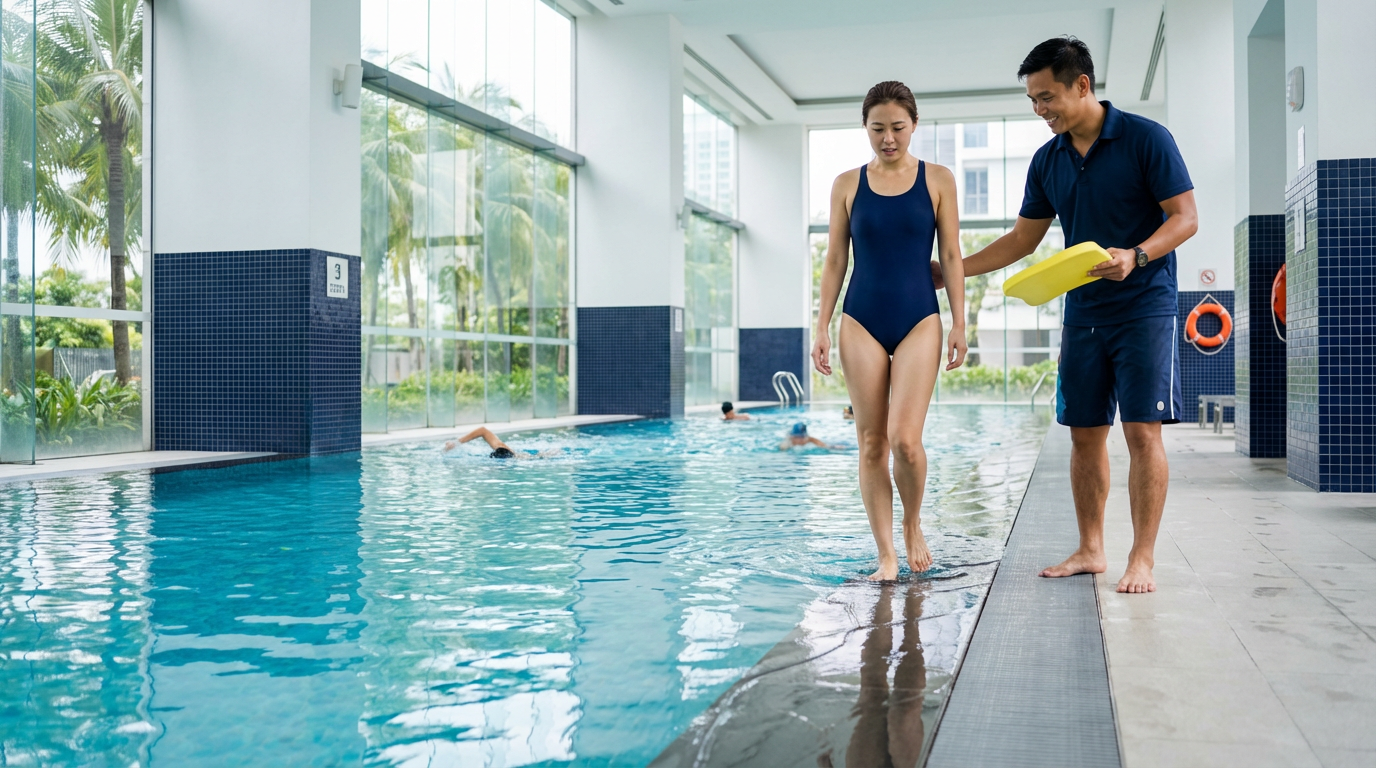
Your initial pool experiences should occur in water shallow enough that you can stand comfortably with your head well above the surface. This non-negotiable safety baseline allows your nervous system to relax, knowing you're not in actual danger. Spend time simply walking around in chest-deep water, feeling how your body moves differently in this medium. Experiment with gentle bouncing, gradually lowering your shoulders under the surface while maintaining the security of your feet firmly on the pool floor. Let yourself splash water on your arms, chest, and eventually face at your own pace, without pressure or judgment.
Much of water fear centers on breathing anxiety—the primal terror of not being able to access air. Breath control exercises address this directly by proving to your nervous system that you can manage your breathing effectively around water. Start by practicing holding your breath for a few seconds on land, then gradually increase duration. Next, practice blowing bubbles into a basin of water at home, which familiarizes you with the sensation of having water near your nose and mouth. In the pool, progress to blowing bubbles while standing in shallow water, then briefly submerging just your mouth, then your nose, and eventually your entire face—always at your own pace and with the ability to stand up immediately if needed.
A transformative moment for many fearful adults is discovering that their body naturally floats when relaxed. Begin by holding the pool edge or a floatation device while experimenting with lifting your feet off the bottom. Feel how the water supports your weight when you allow it to. Practice back floating with an instructor or trusted companion supporting your head and back, gradually reducing their assistance as you gain confidence. Understanding buoyancy intellectually is different from experiencing it viscerally—this experiential knowledge fundamentally shifts how your brain perceives water from threat to support.
Progress isn't linear, and some days will feel more challenging than others. Acknowledging every small achievement—putting your face in water for one second, floating for the first time, swimming three meters unassisted—builds positive associations that counteract years of negative ones. Keep a progress journal documenting these victories and the feelings associated with them. This record becomes invaluable during moments of doubt, providing concrete evidence of how far you've traveled on your swimming journey.
Understanding the structure and approach of professional adult swimming lessons helps reduce anxiety about that crucial first session. Unlike childhood swim classes that often emphasize play and games, adult programs recognize that you're approaching swimming as a serious skill acquisition process with specific fears and goals. Quality adult swimming instruction balances technical skill development with emotional support, creating an environment where you feel safe enough to be vulnerable while learning.
Your initial assessment typically involves a conversation about your specific fears, any previous water experiences, physical limitations or health considerations, and personal goals. A skilled instructor won't push you immediately into uncomfortable situations but will instead establish trust and demonstrate understanding of your emotional state. This assessment might occur entirely outside the pool during your first session, or in very shallow water where you feel completely secure. The instructor should explicitly discuss your comfort boundaries and establish clear communication signals for when you need to pause or stop an activity.
Lesson progression in adult programs follows a more individualized path than standardized children's curricula. While programs like the SwimSafer 2.0 certification provide structured frameworks for skill development, experienced instructors adapt these progressions to your emotional readiness alongside your physical capability. You might spend several lessons just building water confidence through breathing exercises and shallow-water activities before attempting any traditional swimming strokes. This patience, far from being inefficient, actually accelerates long-term progress by ensuring each skill is built on a foundation of genuine confidence rather than forced compliance.
Typical components of adult swimming lessons include:
Group lessons offer the advantage of shared experience—knowing others face similar fears reduces isolation and shame—while private instruction provides completely personalized pacing and individual attention. Many fearful adults find that starting with a few private sessions builds sufficient confidence to transition into small group classes, combining the benefits of both formats. The investment in private lessons, typically $60 to $120 per session in Singapore, often proves worthwhile for the accelerated trust-building and customized approach they enable.
Not all swimming programs are created equal when it comes to addressing adult aquaphobia. The instructor's emotional intelligence, patience, and specific experience with fearful adult learners matters as much as their technical swimming expertise. When researching programs, prioritize organizations with demonstrated track records in adult education, professional certifications, and explicit acknowledgment of the psychological dimensions of learning to swim with fear.
SPEEDISWIM's two decades of experience training over 25,000 students across all age groups and abilities has cultivated deep understanding of adult learners' unique needs. With professionally qualified coaches trained in both technical swimming instruction and the emotional aspects of aquatic education, our programs create psychologically safe environments where fear is treated as a valid starting point rather than an obstacle to overcome through force. Our structured yet flexible approach ensures you develop genuine water competency aligned with SwimSafer 2.0 standards while respecting your individual emotional journey.
Key qualities to seek in an adult swimming program:
Consider visiting potential swimming schools before committing to lessons. Observe how instructors interact with students, the general atmosphere, and whether the environment feels welcoming for adult beginners. Don't hesitate to ask direct questions about experience with fearful adults, teaching methodology for aquaphobia, and whether trial sessions are available. A quality program will welcome these questions and provide thoughtful, detailed answers that demonstrate genuine understanding of your concerns.
Water confidence develops through accumulated positive experiences that systematically override previous negative associations. This process cannot be rushed, but it can be optimized through intentional practice, mindful awareness, and celebration of progress. Beyond formal swimming lessons, incorporating supplementary activities accelerates confidence development and reinforces that water is a safe, enjoyable environment rather than a source of danger.
Between lessons, practice your breathing exercises at home using a basin or bathtub. Simply submerging your face for progressively longer periods in controlled, safe settings helps normalize the sensation without the added anxiety of being in a pool. Visualization practice—mentally rehearsing successful swimming experiences while in a relaxed state—activates similar neural pathways as physical practice and reduces anticipatory anxiety before your next lesson. Some adults find that watching swimming videos or reading about swimming technique helps maintain mental engagement with the skill between sessions.
Supplementary confidence-building activities extend your water exposure beyond formal instruction. Consider visiting a pool during quiet times simply to sit poolside or wade in shallow areas without any pressure to "practice swimming." This casual exposure helps your brain recategorize pools as normal, safe spaces rather than threat environments. Aquatic exercise classes designed for adults, like water walking or aqua aerobics in shallow water, provide structured activities that build comfort without the vulnerability of traditional swim lessons. Some fearful adults benefit from exploring other aquatic activities like water polo or even underwater hockey once they've developed basic water confidence, as these sports provide goal-focused activities that shift attention away from fear toward skill and enjoyment.
Social support significantly impacts confidence development. Consider connecting with other adult learners facing similar challenges—many find that sharing experiences, fears, and victories with others on the same journey reduces shame and provides motivation during difficult moments. If you have understanding friends or family members, their encouragement (without pressure or judgment) can be invaluable. Conversely, distance yourself from anyone who minimizes your fear, rushes your progress, or makes you feel inadequate about your learning pace.
Mindfulness techniques—particularly body awareness and present-moment focus—prove remarkably effective for managing water anxiety. When fear arises, your mind typically jumps to catastrophic future scenarios or recalls past traumatic experiences. Grounding yourself in present sensation—noticing the actual temperature of the water, the feeling of your feet on the pool floor, the sounds around you—interrupts this fear spiral and returns your awareness to the current reality, which is typically safe. Regular mindfulness meditation practice outside the pool strengthens this skill, making it more accessible during moments of acute anxiety in water.
Behind every confident swimmer was once a fearful beginner, and the journeys of adults who've conquered aquaphobia offer both inspiration and practical insight. While individual experiences vary, common themes emerge: the initial terror feels insurmountable until you take that first step; progress happens in unpredictable bursts rather than smooth linear improvement; the moment when fear transforms into confidence is often subtle rather than dramatic; and the pride of accomplishment extends far beyond swimming itself.
Many adults describe their breakthrough moment not as swimming a certain distance, but as the first time they realized they were thinking about technique rather than fear. That cognitive shift—when your brain's processing capacity moves from threat monitoring to skill execution—marks a fundamental neurological change in how you perceive water. Some report that after months of slow, frustrating progress, suddenly everything "clicked" and they found themselves swimming multiple laps with shocked disbelief. Others describe the achievement more gradually, realizing one day that activities which once terrified them now feel routine and unremarkable.
The transformation extends beyond swimming capability into broader life confidence. Adults who conquer water fear often report increased willingness to attempt other intimidating challenges, having proven to themselves that patient persistence can overcome seemingly insurmountable obstacles. Parents describe the profound satisfaction of finally being able to swim with their children or ensure their safety near water. Social opportunities expand as pool parties, beach vacations, and water sports become accessible rather than anxiety-inducing scenarios to avoid.
SPEEDISWIM's experience training thousands of students—from complete beginners to competitive athletes who've earned places on National Youth and National Teams—demonstrates that swimming excellence is achievable regardless of starting point. While you may not aspire to competitive swimming like some of our athletes, the same patient, professional instruction that develops elite swimmers can help you achieve your personal swimming goals, whatever they may be. The methodologies that have groomed over 1,000 athletes across multiple aquatic disciplines including artistic swimming and water polo are equally applicable to helping fearful adults discover water confidence.
One particularly inspiring category of success stories involves adults who progressed from paralyzing water fear to such comfort that they pursued advanced aquatic activities or even became swimming advocates themselves. Former fearful learners have gone on to participate in open water swimming events, complete triathlons, obtain lifeguard certifications, and even become swimming instructors who specialize in helping other fearful adults. These transformations aren't presented to set unrealistic expectations, but rather to illustrate that the ceiling of what's possible is limited only by your goals, not by your fearful starting point.
Standing at the pool's edge with your heart racing doesn't mean you're destined to remain on the sidelines forever. Learning to swim as a fearful adult is absolutely achievable with the right support, appropriate pacing, and compassionate instruction that honors both your emotional reality and your learning potential. Your fear is valid, your concerns are reasonable, and your goal of water competency is within reach—regardless of your age or how long you've lived with aquaphobia.
The journey from fear to confidence follows no standardized timeline. Some adults develop basic swimming competency in a few months, while others require a year or more to feel genuinely comfortable in water. What matters isn't the speed of your progress but rather its sustainability—building genuine confidence through positive experiences rather than forcing yourself through terrifying ordeals that may create additional trauma. With patient, professional guidance, each small victory accumulates into transformative capability.
Swimming represents more than recreational skill; it's a critical life safety competency, particularly in a water-surrounded nation like Singapore. Beyond the practical safety benefits, conquering your water fear offers profound psychological rewards—proving to yourself that growth is possible, that fear can be overcome, and that it's truly never too late to learn something new. The confidence, freedom, and sense of accomplishment that come with finally feeling safe and capable in water are worth every moment of the challenging journey to get there.
SPEEDISWIM's experienced coaches understand the unique challenges facing fearful adult learners. With over 20 years of expertise training swimmers of all ages and abilities, we provide the patient, professional guidance you need to overcome aquaphobia and develop genuine water confidence.
Our structured programs align with SwimSafer 2.0 standards while respecting your individual emotional journey. Whether you're taking your very first steps into water or building on limited previous experience, we'll meet you where you are and support your progress at a pace that works for you.