Every swimmer who has watched elite athletes glide through water with seemingly effortless speed has wondered about the secret behind their power. The answer lies not in raw strength alone, but in the precise mechanics of the arm stroke and the fascinating physics of aquatic propulsion. Understanding these principles separates recreational swimmers from competitive athletes and transforms good technique into exceptional performance.
At SPEEDISWIM, our two decades of coaching experience with over 25,000 students and more than 1,000 athletes has reinforced one fundamental truth: proper arm stroke mechanics form the foundation of efficient swimming. Whether you're preparing for SwimSafer certification or training for national-level competition, mastering the pull phases and understanding propulsion science will dramatically improve your speed and efficiency in the water.
This comprehensive guide examines the biomechanics of swimming arm strokes, breaking down each pull phase with scientific precision while providing practical applications that coaches and swimmers can implement immediately. From the physics of drag and lift forces to stroke-specific techniques across all four competitive strokes, you'll gain the knowledge that has helped produce over 50 national team swimmers from our programs.
Swimming propulsion operates on fundamentally different principles than land-based movement. While runners push against a solid surface, swimmers must generate force against water, a fluid medium that moves and yields to pressure. This creates unique biomechanical challenges that require specific technical solutions.
The human body achieves forward motion in water through two primary mechanisms: drag-based propulsion and lift-based propulsion. For decades, swimming coaches believed that drag forces alone powered swimmers forward. This theory suggested that swimmers simply pushed water backward, creating an equal and opposite forward reaction according to Newton's third law. However, modern research has revealed that elite swimmers primarily rely on lift-based propulsion, similar to how airplane wings generate lift.
Lift-based propulsion occurs when swimmers sculpt their hands and forearms through the water at specific angles, creating pressure differentials that generate propulsive force perpendicular to the direction of hand movement. This sculling motion allows swimmers to maintain continuous pressure against relatively still water rather than pushing against water they've already accelerated backward. The result is more efficient force generation with less energy expenditure.
The most effective swimmers combine both mechanisms strategically throughout their stroke cycle. Understanding when and how to apply each type of propulsion separates technically proficient swimmers from those who struggle despite having adequate strength and conditioning. At our competitive swimming programs, we emphasize this nuanced approach to stroke mechanics from the earliest stages of technical development.
Every swimming stroke follows a cyclical pattern of arm movement that can be divided into five distinct phases. While the specific execution varies between freestyle, backstroke, butterfly, and breaststroke, understanding these fundamental phases provides a framework for analyzing and improving technique across all strokes.
The stroke cycle begins when the hand enters the water and extends forward to the optimal catch position. In freestyle and butterfly, the hand should enter thumb-side down at approximately shoulder width, slicing through the water surface with minimal splash. The entry point significantly affects body rotation and overall stroke efficiency. Entering too wide creates lateral resistance, while entering across the body's centerline can cause the hips to snake, increasing drag.
During extension, the arm reaches forward underwater while the body rotates (in freestyle and backstroke) to maximize distance per stroke. This phase is not passive; swimmers should actively extend with intention while maintaining a streamlined body position. The extension should occur at a depth of 15-20 centimeters below the surface to avoid surface turbulence while preventing excessive depth that would require lifting the arm back up to catch.
Key technical points for entry and extension:
The catch represents the transition from extension to propulsion and is arguably the most critical phase for generating speed. During the catch, swimmers position their hand, forearm, and arm to create the largest possible surface area perpendicular to the direction of travel. This "paddle" will press against the water to generate propulsive force.
An effective catch requires the swimmer to bend at the elbow while keeping it high, a position often called the high elbow catch or early vertical forearm (EVF). The fingertips point downward toward the pool bottom while the elbow remains near the surface, creating an angle of approximately 90-120 degrees at the elbow joint. This positioning allows the swimmer to engage the larger muscle groups of the back and core rather than relying solely on shoulder and arm strength.
Many developing swimmers struggle with the catch phase, either dropping their elbow or initiating the pull before achieving proper positioning. Through our structured training at SPEEDISWIM, where we've developed over 1,000 competitive athletes, we've found that the catch phase requires specific neuromuscular development and proprioceptive awareness that develops gradually with proper drilling and feedback.
The catch should feel like pressing downward and slightly outward against a stable object rather than sweeping the hand backward. Olympic-level swimmers can generate catch pressures exceeding 40 pounds of force, but this power comes from positioning and timing rather than muscular effort alone. Swimmers who master the catch can feel the water "load" onto their forearm and hand before beginning the propulsive pull phase.
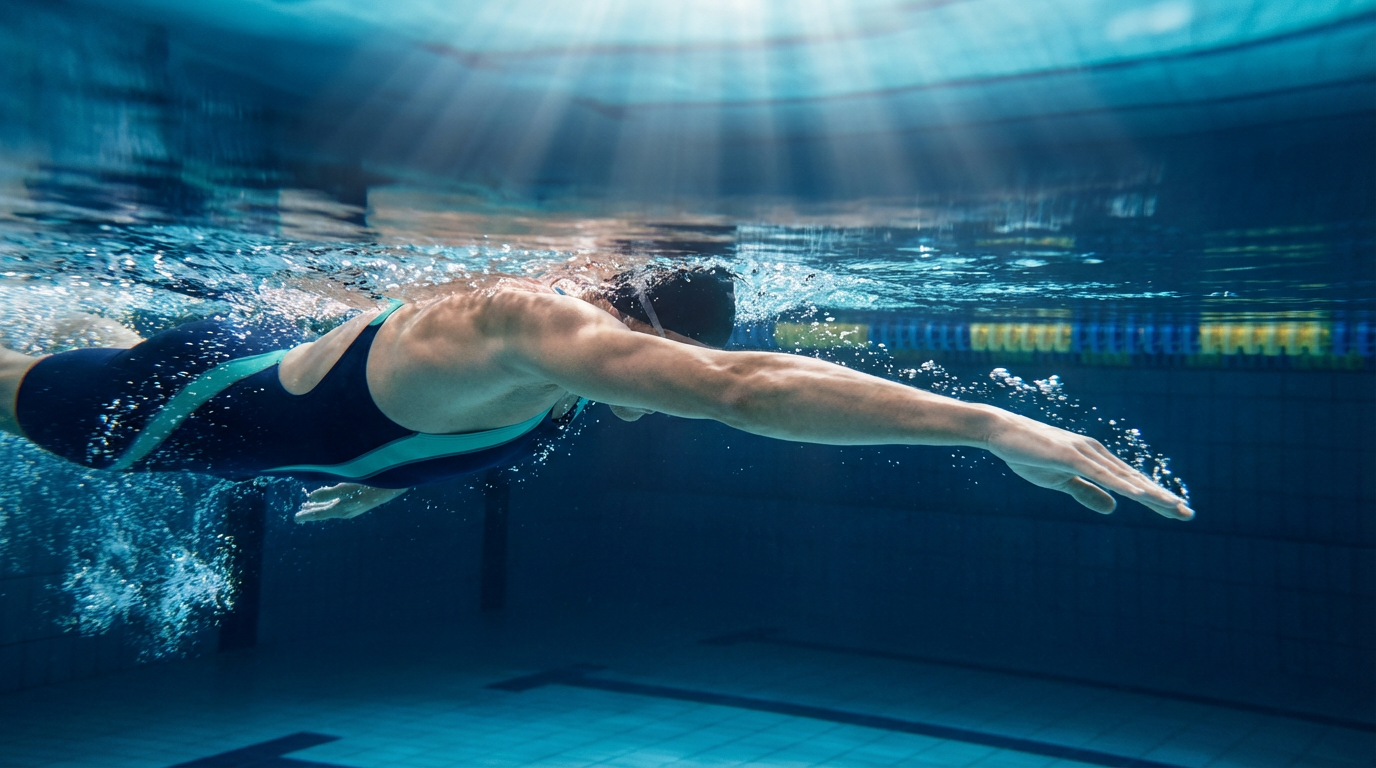
The pull phase generates the majority of propulsive force in most swimming strokes. After establishing the catch, swimmers accelerate their hand and forearm backward and inward, following a path that curves toward the body's centerline. This is not a straight backward push but rather a sculling motion that maintains pressure against relatively still water.
During the pull, the hand follows an S-shaped or question mark-shaped path when viewed from below. This curved path allows swimmers to continuously find "new" water to press against rather than pushing water they've already accelerated. The hand typically moves from a position forward of the shoulder, sweeps slightly outward during the early pull, then curves inward toward the centerline as it passes beneath the chest and shoulder.
Biomechanical principles of the pull phase:
The pull phase integrates the entire kinetic chain from feet to fingertips. Elite swimmers generate force from their core and transfer it through a stable shoulder platform to the hand and forearm. This full-body integration explains why technically proficient swimmers with moderate strength often outperform muscular swimmers with poor mechanics. At our programs across multiple venues including international schools and country clubs, we emphasize this holistic approach to stroke development that has helped athletes achieve Direct School Admission (DSA) placements through sporting excellence.
The push phase, also called the finish, completes the propulsive sequence as the hand accelerates past the hip toward the thigh. This phase is frequently abbreviated or eliminated by age-group swimmers, yet it contributes significantly to stroke power and efficiency. Research using pressure sensors has shown that elite swimmers maintain propulsive force throughout the push phase, whereas developing swimmers often allow pressure to drop off as the hand passes the shoulder line.
During the push, the elbow begins to straighten as the hand continues its backward acceleration. In freestyle, the hand should finish near the thigh with the palm facing upward or inward, having rotated during the push to maintain optimal pitch against the water. The push integrates triceps extension with continued core rotation to maximize the final propulsive impulse before recovery.
The duration and emphasis of the push phase varies between strokes and swimmer body types. Sprint freestylers typically employ a more aggressive, complete push to maximize power output, while distance swimmers may abbreviate the push slightly to conserve energy and increase stroke rate. Coaches must balance the propulsive benefits of a complete push against the energy cost and timing requirements for each swimmer's specific event and technique style.
Though the recovery phase doesn't generate propulsion directly, it critically affects overall stroke efficiency and sets up the next stroke cycle. The recovery begins as the hand exits the water and continues until the hand re-enters for the next stroke. In freestyle and butterfly, recovery occurs above water; in backstroke, it also occurs above water but with the arm rotating differently; in breaststroke, recovery happens underwater.
An efficient recovery is relaxed, allowing muscles used during the propulsive phases to partially recover while minimizing energy expenditure. In freestyle, the elbow should lead the recovery with the hand trailing, maintaining a high elbow position that reduces air resistance and facilitates proper entry positioning. The recovering arm should swing forward in a plane close to the body rather than sweeping wide, which would create balance issues and increase energy cost.
Recovery timing affects stroke rhythm and tempo. Swimmers can manipulate recovery speed to adjust their stroke rate while maintaining propulsive effectiveness. Generally, the recovery should take slightly longer than the underwater pull, creating a rhythm where power application feels controlled rather than rushed. This timing relationship becomes particularly important in middle-distance and distance events where sustainability over many stroke cycles determines success.
Understanding the physics underlying swimming propulsion helps coaches and swimmers make informed technical decisions. Water is approximately 800 times denser than air, which means that small improvements in hydrodynamic efficiency yield substantial performance benefits. Every movement creates either propulsive force or resistive drag, and the net difference determines swimming speed according to the equation: Net Force = Propulsive Force - Resistive Drag.
Bernoulli's principle explains how swimmers generate lift-based propulsion. When the hand moves through water at an angle of attack (pitch), water travels faster over the top surface of the hand than underneath. This speed differential creates a pressure difference, with lower pressure above the hand and higher pressure below. The resulting pressure gradient generates a force perpendicular to the hand's direction of movement. By orienting this force appropriately, swimmers can direct it to produce forward propulsion.
The coefficient of drag and coefficient of lift for the hand vary with pitch angle, velocity, and hand shape. Research has shown optimal pitch angles for propulsion fall between 30-50 degrees for most phases of the stroke. Angles too small generate insufficient force, while angles too large create excessive drag without proportional lift, effectively acting as a brake. Elite swimmers subconsciously adjust hand pitch throughout the stroke cycle to optimize force production, a skill that develops through thousands of practice repetitions with proper technical focus.
Newton's third law (action-reaction) still applies but manifests differently in fluid environments than on solid ground. When swimmers press water backward and downward, the water exerts an equal and opposite force forward and upward on the swimmer. However, because water is mobile, the water itself accelerates backward, carrying away some of the potential propulsive force. This is why swimmers must constantly find "new" water to press against rather than pushing the same water molecules repeatedly.
The concept of relative flow explains why hand speed matters critically for propulsion. The propulsive force generated is proportional to the square of the relative velocity between the hand and the water. This means that doubling hand speed quadruples propulsive force (assuming constant effective surface area and coefficients). This quadratic relationship explains why swimmers should accelerate their hands throughout the pull rather than moving at constant speed, and why even small increases in hand speed during the finish yield disproportionate propulsive benefits.
While the five pull phases apply broadly across swimming strokes, each stroke has unique mechanical characteristics that optimize propulsion for its specific body position and timing requirements.
Freestyle (Front Crawl): Freestyle arm mechanics emphasize continuous propulsion with alternating arms creating an overlapping power application. The catch occurs with the arm extended forward while the body rotates to that side, creating maximum reach. The pull follows a relatively shallow path, typically no deeper than 30-40 centimeters below the surface. Body rotation plays a crucial role, with elite swimmers rotating 45-60 degrees to each side, effectively making freestyle a "side-stroke" rather than purely front-facing swimming. The recovering arm should maintain a high elbow throughout the aerial recovery phase.
Backstroke: Backstroke mechanics mirror freestyle in many respects but with the swimmer supine. The entry occurs with the pinky finger first, arm fully extended directly behind the shoulder line. The catch requires the swimmer to pitch the hand downward while bending at the elbow, creating the same high-elbow position as freestyle but inverted. The pull sweeps downward and outward, then inward past the hip. Body rotation of 40-60 degrees is equally important, and the timing should create continuous propulsion with one arm always in a power phase.
Butterfly: Butterfly features simultaneous arm movement with both arms entering together, catching together, and recovering together. This synchronous motion creates a powerful but energy-intensive stroke. The catch is wider than freestyle, with hands entering at approximately shoulder-width and sweeping outward before catching. The pull follows a keyhole pattern when viewed from below: outward, inward, and then outward again during the push. The arm recovery swings forward with straight or slightly bent elbows, coordinated with the second of two dolphin kicks per stroke cycle. Our competitive swimmers find butterfly particularly challenging to master but tremendously rewarding for building overall swimming power and coordination.
Breaststroke: Breaststroke arm mechanics differ dramatically from the other three strokes. The pull remains entirely in front of the chest, never extending past the shoulder line. Arms sweep outward from a streamlined glide position, pitch to catch with palms facing outward, then sweep inward and forward to return to streamline. This circular motion creates propulsion primarily during the outsweep and insweep phases. The recovery occurs underwater with hands pressing forward from chest to full extension. Breaststroke integrates arm timing with a powerful kick, creating a distinctive rhythm of pull-breathe-kick-glide that requires precise coordination for maximum efficiency.
Despite understanding proper mechanics, swimmers frequently develop compensatory patterns that limit performance. Recognizing and correcting these errors is essential for continued improvement.
Dropped elbow during catch: This extremely common error occurs when swimmers allow their elbow to drop below their hand during the catch phase, creating a weak pulling position that engages primarily shoulder muscles rather than the larger back muscles. The correction involves specific drills like catch-up freestyle and single-arm swimming with focus on maintaining the high elbow position. Many swimmers need external feedback from coaches or underwater video because the correct position feels awkward initially despite being biomechanically superior.
Straight-arm pull: Some swimmers pull with minimal elbow bend, creating an inefficient lever that requires excessive shoulder strength and generates less propulsion than a properly bent-elbow pull. This often results from poor catch positioning or attempting to pull too fast before establishing proper hand and forearm orientation. The correction emphasizes slowing down the stroke to establish the catch before initiating the pull, using sculling drills to develop feel for the water.
Crossing over centerline: In freestyle and backstroke, allowing the hand to cross the body's centerline during entry or pull creates a snaking motion that increases drag and disrupts balance. This error often accompanies breathing issues in freestyle or body position problems. Correction requires awareness of hand entry position and may involve tempo training to prevent rushing the stroke, along with core stability exercises to maintain better body control.
Abbreviated finish: Many swimmers allow their hand to slip past the hip without maintaining pressure, losing significant propulsion during the final phase of the stroke. This typically occurs due to fatigue, lack of awareness, or insufficient triceps strength relative to pulling strength. Correction involves specific finish drills, such as freestyle with exaggerated finish to the thigh, and strength training for the triceps and posterior shoulder muscles.
Poor recovery mechanics: In above-water recoveries, dropping the elbow or swinging the arm too wide wastes energy and disrupts stroke rhythm. These errors often stem from shoulder mobility limitations, inadequate core stability, or timing issues. Addressing recovery mechanics may require both technical focus and supplementary mobility work, particularly for the shoulders and thoracic spine. Throughout our 20+ years training swimmers at SPEEDISWIM, we've found that systematic attention to recovery mechanics significantly improves overall stroke efficiency and sustainability.
Technical improvement requires targeted practice that isolates and reinforces specific movement patterns. The following drills have proven effective across thousands of swimmers in our programs.
1. Sculling progressions: Sculling drills develop feel for the water and hand pitch awareness. Begin with front scull (hands at hip level, creating propulsion with small inward-outward movements), progress to middle scull (hands at chest level), then head scull (hands near face). Each variation emphasizes different aspects of hand pitch and pressure. Swimmers should feel continuous pressure on the palms and forearms, adjusting hand angle until they maximize propulsive feel. Practice 4 x 25 meters of each scull variation with 15 seconds rest between repetitions.
2. Single-arm freestyle: Swimming with one arm while the other remains extended forward or held at the side isolates each arm's mechanics and highlights asymmetries. Focus on establishing a complete catch before initiating the pull, maintaining high elbow position throughout, and finishing completely to the thigh. This drill also challenges balance and rotation, forcing swimmers to engage core stabilization. Execute 6 x 50 meters alternating arms (25 meters right arm, 25 meters left arm) with 20 seconds rest.
3. Catch-up stroke: In catch-up freestyle, one hand remains extended forward until the recovering hand touches or nearly touches it before beginning its stroke. This drill emphasizes full extension, proper entry, and patient establishment of the catch. It prevents rushing and allows swimmers to focus on quality over speed. Begin with actual hand touch, then progress to "3-inch catch-up" where hands pass closely without touching. Perform 8 x 25 meters with focus on stroke length rather than speed.
4. Fist swimming: Swimming with closed fists eliminates the hand surface area, forcing swimmers to engage forearms for propulsion. This drill develops early vertical forearm positioning and catch awareness. Initially, swimmers will feel little propulsion, but with practice, they learn to pitch forearms properly. When returning to normal swimming, the increased hand surface area creates dramatically improved feel and propulsion. Alternate 25 meters fist swimming with 25 meters normal swimming for 400-800 meters total.
5. Pause-and-glide freestyle: Take three normal strokes, then hold a streamlined position with arms extended forward for 3-5 seconds before continuing. This drill develops patience for establishing proper catch position and highlights the importance of maintaining velocity between strokes through streamlining. It also builds awareness of how body position affects glide efficiency. Complete 6 x 50 meters with 30 seconds rest, counting to ensure consistent pause duration.
6. Vertical kicking with sculling: In deep water, assume a vertical position and use only a flutter kick to maintain head above water while sculling hands in front of chest. This drill builds specific strength for the catch and pull while eliminating body position as a variable. It also develops shoulder stability and endurance. Work toward 30-60 second intervals, performing 6-10 repetitions with 30 seconds rest between efforts.
These drills should be incorporated systematically into training rather than practiced randomly. At SPEEDISWIM, where we've groomed over 1,000 athletes across multiple aquatic disciplines including water polo and artistic swimming, we've found that consistent technical work yields compounding benefits over time. Even elite swimmers dedicate 20-30% of training volume to technical drilling, recognizing that maintaining optimal mechanics under fatigue is what separates podium finishers from the rest of the field.
Understanding arm stroke mechanics and propulsion science provides the foundation, but translating knowledge into improved performance requires systematic integration into training. Coaches and swimmers should approach technical development as a long-term process rather than expecting immediate transformation.
Video analysis serves as an invaluable tool for connecting internal feel with external reality. Underwater cameras reveal mechanical patterns that swimmers cannot perceive through proprioception alone. Regular video review, particularly comparing underwater footage to elite swimmers or the athlete's own previous recordings, accelerates technical development by making the invisible visible. Many swimmers are surprised to discover that what feels like a high elbow catch actually shows a dropped elbow on video, demonstrating the gap between perception and reality.
Progressive overload applies to technical training just as it does to physical conditioning. Swimmers should master basic mechanical patterns at slow speeds before attempting to maintain technique at race pace. The progression typically follows: drill execution, slow full-stroke swimming with focus, moderate-pace swimming with technical awareness, race-pace swimming with maintained technique, and finally, maintaining technique under fatigue. Rushing this progression leads to reverting to compensatory patterns under pressure.
Mental rehearsal and visualization complement physical practice by strengthening neural pathways associated with proper movement patterns. Swimmers who spend 10-15 minutes daily visualizing perfect stroke mechanics from both internal and external perspectives demonstrate faster technical acquisition than those who rely solely on pool practice. This mental training is particularly valuable during taper periods or when recovering from injury.
Mastering swimming arm stroke mechanics and understanding propulsion science represents one of the most significant opportunities for performance improvement available to swimmers at all levels. While strength and conditioning certainly matter, the efficiency gains from proper technique often dwarf the benefits of increased physical capacity alone. A swimmer who can maintain effective mechanics under race conditions will consistently outperform stronger competitors with technical flaws.
The five pull phases (entry and extension, catch, pull, push, and recovery) provide a framework for analyzing and refining technique across all swimming strokes. Each phase serves specific biomechanical purposes, and optimizing the transitions between phases is just as important as perfecting each phase individually. The integration of lift-based and drag-based propulsion, proper hand pitch throughout the stroke cycle, and the acceleration of the hand from catch through finish all contribute to maximizing propulsive force while minimizing resistive drag.
At SPEEDISWIM, our 20+ years of experience developing swimmers from beginners in our SwimSafer programs to national team athletes has proven that systematic technical development, supported by scientific understanding, creates sustainable improvement. The same mechanical principles that help eight-year-olds develop basic freestyle technique continue to refine the performance of swimmers competing at the highest levels. This continuity allows coaches to build progressively on foundational skills rather than rebuilding technique from scratch as swimmers advance.
Whether you're a parent seeking quality instruction for your child, a competitive swimmer looking to break through a performance plateau, or a coach searching for deeper technical knowledge, understanding arm stroke mechanics and propulsion science provides the roadmap for continued improvement. The water yields its secrets not through force alone but through the intelligent application of biomechanical principles refined through dedicated practice.
Join SPEEDISWIM's expert coaching programs and experience the difference that proper technique makes. With over 20 years of proven results training national athletes and everyday swimmers alike, our qualified coaches provide the personalized instruction you need to master arm stroke mechanics and maximize your potential in the water.