Your legs generate up to 30% of your propulsion in competitive swimming, yet many swimmers never master proper kick technique. Whether you're learning water safety skills through SwimSafer 2.0 or training for competitive meets, understanding the biomechanics of each swimming kick technique can dramatically improve your efficiency and speed in the water.
At SPEEDISWIM, we've spent over two decades teaching swimmers from complete beginners to national team athletes, and we've observed that kick technique often separates good swimmers from great ones. Each of the four primary kick types serves specific purposes and demands distinct muscle activation patterns, body positioning, and timing coordination.
In this comprehensive guide, we'll break down the flutter kick, dolphin kick, breaststroke kick, and scissor kick with the same technical precision our coaches use when developing athletes. You'll learn the proper mechanics of each kick, understand when to apply them, identify common errors that limit performance, and discover progressive training methods to refine your technique. Whether you're just starting your swimming journey or looking to shave seconds off your competitive times, mastering these fundamental kick techniques will transform your relationship with the water.
Before diving into specific kick techniques, it's essential to understand the underlying principles that make any swimming kick effective. All successful kicks share common biomechanical foundations: they generate propulsion through creating pressure differences in the water, they maintain body alignment to reduce drag, and they coordinate with breathing and arm movements to create efficient stroke cycles.
The primary purpose of kicking in swimming extends beyond simple propulsion. Your kick stabilizes your body position, prevents your hips and legs from sinking, and creates a streamlined body line that reduces resistance. In our competitive swimming programs, we emphasize that kick technique must be developed alongside arm technique because they function as an integrated propulsion system rather than separate components.
Ankle flexibility plays a crucial role in all kick types. Swimmers with limited ankle mobility cannot effectively transfer force through their feet, which acts like a paddle or fin. Similarly, core engagement connects upper and lower body movements, ensuring that force generated by the kick travels efficiently through the kinetic chain. These foundational elements apply universally, though each specific kick technique demands unique adaptations.
Understanding the role of drag is equally important. Poor kick technique creates turbulence and resistance that can slow you down more than weak kicking speeds you up. This principle is particularly relevant for distance swimmers, who sometimes adopt a two-beat kick to conserve energy while maintaining body position. The key is matching your kick intensity and style to your swimming goals, stroke type, and event distance.
The flutter kick forms the backbone of both freestyle and backstroke swimming, making it the most widely practiced kick technique. This alternating up-and-down leg movement originates from the hips rather than the knees, creating a whip-like action that propels swimmers forward with minimal energy expenditure when performed correctly.
Proper flutter kick mechanics begin with hip flexion and extension. Your legs should remain relatively straight but not rigidly locked, with a slight knee bend occurring naturally during the downward phase. The kick initiates from your hip flexors, travels through your thighs, and culminates in a snapping motion at the ankles. Your feet should be pointed (plantar flexed) throughout the kick cycle, with the tops of your feet creating pressure against the water during the downbeat.
In our SwimSafer program, we introduce flutter kick progressions starting at Stage 2, where students learn to maintain a continuous kick while floating on their front and back. The flutter kick's versatility makes it ideal for teaching water safety and building foundational swimming competence. As swimmers advance through the SwimSafer 2.0 stages, we gradually increase expectations for kick efficiency, endurance, and coordination with arm strokes.
Common flutter kick errors include kicking from the knees instead of the hips, which creates bicycle-pedaling motion that actually slows you down. Another frequent mistake is breaking the water surface excessively, which wastes energy creating splash rather than propulsion. We also see many swimmers holding tension in their ankles, preventing the relaxed but pointed foot position that maximizes surface area and creates effective propulsion.
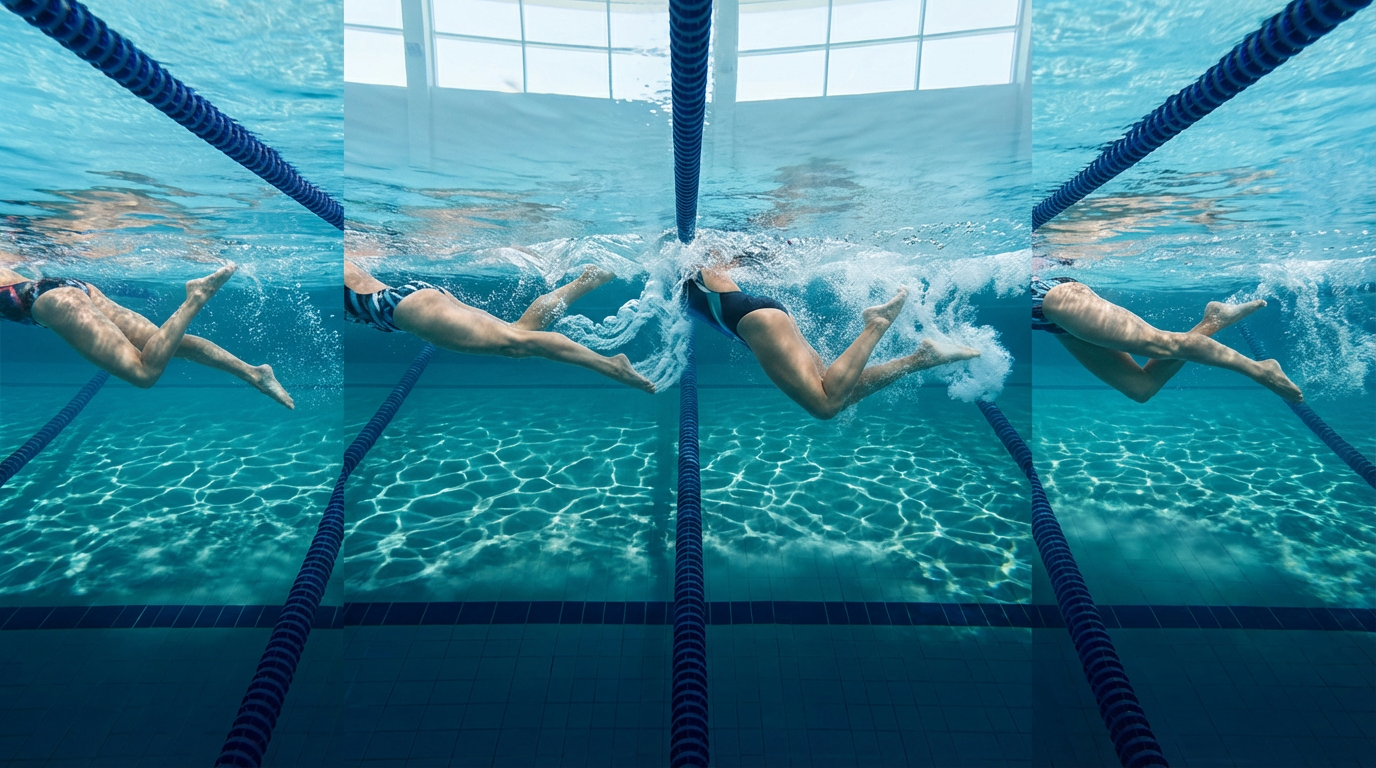
The dolphin kick, also called the butterfly kick, represents the most powerful propulsive kick in competitive swimming. Unlike the alternating action of the flutter kick, the dolphin kick moves both legs together in a synchronized wave-like motion that travels from your chest through your entire body to your feet. This full-body undulation generates remarkable propulsion when executed with proper timing and amplitude.
Biomechanically, the dolphin kick consists of two phases: the downbeat and the upbeat, both contributing to forward propulsion. The kick initiates with a slight chest press downward, creating a wave that travels posteriorly through your core, hips, knees, and finally your feet. Your knees bend naturally during the downbeat (approximately 30-40 degrees) as your feet snap downward, then straighten during the upbeat as your feet drive upward. The upbeat actually generates more propulsion than the downbeat for most swimmers, challenging the common misconception that only the downward kick provides thrust.
The dolphin kick has revolutionized competitive swimming over the past two decades. Elite swimmers now spend significant portions of their races underwater, where dolphin kicking proves faster than surface swimming due to reduced wave drag. This technique requires exceptional core strength, flexibility, and cardiovascular fitness, making it a hallmark of well-rounded competitive swimmers. Our competitive swimming coaches dedicate substantial training time to dolphin kick development, as mastery of this skill often determines success at higher competition levels.
Learning the dolphin kick presents unique challenges. Many swimmers initially struggle with coordinating the full-body wave, instead bending excessively at the waist or knees. Others develop a "rocking horse" motion where their hips pike sharply rather than flowing smoothly. Patience and progressive skill development are essential. We typically introduce basic dolphin kick concepts after swimmers have mastered flutter kick fundamentals, as the body awareness required for effective undulation builds on earlier movement patterns.
The breaststroke kick, technically termed the whip kick, stands apart from all other swimming kicks due to its unique biomechanics. This kick provides the majority of propulsion in breaststroke (approximately 70%), making it the only competitive stroke where the legs contribute more than the arms. The breaststroke kick involves a simultaneous recovery phase where you draw your heels toward your buttocks, followed by a powerful outward and backward thrust, concluding with the legs snapping together.
Proper breaststroke kick execution requires exceptional hip flexibility, particularly hip external rotation that allows your feet to turn outward (dorsiflex and evert) during the propulsive phase. The kick sequence begins from a streamlined position with legs extended. You bend your knees, drawing your heels toward your buttocks while keeping your knees relatively close together (no wider than hip width). As your heels approach your buttocks, you dorsiflex your ankles and rotate your feet outward, preparing to catch the water. The propulsive phase drives your feet outward in a circular motion, then sweeps them together forcefully, creating a squeezing action that generates forward thrust.
The breaststroke kick presents the steepest learning curve of all competitive kicks. Many swimmers develop a "frog kick" where their feet simply push straight backward rather than sweeping in the circular, squeezing pattern that generates maximum propulsion. Others kick too wide, creating excessive drag during recovery. Ankle flexibility limitations prevent some swimmers from achieving the proper foot position, significantly reducing kick effectiveness. These challenges require patient, progressive instruction and often supplementary flexibility training.
In SwimSafer 2.0 progression, breaststroke kick is typically introduced in Stage 3 or 4, after students have developed basic coordination and body awareness. We often use progression drills that isolate different kick phases, helping swimmers develop the muscle memory required for this complex movement pattern. The breaststroke kick's importance extends beyond competitive swimming; it's a crucial component of water safety skills, as breaststroke allows swimmers to keep their heads above water while making forward progress, making it valuable in survival situations.
The scissor kick powers the sidestroke, a swimming technique valued more for its efficiency and practicality than its competitive applications. This kick involves a scissors-like opening and closing of the legs while swimming on your side, creating propulsion through both the opening and closing phases. The scissor kick is particularly important in lifesaving and water polo contexts, as it allows swimmers to carry objects or support others while maintaining forward progress.
Executing the scissor kick requires lying on your side with your body in alignment. From the glide position with legs together, you bend both knees slightly and draw your heels toward your buttocks. Your top leg (the one closer to the surface) extends forward while your bottom leg extends backward, creating a split position similar to a walking stride. The power phase involves snapping your legs together forcefully, with your top leg sweeping backward and your bottom leg sweeping forward until they meet. This closing action generates forward thrust and returns you to the streamlined starting position.
The scissor kick is notably absent from competitive swimming events (except as part of medley swimming's individual medley turn technique), but it remains relevant in several contexts. Our water polo program teaches modified scissor kicking as part of the eggbeater kick foundation. Lifesaving certifications require proficiency in sidestroke and scissor kick techniques for rescue swimming. The kick's efficiency makes it valuable for survival swimming and long-distance water crossings where energy conservation is paramount.
Many swimmers initially struggle with coordinating the scissor kick's opposing leg movements while maintaining side-lying body position. The natural tendency is to roll toward the front or back, which compromises streamlining and kick effectiveness. Developing the core control necessary to stabilize your body position while executing powerful leg movements requires practice and body awareness. We typically introduce scissor kick progressions after swimmers have mastered other fundamental kicks, as it demands greater coordination and spatial awareness.
Understanding the relative efficiency and propulsive power of each kick type helps swimmers and coaches make informed decisions about training emphasis and technique selection. Each kick offers distinct advantages depending on the swimming context, distance, and strategic goals.
The flutter kick provides moderate propulsion with excellent efficiency, making it ideal for sustained swimming over distance. Research indicates that flutter kick contributes 10-15% of propulsion in distance freestyle but up to 30% in sprint freestyle when swimmers employ an aggressive six-beat kick. Its alternating nature creates less speed fluctuation than symmetric kicks, promoting smooth, consistent velocity. The flutter kick's relatively low energy cost makes it sustainable over extended periods, explaining its dominance in freestyle and backstroke events.
The dolphin kick generates the highest peak propulsive forces of any swimming kick, which is why elite swimmers maximize underwater dolphin kicking off starts and turns. However, this power comes at a significant metabolic cost. Dolphin kicking demands exceptional core strength and cardiovascular fitness, making it difficult to sustain at high intensity for more than short bursts. Underwater dolphin kicking proves faster than surface swimming up to approximately 15 meters for elite swimmers, after which oxygen demand typically necessitates surfacing.
The breaststroke kick delivers the most propulsion relative to arm movements, contributing approximately 70% of total propulsion in breaststroke. However, the kick also creates substantial drag during the recovery phase when swimmers draw their heels toward their buttocks. This creates the characteristic surge-and-glide rhythm of breaststroke, with significant speed fluctuations during each stroke cycle. Breaststroke remains the slowest competitive stroke primarily due to these drag-inducing recovery movements, despite the kick's powerful propulsive phase.
The scissor kick offers excellent efficiency for sustained swimming with minimal energy expenditure, making it valuable for survival swimming and rescue scenarios. However, it generates less raw propulsive force than other kick types. Its primary advantage lies in enabling side-lying body position, which facilitates breathing and allows swimmers to carry objects or tow others. From a pure speed perspective, scissor kick cannot compete with flutter or dolphin kicks, but speed isn't its intended purpose.
Despite the technical differences between kick types, certain errors appear consistently across all swimming kicks. Identifying and correcting these universal mistakes can dramatically improve kick effectiveness regardless of which technique you're performing.
Excessive knee bending ranks among the most prevalent kick errors. When swimmers kick primarily from their knees rather than their hips, they create a "bicycle pedaling" motion that increases drag substantially while generating minimal propulsion. This mistake appears in flutter kick, dolphin kick, and even scissor kick. The correction involves focusing on hip-initiated movement, maintaining relatively straight legs throughout most of the kick cycle, and allowing knee flexion to occur naturally rather than deliberately bending.
Ankle rigidity severely limits kick effectiveness across all techniques. Swimming kicks require relaxed, flexible ankles that allow your feet to act as flexible fins, conforming to water pressure and maximizing surface area. When swimmers hold tension in their ankles or lack adequate flexibility, their feet cannot achieve optimal positions, dramatically reducing propulsion. Regular ankle flexibility exercises, including plantar flexion stretches and resistance band work, address this limitation.
Kicking outside the body line creates unnecessary drag that slows swimmers down more than weak kicking limits their speed. This manifests as flutter kicks breaking the water surface excessively, breaststroke kicks spreading too wide during recovery, or dolphin kicks with excessive amplitude. The principle of maintaining kicks within your body's streamlined profile applies universally. Coaches often use the cue "kick inside the tunnel" to help swimmers visualize keeping their leg movements within the cylindrical space their body occupies.
Poor timing coordination between kicks and arm movements disrupts stroke rhythm and reduces efficiency. Each stroke has optimal kick timing patterns that maximize propulsion while maintaining body position. Flutter kick should coordinate with body rotation in freestyle, dolphin kick must synchronize with arm entry and exit in butterfly, and breaststroke kick timing determines the glide phase duration. Developing this temporal coordination requires progressive drilling and often benefits from video analysis that makes timing relationships visible to swimmers.
Developing proficient kick technique requires systematic progression from basic movements to integrated swimming. At SPEEDISWIM, we've refined teaching progressions through over two decades of coaching experience with more than 25,000 students across all ability levels.
1. Vertical Kicking: Begin by holding the pool wall or gutter, floating vertically, and practicing flutter kick. This position allows you to focus entirely on hip-initiated movement without worrying about breathing or body position. Your goal is maintaining a steady, rhythmic kick that keeps you at the surface.
2. Streamline Kicking on Front: Push off the wall in a streamlined position (arms extended overhead, hands stacked, body aligned) and kick on your front. This progression introduces the prone body position and challenges you to maintain streamlining while kicking. Start with short distances (5-10 meters), gradually increasing as technique improves.
3. Side Kicking: Kick on your side with your bottom arm extended and top arm at your side. This position helps develop the body rotation awareness necessary for efficient freestyle while continuing to build kick strength. Practice breathing by rotating your head to breathe, then returning to the side-lying position.
4. Kicking with Breathing Pattern: Progress to front kicking with a breathing pattern that matches your intended stroke. For freestyle, this typically means breathing every 3-5 kicks. This step integrates breathing coordination before adding arm movements.
5. One-Arm Swimming: Swim with one arm stroking while the other remains extended, maintaining continuous flutter kick. This progression adds arm coordination gradually while keeping kicking as the primary propulsion source.
1. Body Wave on Wall: Hold the pool wall with both hands and practice the wave motion, initiating from your chest, traveling through your hips, and culminating at your feet. Focus on rhythm and flow rather than power. This drill establishes the fundamental movement pattern without fatigue.
2. Vertical Dolphin Kicking: Perform dolphin kick vertically, which provides immediate feedback about kick effectiveness. If your kick isn't propulsive, you'll sink. Start with arms at your sides, then progress to arms overhead for added challenge.
3. Streamline Dolphin Kicking: Push off underwater in a streamlined position and execute continuous dolphin kicks. Begin with short underwater distances (5-7 meters), focusing on maintaining the wave motion and efficient body position. Gradually increase distance as your fitness and technique improve.
4. Surface Dolphin Kicking: Transition to surface dolphin kicking with a kickboard or in streamline position. Surface kicking is actually more challenging than underwater kicking due to wave drag, so don't be discouraged if progress seems slower.
5. Single-Arm Butterfly: Swim butterfly with one arm while maintaining the two-kick rhythm. Alternate arms each length. This progression introduces arm coordination while keeping the focus on kick timing and body undulation.
1. Seated Wall Kicks: Sit on the pool deck with your legs in the water and practice the kick motion slowly. This position allows you to watch your feet and ensure proper foot angle and circular sweeping path without the complexity of body position or breathing.
2. Supine Kicking: Float on your back with arms in streamline position and practice breaststroke kick. The back-lying position makes breathing easy and allows you to see your knees and feet, providing visual feedback about technique.
3. Prone Kicking with Board: Hold a kickboard with arms extended and perform breaststroke kick on your front. This introduces the correct body orientation while the kickboard provides support. Focus on keeping knees hip-width apart and achieving proper foot angle.
4. Prone Kicking in Streamline: Progress to streamlined breaststroke kicking without a board. This demands better body position control and reveals any balance issues the kickboard was masking. Breathe every 2-3 kicks by lifting your head forward.
5. Pull-Kick-Glide Timing: Practice the complete breaststroke sequence: pull, breathe, kick, glide. Focus on timing relationships, ensuring your kick occurs while your arms recover forward and that you maintain a streamlined glide phase after the kick completes.
These progressions form the foundation of our teaching methodology across all programs, from SwimSafer 2.0 fundamental skills to advanced competitive technique refinement. The key is patience and emphasis on quality over quantity. Swimmers who rush through progressions often develop compensatory movement patterns that become increasingly difficult to correct as they become ingrained.
Your swimming objectives should guide which kick techniques receive priority in your training. Different kicks serve different purposes, and the optimal emphasis varies based on whether you're focused on water safety, fitness swimming, competitive performance, or specialized aquatic sports.
For water safety and survival swimming, mastering all four kicks provides versatility in different scenarios. The breaststroke kick allows you to keep your head above water while making forward progress, valuable in emergency situations. The scissor kick (via sidestroke) enables one-handed swimming for towing objects or assisting others. Flutter kick provides the most efficient sustained propulsion for longer distances. This comprehensive approach aligns with SwimSafer 2.0 philosophy, which emphasizes skill diversity for water safety.
For fitness and recreational swimming, the flutter kick deserves primary attention as it supports freestyle, the most accessible and efficient stroke for continuous swimming workouts. Developing a sustainable flutter kick allows you to swim longer distances without excessive fatigue, maximizing cardiovascular benefits. Secondary emphasis on breaststroke kick provides variety and works different muscle groups, creating more balanced fitness development. Most recreational swimmers can achieve their goals with proficient flutter and breaststroke kicks.
For competitive swimming, all kicks require development, with emphasis determined by your primary events. Sprint specialists must develop explosive dolphin kicks for underwater phases and powerful six-beat flutter kicks. Distance swimmers benefit from efficient two-beat or four-beat flutter kicks that conserve energy while maintaining body position. Breaststroke specialists obviously prioritize breaststroke kick development, but they also need dolphin kick proficiency for underwater phases off starts and turns. Individual medley swimmers must master all techniques at a high level.
For specialized aquatic sports, kick requirements vary significantly. Our water polo program emphasizes eggbeater kick (a modified scissors kick) for treading water and maintaining head position during play. Artistic swimming demands exceptional dolphin kick proficiency for propulsion during vertical movements and hybrid kicks that combine flutter and dolphin elements. Underwater hockey requires powerful dolphin kicks for underwater speed and maneuverability.
Regardless of your swimming goals, building a foundation of proper technique in all four basic kicks creates versatility and opens doors to various aquatic pursuits. The investment in comprehensive kick development pays dividends throughout your swimming journey, whether you're pursuing competitive excellence or simply enjoying greater confidence and capability in the water.
Mastering swimming kick technique represents one of the most significant performance improvements available to swimmers at any level. Whether you're developing foundational water safety skills, pursuing competitive swimming excellence, or exploring specialized aquatic sports, understanding the distinct mechanics of flutter, dolphin, breaststroke, and scissor kicks empowers you to move through water with greater efficiency, speed, and confidence.
The journey from basic kick movements to refined technique requires patience, progressive skill development, and expert instruction. Each kick type presents unique challenges, from the hip-initiated wave motion of dolphin kick to the complex circular sweeping action of breaststroke kick. Common mistakes like excessive knee bending, ankle rigidity, and poor timing coordination can limit your progress, but systematic training progressions and attentive coaching help you overcome these obstacles.
At SPEEDISWIM, we've spent over 20 years helping swimmers of all abilities develop kick techniques that match their goals and unlock their potential in the water. Our proven coaching methodologies, supported by SwimSafer 2.0 certification frameworks and competitive swimming expertise, provide the structured guidance necessary for meaningful skill development. Whether you're just beginning your swimming education or refining advanced competitive techniques, proper kick development forms an essential foundation for aquatic success.
The water offers limitless opportunities for those with the skills to navigate it confidently. By investing time in mastering these fundamental kick techniques, you're not just improving your swimming performance; you're developing capabilities that serve you throughout your lifetime, from water safety competence to competitive achievement and beyond.
Join over 25,000 students who have developed exceptional swimming skills with SPEEDISWIM's expert coaching. From SwimSafer 2.0 fundamentals to competitive excellence, our proven programs deliver results.