As a parent in Singapore, you want to give your child the best foundation in water safety and swimming skills. With drowning remaining one of the leading causes of accidental death among children globally, making the right choice about swimming instruction isn't just about sport development; it's about equipping your child with essential life skills.
The question many parents face is whether to invest in private swimming lessons or enroll their child in group classes. Both formats have distinct advantages, and the right choice depends on your child's personality, learning style, goals, and your family's circumstances. Some children thrive in the social environment of group classes, while others make faster progress with the individualized attention of private instruction.
At SPEEDISWIM, we've taught over 25,000 students since 1998 across both private and group settings, giving us unique insight into what works for different children. This guide will help you understand the key differences between these two learning formats, explore the benefits and drawbacks of each, and provide a framework for making the decision that's right for your family. Whether your goal is basic water safety, SwimSafer certification, or competitive swimming development, understanding these options will help you invest your time and resources wisely.
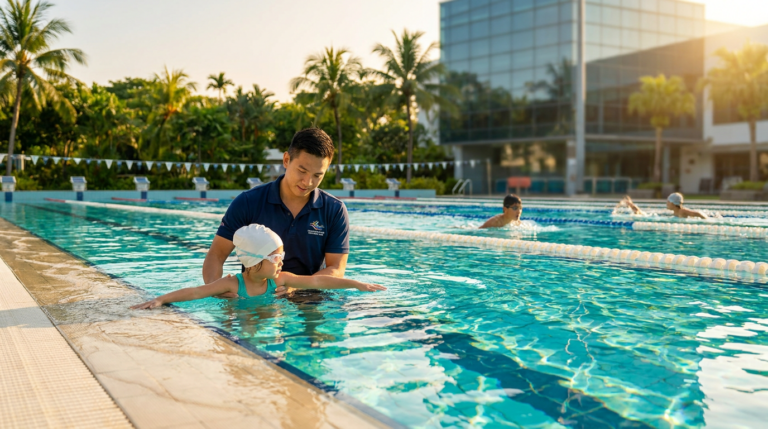
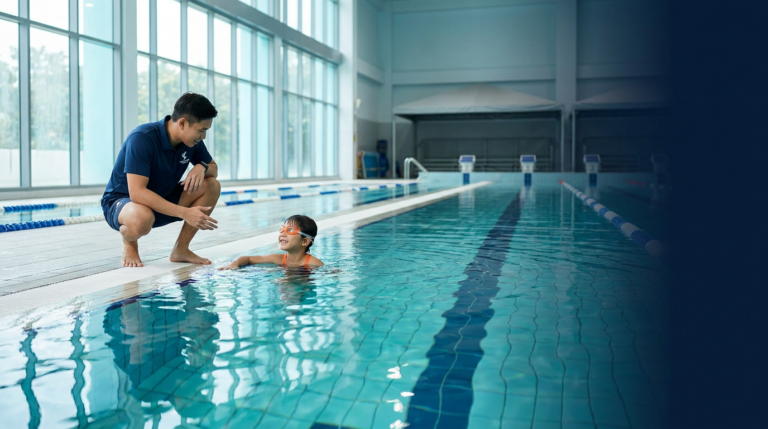
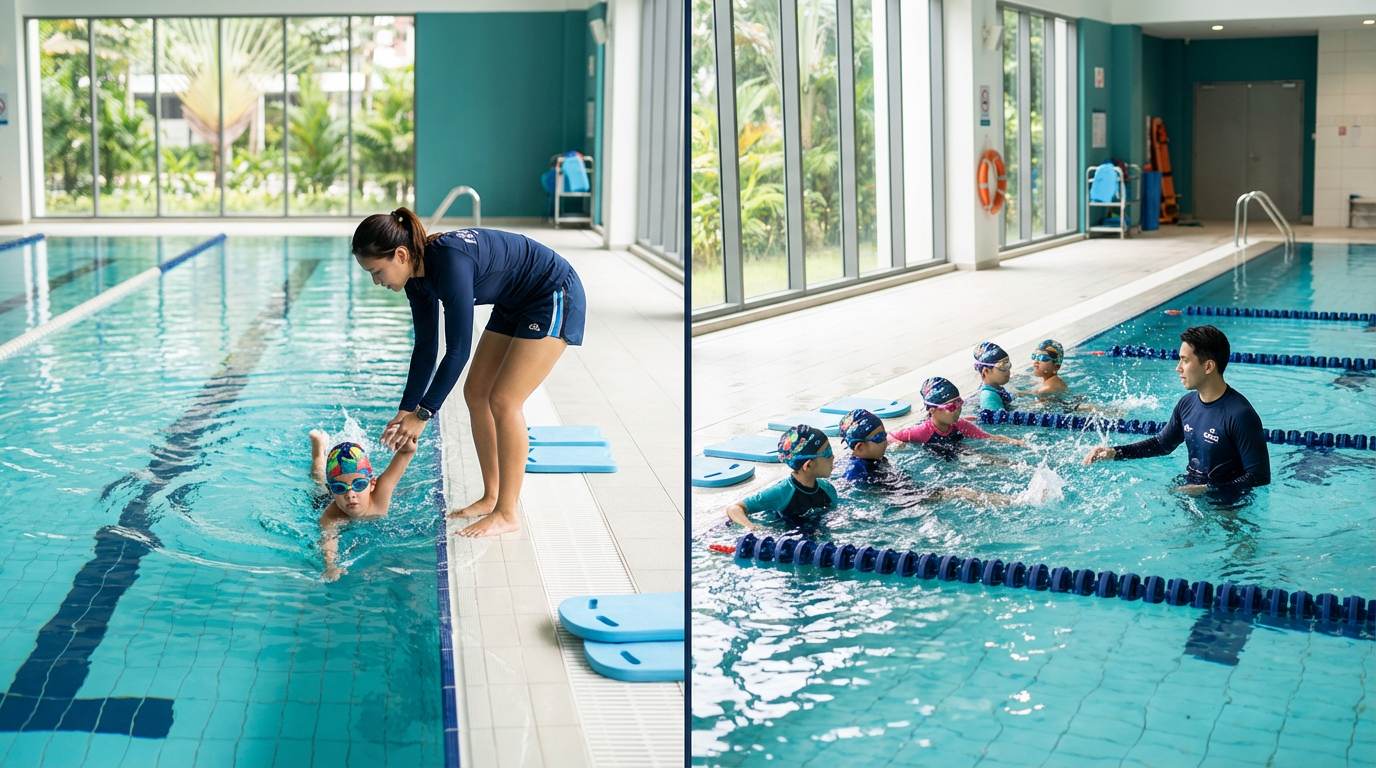
The primary distinction between private swimming lessons and group classes lies in the student-to-instructor ratio and the resulting level of individualized attention. In private lessons, one instructor focuses exclusively on your child (or occasionally on a small sibling pair in semi-private sessions). This creates an environment where every minute of instruction is tailored to your child's specific needs, progress, and challenges.
Group classes typically range from four to eight students per instructor, though this can vary depending on the program and age group. In Singapore's structured swimming programs like SwimSafer 2.0, group classes follow a standardized curriculum designed to move students through progressive skill levels. The instructor divides attention among multiple children, creating a more social learning environment where students can observe peers and practice together.
Both formats can be highly effective, and the quality of instruction matters more than the format itself. What differs is the learning experience and how quickly your child progresses through fundamental skills. Understanding these differences helps you align your choice with your child's developmental needs and your family's priorities.
Private swimming instruction offers an intensive, customized learning experience that can accelerate skill development significantly. When a professionally qualified coach focuses exclusively on one student, they can identify and correct technique issues immediately, adapt teaching methods to match the child's learning style, and progress at a pace determined entirely by the student's readiness rather than a group schedule.
Accelerated learning pace is perhaps the most significant benefit of private instruction. Without needing to coordinate with other students or wait for classmates to master skills, children often progress two to three times faster than in group settings. For families preparing for specific milestones like school swimming tests or SwimSafer assessments, this efficiency can be invaluable. A child who might need twelve group sessions to master a skill level could potentially achieve the same competency in four to six private sessions.
Personalized attention to fears and challenges makes private lessons particularly effective for children with water anxiety or previous negative experiences. An instructor can spend entire sessions building confidence and addressing specific fears without the pressure of keeping up with peers. This individualized approach often helps anxious swimmers overcome barriers that might persist much longer in group environments where they feel self-conscious about being behind others.
Flexible curriculum adaptation allows instructors to focus on exactly what your child needs. If your child excels at breathing techniques but struggles with leg kicks, the instructor can dedicate more time to kicks without being constrained by a fixed group curriculum. For children training for competitive swimming, this targeted approach enables refinement of specific strokes and techniques that need attention.
Schedule flexibility tends to be greater with private lessons. Many providers, including SPEEDISWIM's programs across international schools and country clubs, can accommodate specific timing needs that work around your family's schedule. This flexibility becomes particularly valuable for families juggling multiple children's activities or parents with demanding work commitments.
The investment required for private lessons extends beyond financial cost. While the per-session price is higher, families should consider the total investment needed to reach specific milestones. If a child reaches SwimSafer Stage 3 in ten private sessions versus twenty group sessions, the total cost differential may be smaller than it initially appears, especially when accounting for the value of time saved.
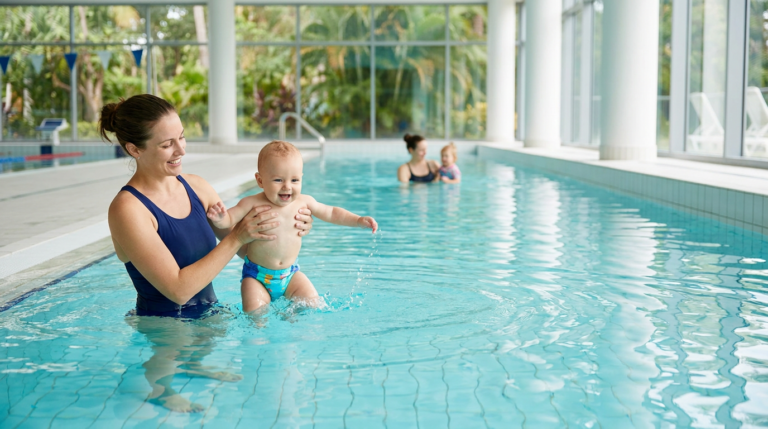
Some children actually benefit from the social aspects of group learning and may find private lessons less engaging. The absence of peers means no friendly competition, no opportunity to learn by watching others, and potentially less fun for socially motivated children. This is particularly relevant for younger children (ages 4-6) who often enjoy the playful group dynamic and may lose interest in purely technical instruction.
Additionally, private lessons require sustained focus from the child throughout the entire session. Some younger students struggle to maintain attention for 30-45 minutes of continuous individual instruction, whereas group classes naturally include moments of observation and rest while the instructor works with other students.
Group swimming classes represent the traditional approach to learn-to-swim programs and remain the most common choice for families in Singapore. These structured classes follow progressive curricula like the SwimSafer Program, which was developed by the National Water Safety Council in collaboration with Sport Singapore to teach people of all ages to swim and be safe in and around water.
Social development and peer learning create valuable opportunities beyond just swimming skills. Children learn to follow instructions in a group setting, take turns, and encourage classmates. Many students find motivation in watching peers master skills, thinking "if they can do it, so can I." This peer modeling effect can be particularly powerful for children who are naturally competitive or socially motivated. The friendships formed in swimming classes often extend beyond the pool, creating a community that makes children look forward to lessons.
Structured progression through recognized standards ensures systematic skill development. SwimSafer 2.0, which was refreshed in 2016-2017, emphasizes skill development in conjunction with water safety and personal water survival education. Group classes following this framework ensure children don't just learn to swim but understand water safety principles and develop survival skills. The standardized assessment process at official CAMS (Centralised Assessment Management System) centres, like SPEEDISWIM at Orchid Country Club, provides recognized certification that schools and programs accept.
Cost effectiveness makes group classes accessible to more families. At typical Singapore rates of $35 to $55 per session compared to $60 to $120 for private instruction, group classes represent a more budget-friendly option for ongoing swimming education. For families with multiple children, this difference becomes even more significant.
Preparation for team environments is valuable if your child might pursue aquatic sports. Whether they're interested in water polo, artistic swimming, or competitive swim teams, group class experience builds comfort with training in team settings. Children learn to focus despite distractions, follow coach instructions in busy environments, and develop the social skills needed for team sports.
The pace of group classes is necessarily set for the average student in the class, which means some children will find it too slow while others struggle to keep up. Advanced learners may become bored waiting for classmates, while those who need extra time may feel rushed or anxious about holding others back. This one-size-fits-most approach works well for many children but isn't optimal for those at either end of the learning spectrum.
Individual attention is inherently limited when an instructor manages multiple students. While qualified coaches can effectively teach groups, they cannot provide the same level of immediate feedback and correction possible in private lessons. Technique issues may persist longer because the instructor doesn't have time to work extensively with each child every session.
Class schedules are fixed, offering less flexibility than private lessons. If your child misses a class due to illness or family commitments, they miss that week's instruction entirely. Some programs offer make-up classes, but these may not align with your regular instructor or classmates, potentially disrupting continuity.
Understanding the true cost difference requires looking beyond per-session pricing to consider the total investment needed to achieve your goals. Group swimming lessons in Singapore typically range from $35 to $55 per session, with most programs offering packages of eight to twelve sessions. A complete SwimSafer stage might require 12-20 group sessions depending on the child's starting ability and progression rate.
Private or semi-private lessons command premium pricing, generally ranging from $60 to $120 per session. However, the accelerated progression means fewer total sessions are often needed. A child might complete the same SwimSafer stage in 6-10 private sessions that would require 12-20 group sessions.
For a practical comparison, consider a child progressing through SwimSafer Stage 2. In a group setting at $45 per session for 16 sessions, the total investment is $720. In private lessons at $90 per session for 8 sessions, the total is also $720. While this is a simplified example and actual progression varies, it illustrates that the total cost differential may be smaller than the per-session price suggests.
Additionally, consider the value of time. If your child can achieve swimming competency in three months via private lessons versus six months in group classes, there's value in the earlier achievement of water safety and the ability to move on to other activities or more advanced training sooner.
The decision between private lessons and group classes should center on your child's individual characteristics, learning style, and specific needs. Consider your child's personality first. Outgoing, socially motivated children often thrive in group settings where they enjoy the camaraderie and friendly competition. They may find private lessons isolating and less enjoyable, which can impact their engagement and progress. Conversely, shy or introverted children sometimes feel more comfortable in one-on-one settings where they can ask questions freely without peer judgment.
Assess your child's current relationship with water. Children with significant water fear or anxiety typically benefit enormously from private instruction where they can progress at their own pace without feeling pressure from peers. The ability to spend entire sessions on confidence-building activities without worrying about falling behind a group curriculum can make the difference between developing a lifelong comfort with water or maintaining persistent anxiety.
Consider your timeline and goals. If you need your child to achieve basic water safety quickly, perhaps before a family beach vacation or to meet school requirements, private lessons offer the fastest path. If you're taking a longer-term approach to swimming education without immediate deadlines, group classes provide excellent value while building social skills alongside swimming ability.
Think about your child's attention span and learning style. Children who struggle with sustained focus may actually do better in group classes where the instructor's attention naturally rotates, providing built-in mental breaks. Children who learn best through careful observation and repetition with immediate feedback may progress faster in private settings.
For children showing potential for competitive swimming or interest in specialized aquatic sports, starting with private lessons to build strong foundational technique can be valuable. Poor technique is harder to correct later, and private instruction ensures fundamentals are mastered correctly from the beginning. Once solid basics are established, transitioning to group training prepares them for the team environment they'll experience in competitive swimming programs.
Singapore's national SwimSafer 2.0 program provides a structured framework that works with both private and group instruction formats. The program teaches essential swimming and water safety skills through six progressive stages, emphasizing skill development in conjunction with water safety and personal water survival education. Whether your child learns through private lessons or group classes, they can be assessed and certified through the official CAMS system.
Group classes designed around SwimSafer progression offer the advantage of being specifically structured to prepare students for each stage's assessment criteria. The curriculum is built into the class progression, ensuring comprehensive coverage of all required skills. Private lessons can be similarly structured but require you to work with your instructor to ensure all SwimSafer competencies are addressed, not just swimming technique.
At SPEEDISWIM, our programs across multiple venues are aligned with SwimSafer 2.0 standards, and our Orchid Country Club location serves as an official Non-ActiveSG Pool CAMS Centre. This means students can be assessed and certified regardless of whether they've trained in private or group settings, providing flexibility in how you approach your child's swimming education while ensuring they receive nationally recognized certification.
For children who will need SwimSafer certification for school requirements or Direct School Admission (DSA) applications, both pathways work effectively. The choice should be based on the other factors we've discussed rather than the certification itself.
An increasingly popular strategy combines both private and group instruction to maximize benefits while managing costs. This hybrid approach recognizes that different stages of swimming education may benefit from different learning formats.
Many families start with private lessons to establish foundational skills and water confidence, particularly for young children or anxious swimmers. Once the child is comfortable in water and has mastered basic skills like floating, submersion, and elementary propulsion, they transition to group classes for continued development. This approach frontloads the investment in rapid initial progress while leveraging the social and financial benefits of group classes for ongoing learning.
Another effective hybrid model uses group classes as the primary instruction method while incorporating periodic private sessions to address specific technique issues or prepare for assessments. For example, a child might attend weekly group classes but schedule two or three private sessions before SwimSafer assessments to refine skills and build confidence for testing.
For families with children interested in competitive swimming, the progression might involve group SwimSafer classes for basic competency, private lessons to develop strong stroke technique, and then specialized group training programs for competitive development. SPEEDISWIM's experience grooming over 1,000 athletes across multiple aquatic disciplines demonstrates the effectiveness of properly structured progression through different training formats.
The hybrid approach requires more planning and coordination but can optimize both learning outcomes and resource investment. Discuss this possibility with your swimming program to understand how they can support a combined approach tailored to your child's development.
Choosing between private swimming lessons and group classes isn't about identifying one universally superior option; it's about understanding your child's unique needs, learning style, and your family's circumstances. Both formats offer distinct advantages, and both can effectively teach children to swim safely and competently.
Private lessons excel at accelerating learning, addressing individual challenges, and accommodating scheduling needs. They're particularly valuable for children with water anxiety, those needing rapid skill development, or swimmers requiring specialized technical coaching. Group classes provide social learning opportunities, cost-effective ongoing instruction, and structured progression through recognized standards like SwimSafer 2.0. They work wonderfully for socially motivated children and families taking a patient, long-term approach to swimming education.
The hybrid approach offers a middle path that many families find optimal, combining the intensive skill-building of private instruction with the social and economic benefits of group learning. Whatever you choose, the most important factors are consistent attendance, qualified instruction, and ensuring your child develops both swimming ability and crucial water safety awareness.
At SPEEDISWIM, our two decades of experience teaching over 25,000 students has shown us that success comes in many forms. Some of our nationally ranked competitive swimmers started in group classes, while others began with private instruction. What matters most is matching the learning format to the child and maintaining the commitment to their aquatic education.
Whether you're considering private lessons, group classes, or a combination of both, SPEEDISWIM's experienced coaches can help you make the right choice for your child. With over 20 years of experience and programs across multiple venues including international schools and country clubs, we offer flexible options to match your family's needs.
Contact us today to discuss your child's swimming education and schedule a trial session.