When parents watch their child successfully complete SwimSafer Bronze, a common question emerges: "What comes next?" The answer lies in SwimSafer Silver, a pivotal stage that transforms basic swimmers into competent, water-confident individuals capable of handling more complex aquatic environments.
SwimSafer Silver represents far more than the next certification checkbox in Singapore's national swimming framework. This intermediate level serves as the critical bridge where fundamental water skills evolve into refined techniques, where pool-bound confidence extends to understanding open water challenges, and where young swimmers develop the foundation necessary for either advanced recreational swimming or competitive pursuits.
Since the introduction of SwimSafer 2.0 by the National Water Safety Council in collaboration with Sport Singapore, the Silver level has been carefully designed to address a specific developmental need: preparing swimmers aged 7 and above to handle diverse aquatic situations with both technical competence and safety awareness. For organizations like SPEEDISWIM, which has trained over 25,000 students across two decades, understanding these requirements intimately has been key to successfully guiding swimmers through this transformative stage.
In this comprehensive guide, we'll explore every aspect of SwimSafer Silver requirements, examine why each component matters for your child's aquatic development, and provide practical insights to help families navigate this crucial progression point with confidence.
The SwimSafer program, refreshed in 2016-2017 as SwimSafer 2.0, follows a progressive six-stage framework designed to develop swimmers from water introduction through advanced competency. Silver occupies the third position in this sequence, creating an essential transition point where swimmers move beyond survival-focused basics into skill refinement and expanded water awareness.
Where Silver Fits in the Progression: After completing Bronze, swimmers typically possess fundamental front and back swimming abilities, basic entries and exits, and foundational water safety knowledge. Silver builds systematically on this base, introducing greater distances, refining stroke mechanics, and expanding the environmental contexts swimmers must understand. This level prepares students for the more demanding Gold stage, where competitive stroke techniques and advanced survival skills become the focus.
What distinguishes Silver from its predecessor is the emphasis on controlled technique over mere capability. While Bronze swimmers demonstrate they can move through water, Silver swimmers must show they can do so with proper form, sustained endurance, and tactical awareness of their surroundings. This shift reflects SwimSafer 2.0's core philosophy: developing comprehensive aquatic competence that combines skill execution with safety education and personal survival capabilities.
For families considering the investment in swimming lessons (group sessions typically range from $35 to $55 per session in Singapore), understanding that Silver represents this critical developmental threshold helps contextualize its value. This isn't simply another certification level—it's the foundation upon which all advanced swimming capabilities are built, whether your child aims for competitive swimming success or simply confident, safe recreational enjoyment of aquatic activities.
SwimSafer Silver assessment encompasses three integrated components: water safety knowledge, survival skills, and technical swimming abilities. Each element has been carefully calibrated to ensure swimmers develop holistic aquatic competence rather than isolated skills.
The technical swimming requirements for Silver level demonstrate significant progression from Bronze, both in distance and precision:
These distances represent meaningful increases from Bronze's 50-meter requirements, challenging swimmers to develop not just technique but also cardiovascular endurance and mental stamina. The 100-meter swims, in particular, require swimmers to maintain form consistency even as fatigue develops—a critical skill that translates directly to real-world aquatic situations where reaching safety may require sustained effort.
Silver level introduces foundational rescue awareness concepts appropriate for this developmental stage. While swimmers aren't expected to perform complex rescues, they must understand basic principles of helping others safely. This includes demonstrating a reach rescue using appropriate equipment (a pole, rope, or flotation device) and understanding the dangers of direct contact rescue attempts without proper training.
This component reflects SwimSafer 2.0's emphasis on developing responsible, safety-conscious swimmers who understand their capabilities and limitations. Through structured programs like those offered by SPEEDISWIM's SwimSafer curriculum, students learn these concepts through age-appropriate scenarios that build judgment alongside physical skills.
The theoretical knowledge component of SwimSafer Silver extends significantly beyond Bronze, addressing more complex safety scenarios and environmental awareness. This isn't abstract classroom learning—it's practical knowledge that could save lives in real aquatic emergencies.
Environmental Awareness: Silver swimmers must demonstrate understanding of different aquatic environments and their specific hazards. This includes recognizing dangerous conditions in pools (slippery surfaces, diving restrictions), beaches (waves, currents, designated swimming areas), and open water (sudden depth changes, underwater obstacles). They learn to identify warning signs and flags, understand what different colored flags mean at beaches, and recognize when conditions exceed their capability level.
The survival sequence assessment tests swimmers' ability to respond appropriately to an unexpected entry into deep water. Students must demonstrate the correct sequence: enter the water (simulating an accidental fall), orient themselves, signal for help, maintain flotation, and swim to safety. This integrated skill set proves they can think clearly and act effectively in a genuine emergency rather than panicking.
Personal Limitation Recognition: Perhaps one of the most valuable components is teaching swimmers to honestly assess their own abilities and make safe decisions. Silver students learn to evaluate whether a swimming situation is within their skill level, understand the importance of swimming with others rather than alone, and recognize signs of fatigue before they become dangerous. This metacognitive awareness represents a sophisticated developmental leap that distinguishes Silver from earlier levels.
For swimming centers operating as official CAMS (Centralised Assessment Management System) assessment venues like SPEEDISWIM at Orchid Country Club, these knowledge components are assessed through both verbal questioning and practical demonstration, ensuring comprehension goes beyond memorization to genuine understanding.
While Bronze introduces basic stroke mechanics, Silver demands refinement and consistency. The 100-meter distance requirements aren't arbitrary—they're specifically designed to reveal whether swimmers have truly internalized proper technique or are simply capable of short-distance approximations.
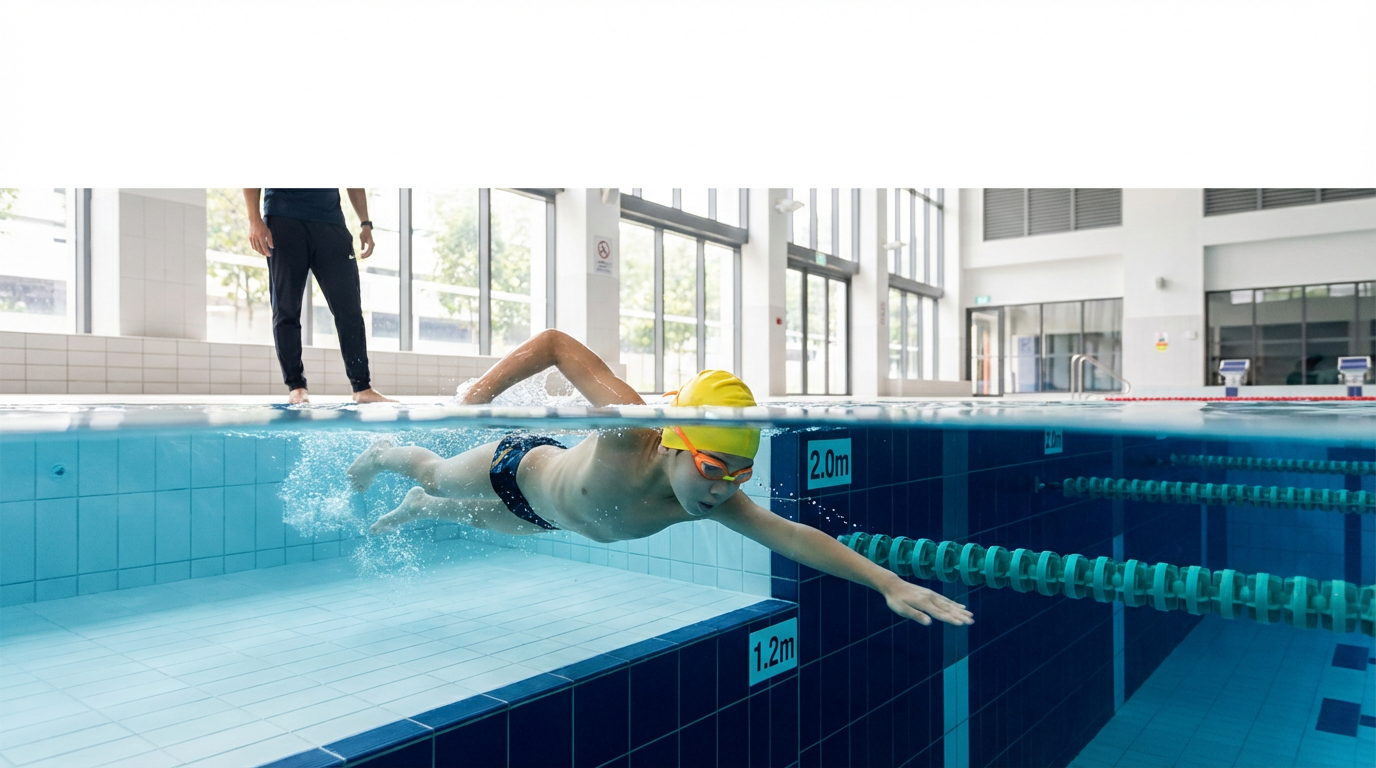
At Silver level, front crawl expectations move beyond "swimming forward on the front" to specific technical standards. Swimmers must demonstrate proper body rotation, with the torso rolling rhythmically rather than remaining flat. Arm recovery should be relaxed with high elbows, and the underwater pull must show an effective catch and pull-through pattern rather than simply pushing water backward.
Breathing becomes a particular focus area. Unlike Bronze, where any functioning breathing pattern suffices, Silver swimmers should show controlled, rhythmic breathing that doesn't disrupt stroke mechanics. Many swimmers at this level begin developing bilateral breathing (breathing on both sides), which creates more balanced stroke development and better spatial awareness—skills that become essential for those progressing toward competitive swimming.
The 100-meter backstroke requirement challenges swimmers to maintain horizontal body position without visual reference to their direction. Silver-level backstroke emphasizes consistent alternating arm action, continuous flutter kick maintaining body position, and the critical skill of straight-line swimming without seeing where you're going.
This distance also reveals whether swimmers have developed the core stability necessary for efficient backstroke. Swimmers who lack this stability will show excessive hip drop or scissor kick patterns—technical flaws that become apparent over longer distances. Quality coaching programs address these refinements systematically, building the strength and body awareness required for proper execution.
The 15-meter underwater swim introduces streamlining concepts essential for efficient swimming. Swimmers learn to minimize drag by maintaining a tight, arrow-like position with arms extended overhead, one hand over the other, head positioned between the arms, and legs together with pointed toes. Propulsion comes from either dolphin kicks or a breaststroke pull-out, depending on the swimmer's development.
This skill serves multiple purposes: it develops breath control, introduces the streamlined position used in competitive swimming turns and starts, and builds confidence in breath-holding situations. For young swimmers who may progress into disciplines like underwater hockey or water polo, this foundational skill becomes particularly valuable.
SwimSafer assessments follow standardized protocols administered by certified assessors, ensuring consistency across Singapore's swimming programs. For Silver candidates, understanding the assessment structure helps reduce anxiety and enables better preparation.
Assessment Environment: Silver assessments typically occur in pools with both shallow and deep sections, as the requirements mandate performance in water at least 1.5 meters deep. At official CAMS centers, assessors follow strict evaluation criteria aligned with Sport Singapore's national standards. The assessment isn't competitive—swimmers are evaluated against established criteria rather than compared to one another.
The typical assessment sequence begins with entries and deep-water skills, progresses through the distance swimming requirements (often conducted in groups to maximize efficiency), and concludes with survival skills and knowledge components. Most Silver assessments span 45-60 minutes, depending on group size.
Common Assessment Challenges: Based on experience from training thousands of swimmers, several skills frequently present difficulties. The 100-meter continuous swims challenge swimmers who haven't developed adequate endurance or who sacrifice technique when fatigued. The feet-first surface dive requires spatial awareness and efficient movement that some swimmers find initially difficult. The 2-minute treading water assessment reveals whether swimmers have developed truly efficient flotation methods or are expending unnecessary energy.
Quality preparation through structured programs addresses these challenges systematically. Centers like SPEEDISWIM, with over 20 years of experience guiding swimmers through SwimSafer progressions, understand precisely where swimmers commonly struggle and can target these areas during training. This experience translates to higher first-time assessment success rates and more confident, competent swimmers.
One of the most common parent questions concerns the timeline between Bronze certification and Silver readiness. The answer depends on several interconnected factors, but understanding typical progressions helps set realistic expectations.
Frequency and Quality of Training: Swimmers attending twice-weekly group lessons typically require 3-6 months between Bronze and Silver certification, assuming consistent attendance and appropriate practice between sessions. This timeline allows for adequate repetition to internalize technique corrections, gradual endurance building, and progressive confidence development in deeper water.
However, lesson frequency represents only part of the equation. The quality of instruction, class size, and individual attention significantly impact progression speed. Swimmers in smaller groups or receiving semi-private instruction (generally $60-$120 per session) often progress more rapidly because coaches can provide more individualized feedback and address technical issues before they become ingrained habits.
Individual Variability: Children develop aquatic skills at different rates based on multiple factors including physical development, prior water exposure, comfort in deep water, and cardiovascular fitness. Some swimmers demonstrate natural affinity for the endurance requirements but need additional technique refinement. Others master stroke mechanics quickly but require more time building the stamina for 100-meter swims.
Age also influences progression, though perhaps not in the ways parents expect. While younger swimmers (7-8 years) may take slightly longer to develop the endurance and body awareness Silver requires, they often show fewer ingrained technique flaws to correct. Older beginners may build endurance more quickly but sometimes struggle with elements like bilateral breathing or horizontal body position if they've developed compensatory movement patterns.
Practice Beyond Lessons: Swimmers who supplement formal lessons with recreational swimming typically progress faster. This doesn't mean drilling skills during family pool time, but rather maintaining water comfort and building unconscious competence through play. Simple activities like underwater treasure hunts develop breath control, diving for objects builds confidence in submerged environments, and games involving continuous movement build endurance organically.
The most successful approach combines regular, high-quality instruction with patient, progressive development that respects individual timelines. Rushing to assessment before genuine readiness typically results in failed attempts, damaged confidence, and reinforcement of anxiety around testing situations.
Successfully completing SwimSafer Silver opens multiple progression pathways, each offering distinct opportunities for continued aquatic development. Understanding these options helps families make informed decisions aligned with their child's interests, abilities, and goals.
The Gold Level Progression: SwimSafer Gold represents the next step in the national framework, introducing competitive stroke techniques (butterfly and competitive breaststroke), longer distances (200-meter swims), and more sophisticated survival skills including rescue approaches and personal survival sequences. Gold swimmers also develop advanced entries including dive entries where pool facilities permit.
For swimmers showing aptitude and interest, Gold certification often serves as the launching point toward competitive swimming. Organizations like SPEEDISWIM, which has groomed over 1,000 athletes and seen more than 50 swimmers selected for National Youth and National Teams, use the Gold level as a talent identification opportunity. Swimmers demonstrating strong technical foundation, competitive mindset, and commitment often receive invitations to join development squads or competitive swimming programs.
Not every Silver swimmer aspires to competitive lane swimming, yet the skills developed create foundations for diverse aquatic sports. The underwater skills, breath control, and deep-water confidence from Silver translate effectively to disciplines like synchronized swimming (now called artistic swimming), which combines swimming ability with dance, gymnastics, and teamwork. The treading water and spatial awareness skills prove valuable for water polo, where players must maintain vertical position while handling a ball and navigating team dynamics.
Some swimmers discover passion for lifesaving sport, which transforms rescue skills into competitive disciplines involving timed rescues, obstacle courses, and team events. Others gravitate toward diving, using their water confidence and body awareness as springboards for learning somersaults, twists, and platform diving.
Recreational Confidence: Perhaps most importantly, Silver certification provides the competence necessary for safe, independent enjoyment of aquatic environments. Silver swimmers can participate in school swimming activities, handle beach outings with appropriate supervision, and engage in water-based family recreation with significantly reduced risk. This practical safety value often represents the primary goal for families focused on water safety rather than competitive ambitions.
Maintaining and building on Silver-level skills requires ongoing engagement with water. For families not pursuing structured programs beyond Silver, several approaches help prevent skill regression. Regular recreational swimming maintains comfort and basic technique. Enrollment in seasonal or holiday intensive programs provides periodic skill reinforcement without year-round commitment. Many swimming centers offer "stroke improvement" or "skills maintenance" programs specifically designed for certified swimmers wanting to preserve and refine their abilities without competitive pressure.
The investment in reaching Silver level—both financial and in terms of time commitment—deserves protection through continued aquatic engagement. Like any physical skill, swimming abilities deteriorate without practice, but even modest ongoing water exposure preserves the core competencies developed through this demanding certification level.
SwimSafer Silver represents far more than a middle certification level in Singapore's national swimming framework. It embodies the critical transition where fundamental water survival skills evolve into refined swimming technique, where pool-bound comfort extends to broader environmental awareness, and where young swimmers develop the foundation necessary for whatever aquatic pathway they choose to pursue.
The comprehensive requirements—spanning technical swimming skills, survival capabilities, and safety knowledge—reflect the program's holistic approach to aquatic education. This isn't simply about swimming faster or farther, but about developing competent, safety-conscious individuals capable of making sound decisions in diverse water environments.
For parents navigating their child's swimming journey, understanding that Silver serves as this pivotal bridge helps contextualize its importance and justifies the investment of time, effort, and resources required to achieve it. Whether your child continues toward competitive excellence, explores alternative aquatic sports, or simply gains the confidence and skills for safe recreational water enjoyment, the competencies developed at Silver level provide the essential foundation.
Success at this level requires quality instruction, adequate practice time, patient progression respecting individual development timelines, and a supportive environment that balances challenge with encouragement. Organizations with deep experience in the SwimSafer framework understand precisely how to navigate this progression, addressing the specific challenges Silver presents while building toward each swimmer's unique potential.
SPEEDISWIM's experienced coaches have successfully guided thousands of swimmers through the SwimSafer progression over two decades. As an official CAMS assessment center with a proven track record of developing both recreational swimmers and competitive athletes, we provide the expert instruction and supportive environment your child needs to master Silver requirements and progress confidently toward their aquatic goals.