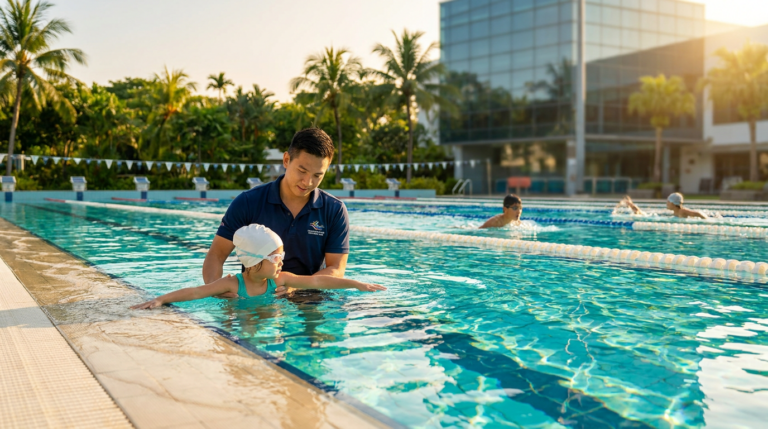
Learning to swim is one of the most valuable life skills anyone can develop, combining essential water safety knowledge with the foundation for lifelong fitness and potentially competitive achievement. At SPEEDISWIM, with over two decades of experience training more than 25,000 students across Singapore, we've refined a progressive approach to swimming instruction that builds confidence, competence, and proper technique from the very first lesson.
Swimming drills are the building blocks of effective aquatic education. Unlike simply "practicing swimming," structured drills isolate specific skills, allowing beginners to master individual components before combining them into complete strokes. This methodical approach aligns perfectly with the SwimSafer 2.0 program framework, which emphasizes skill development alongside water safety and personal survival education.
This comprehensive guide presents 20 carefully selected swimming drills organized into a progressive training program. Whether you're a parent supporting your child's swimming journey, an adult learning to swim, or a coach seeking structured lesson plans, these drills provide a clear pathway from water introduction to confident swimming. Each drill includes step-by-step instructions, key focus points, and professional coaching insights developed through SPEEDISWIM's proven track record of developing swimmers from beginners to national-level athletes.
Before diving into specific drills, it's important to understand why drill-based training is so effective for beginners. Swimming is a complex motor skill that requires coordination of breathing, body position, arm movements, and leg kicks—all while maintaining buoyancy in an unfamiliar environment. Attempting to master everything simultaneously often leads to frustration, poor technique habits, and slower progress.
Progressive skill isolation allows learners to focus on one element at a time, building muscle memory and confidence before adding complexity. This approach mirrors how SPEEDISWIM has successfully trained over 1,000 athletes across multiple aquatic disciplines, always starting with fundamentals regardless of the swimmer's eventual goals. A beginner working through structured drills develops not just swimming ability, but also body awareness, spatial orientation, and the mental resilience that translates to success in competitive swimming and other aquatic sports.
The 20 drills presented here follow a carefully designed progression: water confidence and safety fundamentals first, followed by body position and breathing mechanics, then stroke-specific techniques for freestyle, backstroke, and breaststroke. This sequence ensures that each new skill builds upon previously mastered foundations, creating a stable platform for continued advancement.
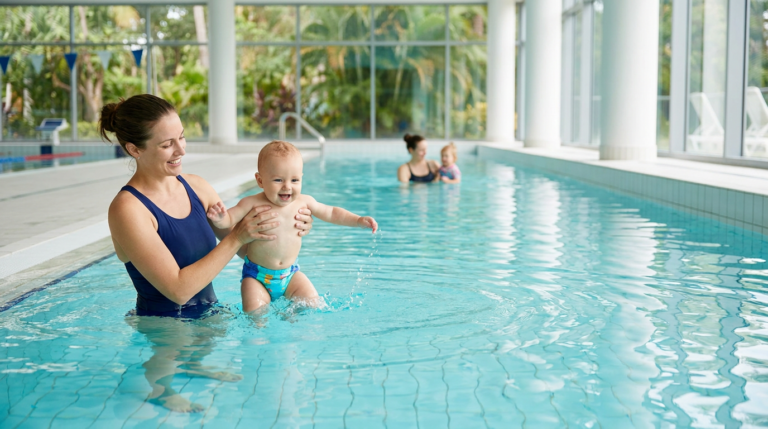
Water confidence forms the essential foundation for all swimming skills. These first five drills help beginners become comfortable in the aquatic environment, develop trust in the water's buoyancy, and establish basic safety awareness.
1. Start in chest-deep water – Position yourself where the water reaches mid-chest level, allowing comfortable standing while experiencing water resistance.
2. Walk across the width of the pool – Move through the water using normal walking motions, focusing on maintaining balance against water resistance.
3. Progress to jogging and direction changes – Increase speed and practice turning, moving backwards, and sideways to develop multidirectional water confidence.
Key Focus Points:
1. Stand in shoulder-deep water – Position yourself where you can comfortably touch the bottom while water reaches your shoulders.
2. Take a breath and submerge completely – Inhale through your mouth, hold your breath, and lower yourself until your head goes underwater.
3. Return to the surface and exhale – Push up to standing position and breathe out through your nose and mouth above water.
4. Repeat rhythmically for 10-15 repetitions – Establish a comfortable breathing pattern: breathe in above water, hold while submerged, breathe out upon surfacing.
Key Focus Points:
1. Hold the pool wall with both hands – Face the wall in chest-deep water, gripping the edge or gutter firmly.
2. Take a breath and lean forward – Inhale deeply, then gently lean your body forward while keeping your face in the water.
3. Allow your legs to float upward – Relax your lower body and let your legs naturally rise toward the surface as your lungs provide buoyancy.
4. Hold the position for 5-10 seconds – Maintain the horizontal floating position while holding your breath, then return to standing.
Key Focus Points:
1. Position yourself with your back to the wall – Stand in chest-deep water, holding the wall edge behind you.
2. Lean back and allow your body to recline – Gently tilt your head back and recline your body while maintaining wall contact with your hands.
3. Lift your feet off the bottom – Allow your legs to rise as you transition to a horizontal back-floating position.
4. Relax and breathe normally – Maintain the float with your ears submerged, breathing comfortably while supported by the wall.
Key Focus Points:
1. Push off from the wall into a front float – Release the wall and maintain horizontal position without support for 3-5 seconds.
2. Recover to standing position – Bring your knees toward your chest, push your hands down and forward, and lift your head to return to vertical.
3. Practice back float without wall support – From standing, lean back and establish a horizontal back float independently.
4. Alternate between front and back floats – Develop comfort transitioning between positions, building essential water safety skills.
Key Focus Points:
With foundational water confidence established, these drills develop the critical skills of proper breathing mechanics and streamlined body position. These elements form the technical foundation for efficient swimming in all strokes.
1. Stand in chest-deep water – Position yourself comfortably with water at chest level.
2. Submerge your face and exhale slowly – Put your face in the water and blow bubbles steadily through your nose and mouth for 3-5 seconds.
3. Lift your head and inhale quickly – Raise your face just enough to breathe in through your mouth, then immediately return underwater.
4. Establish a 3:1 rhythm – Exhale underwater for three seconds, quickly inhale for one second, then repeat continuously for 10 cycles.
Key Focus Points:
1. Face the wall in shallow water – Stand facing the pool wall with hands ready to push off.
2. Take a breath and push off underwater – Inhale, submerge, and push from the wall with moderate force.
3. Assume streamline position – Extend both arms straight overhead with biceps squeezing your ears, one hand stacked on the other, legs together and pointed.
4. Glide until momentum decreases – Maintain the tight, streamlined position throughout the glide, then return to standing.
Key Focus Points:
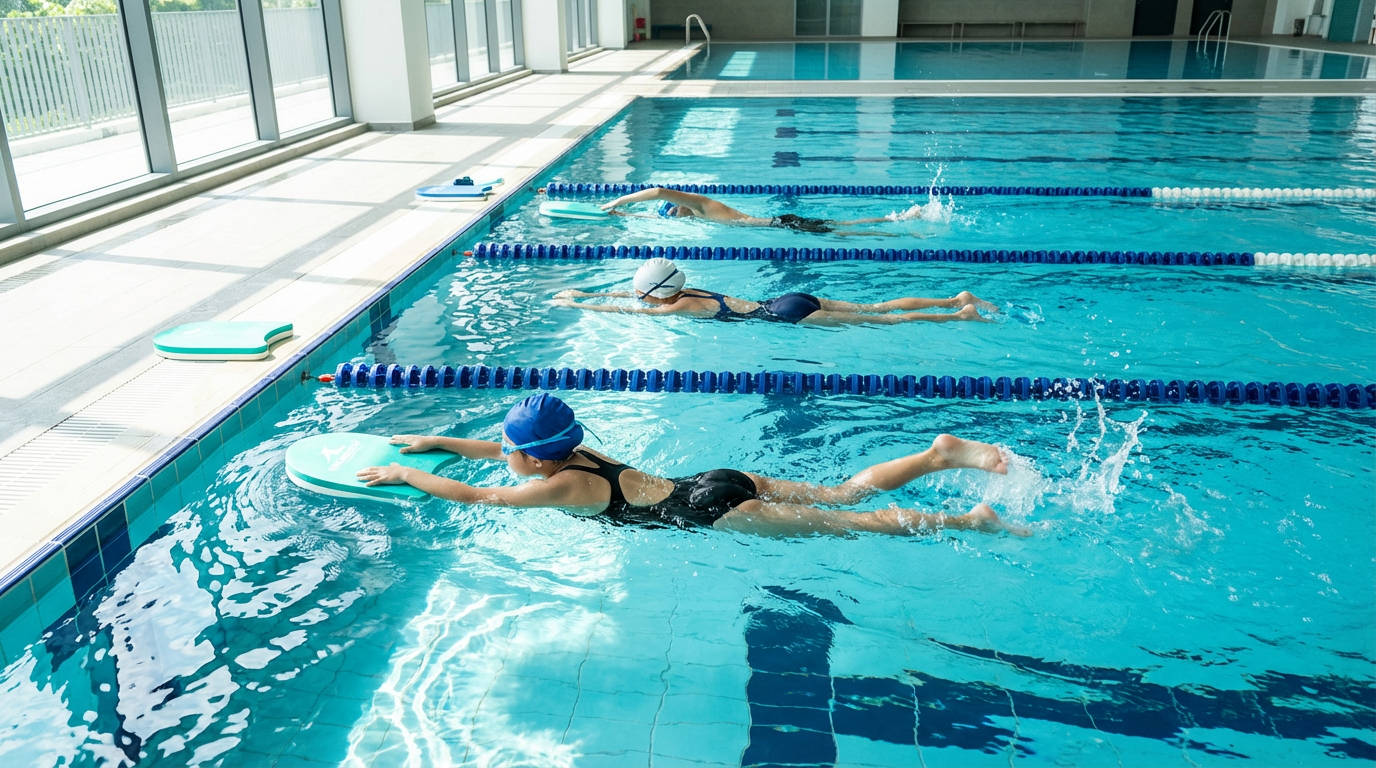
1. Hold a kickboard with extended arms – Grip the top edge of the kickboard with hands shoulder-width apart, arms straight.
2. Assume a horizontal front float position – Push off from the wall and establish a streamlined body position with the kickboard for support.
3. Execute flutter kicks from the hips – Initiate small, rapid alternating kicks from your hip flexors, keeping legs relatively straight with relaxed ankles.
4. Maintain steady kicking for 10-15 meters – Focus on consistent kick rhythm while breathing to the side when needed.
Key Focus Points:
1. Establish a back float position – Begin floating on your back with arms by your sides or extended overhead.
2. Initiate gentle flutter kicks – Begin small, alternating kicks while maintaining your horizontal back position.
3. Focus on body alignment – Keep your chest elevated, hips near the surface, and head positioned back with ears submerged.
4. Kick continuously for 10-15 meters – Maintain steady kicking while breathing normally throughout the distance.
Key Focus Points:
1. Hold the wall with your left hand – Stand sideways to the wall in chest-deep water, left arm extended to hold the edge.
2. Extend your right arm forward – Reach your right arm straight ahead in swimming position, body turned slightly away from the wall.
3. Rotate face down into the water – Turn your face down and forward, exhaling steadily through nose and mouth.
4. Rotate face to the right to breathe – Turn your head to the right (away from the extended arm) to inhale, then return face to water and exhale.
5. Repeat 10 times, then switch sides – Practice the breathing rotation rhythm, then turn to practice breathing to the left side.
Key Focus Points:
Freestyle is typically the first full stroke that beginners learn due to its natural motion and efficiency. These five drills systematically build proper freestyle technique, from arm movement to coordinated swimming.
1. Hold a kickboard with your left arm – Extend your left arm forward holding the kickboard for support.
2. Begin flutter kicking – Establish consistent kicking to maintain forward momentum and body position.
3. Execute freestyle strokes with right arm only – Perform complete arm cycles with your right arm: reach forward, pull through to your hip, recover over the water.
4. Coordinate breathing to the right – Turn your head to breathe as your right arm completes the pull phase and begins recovery.
5. Complete 10-15 meters, then switch arms – Practice with the right arm, then transfer the kickboard to practice left arm strokes.
Key Focus Points:
1. Push off in streamline position – Begin with both arms extended forward in proper streamline.
2. Pull with one arm while the other remains extended – Execute a complete stroke with one arm while keeping the other arm stationary and extended forward.
3. "Catch up" with the extended arm – Return the stroking arm to the starting position to meet the stationary arm before beginning the next stroke.
4. Alternate arms in this pattern – Continue alternating arms, ensuring one arm is always fully extended forward.
Key Focus Points:
1. Push off on your right side – Begin with your right arm extended forward, left arm at your side, body rotated 90 degrees, looking down.
2. Kick for six flutter kicks – Maintain the side position while kicking steadily, taking a breath to the side if needed.
3. Take three freestyle strokes – Rotate through three complete stroke cycles, breathing as needed.
4. Return to left-side position for six kicks – Finish the three strokes by rotating to your left side, left arm extended, right arm at side.
5. Repeat the pattern – Continue alternating six kicks on each side with three strokes in between.
Key Focus Points:
1. Swim regular freestyle – Begin swimming normal freestyle with comfortable breathing pattern.
2. Drag fingertips along water surface during recovery – As you recover each arm over the water, maintain contact by dragging your fingertips along the surface.
3. Emphasize high elbow position – Keep your elbow elevated above your hand throughout the recovery to enable fingertip contact with water.
4. Continue for 15-20 meters – Maintain the exaggerated recovery position while swimming at reduced speed.
Key Focus Points:
1. Push off and establish steady freestyle – Begin swimming with coordinated arm strokes, leg kicks, and body rotation.
2. Implement a breathing pattern – Breathe every 3-5 strokes, maintaining the same side initially for consistency.
3. Focus on complete coordination – Synchronize all elements: continuous flutter kick, alternating arm strokes, body rotation, and timed breathing.
4. Swim 25 meters continuously – Complete a full pool length maintaining technique and breathing pattern.
Key Focus Points:
Once basic freestyle competency is established, beginners can expand their aquatic skills by learning backstroke and breaststroke fundamentals. These final five drills introduce essential techniques for these important strokes.
1. Establish back float with flutter kick – Begin floating on your back with steady flutter kicks maintaining horizontal position.
2. Extend right arm overhead – Reach your right arm straight back past your head, entering the water pinky-finger first.
3. Pull through to your hip – Sweep your arm in an elongated arc from overhead to your thigh, palm pressing against the water.
4. Recover arm straight over the water – Lift your straight arm out of the water at your hip and swing it overhead in a vertical arc.
5. Practice with alternating arms – Perform continuous backstroke arm cycles, alternating arms in opposition.
Key Focus Points:
1. Begin back float with kicking – Establish horizontal back position with consistent flutter kick.
2. Pull with both arms simultaneously – Execute underwater pull with both arms at the same time, sweeping from overhead to hips.
3. Recover both arms together over water – Lift both straight arms out and swing them overhead together in windmill fashion.
4. Repeat for 10-15 meters – Continue the symmetrical double-arm backstroke pattern.
Key Focus Points:
1. Place pull buoy between thighs – Position a flotation pull buoy between your upper thighs to support your legs.
2. Begin in streamline glide position – Push off with arms extended forward, body horizontal and streamlined.
3. Execute breaststroke arm pull – Press hands outward and backward in heart-shaped pattern, then bring hands together under chin.
4. Extend arms forward to glide – Shoot arms forward to streamline position and glide momentarily before the next pull.
5. Breathe during the pull phase – Lift your head to breathe as hands pull backward, then return face to water during arm extension.
Key Focus Points:
1. Hold the pool wall face-down – Grip the wall or gutter with hands, body extended horizontally in front float position.
2. Draw heels toward buttocks – Bend knees and bring your heels up toward your bottom, keeping knees relatively close together.
3. Rotate feet outward – Turn your feet and ankles outward (dorsiflexion) so toes point to the sides.
4. Sweep feet outward and together – Push water backward in a circular sweeping motion, bringing feet together in streamline position.
5. Hold the glide briefly – Maintain streamlined leg position for 2-3 seconds before beginning the next kick.
Key Focus Points:
1. Begin in streamline glide position – Push off from the wall in proper streamline with arms extended forward.
2. Execute one arm pull – Perform a complete breaststroke arm pull, breathing as hands pull back.
3. Bring hands to streamline as legs prepare to kick – As arms extend forward, simultaneously draw your heels up to prepare for the kick.
4. Execute one powerful kick – Complete one breaststroke kick as arms reach full extension forward.
5. Glide in streamline position – Hold the streamlined glide for 2-3 seconds before beginning the next stroke cycle.
Key Focus Points:
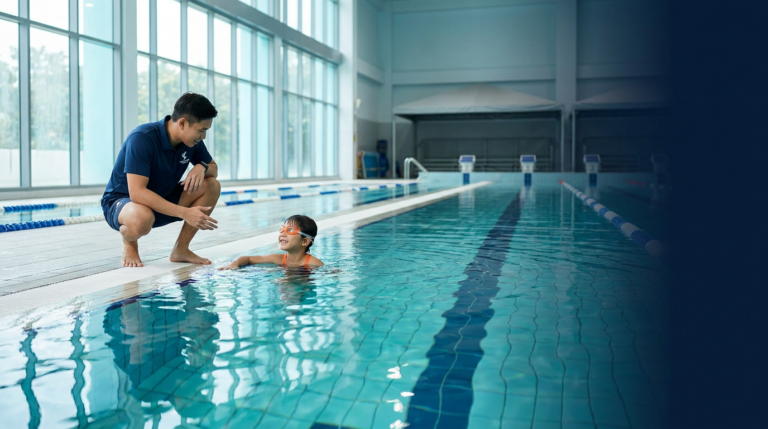
These 20 drills represent a comprehensive progression from water introduction to competent swimming across multiple strokes. However, effective implementation requires structured practice, appropriate pacing, and quality instruction. At SPEEDISWIM, our professionally qualified coaches guide students through similar progressions, carefully monitoring technique development and adjusting instruction to individual learning rates.
Recommended practice structure for beginners: Focus on mastering drills 1-5 before progressing to breathing and body position work. Most beginners require 4-6 sessions to develop comfortable water confidence. Drills 6-10 typically require another 6-8 sessions to establish proper breathing mechanics and body position. Stroke-specific drills (11-20) can then be introduced progressively over 12-16 sessions, with freestyle receiving the most emphasis initially.
The SwimSafer 2.0 framework, which SPEEDISWIM's programs follow, emphasizes that skill development must occur alongside water safety education. While practicing these drills, beginners should also learn safe pool entry and exit, understanding of water depth, basic rescue techniques, and personal survival skills. This holistic approach ensures that swimmers develop not just technical proficiency but also the judgment and knowledge necessary for lifelong water safety.
Group swimming lessons in Singapore typically range from $35 to $55 per session, while private or semi-private instruction commands premium pricing from $60 to $120 per session. The investment in professional instruction significantly accelerates progress, as qualified coaches provide immediate feedback, safety supervision, and individualized modifications to drills based on each swimmer's needs. SPEEDISWIM's track record of training over 1,000 athletes and achieving national-level success demonstrates the long-term value of structured, professionally guided instruction from the beginning stages.
For parents considering swimming programs for their children, or adults embarking on their own swimming journey, consistent practice is more valuable than intensive but sporadic training. Two to three sessions per week allows adequate practice frequency while providing recovery time for motor learning consolidation. Each session should include warm-up activities, focused drill practice on 2-4 specific skills, and enjoyable free swimming to maintain engagement and motivation.
Beyond basic swimming competence, these foundational skills open pathways to various aquatic disciplines. SPEEDISWIM offers progression opportunities into competitive swimming, artistic swimming, water polo, and even underwater hockey. Many students who begin with basic learn-to-swim programs discover passion and talent that leads to competitive achievement, with SPEEDISWIM having groomed over 50 swimmers selected for National Youth and National Teams.
Mastering swimming begins with mastering fundamentals, and these 20 progressive drills provide a comprehensive roadmap for beginners developing essential aquatic skills. From initial water confidence through freestyle proficiency to introductory backstroke and breaststroke techniques, each drill builds upon previous achievements to create a solid foundation for lifelong swimming competence.
The progressive approach outlined here mirrors the evidence-based methodology that SPEEDISWIM has refined over more than two decades of aquatic education in Singapore. Whether your goal is basic water safety, recreational swimming fitness, or potential competitive development, the journey begins with these fundamental skills practiced consistently under qualified instruction.
Swimming is unique among physical activities in combining essential safety knowledge, comprehensive fitness benefits, low-impact exercise, and potential competitive pathways. By committing to structured skill development through drills like these, beginners establish not just swimming ability but confidence, body awareness, and the foundation for whatever aquatic pursuits they choose to explore.
Remember that individual progress rates vary based on age, previous experience, physical characteristics, and practice frequency. Some learners master these 20 drills in several months, while others require longer development periods. The key is consistent practice, quality instruction, and patience with the learning process. With proper guidance and dedication, every beginner can develop into a confident, competent swimmer.
Ready to transform from beginner to confident swimmer? SPEEDISWIM's professionally qualified coaches provide structured, progressive instruction aligned with SwimSafer 2.0 standards across multiple venues in Singapore. With over 20 years of experience training more than 25,000 students, we offer the expertise and proven methodology to help you achieve your aquatic goals.
Whether you're seeking water safety skills, recreational swimming competence, or a pathway to competitive achievement, we're here to guide your journey.