Every swimmer wants to go faster. We invest hours perfecting stroke technique, building endurance, and strengthening our core. Yet one of the most powerful speed-boosting techniques remains consistently overlooked in training sessions across pools worldwide: the streamline position.
While flashy stroke improvements and powerful kicks capture attention, streamline position quietly determines whether you glide through the water like a torpedo or fight against it like a parachute. The difference between a tight, efficient streamline and a loose one can cost you precious tenths of seconds—or even entire positions—in competitive races.
At SPEEDISWIM, where we've trained over 25,000 students and developed more than 50 National Youth and National Team swimmers over two decades, we've witnessed firsthand how mastering streamline position transforms swimmers from good to exceptional. This comprehensive guide reveals why streamline deserves far more attention in your training, and exactly how to perfect this fundamental yet underrated technique for measurable speed gains.
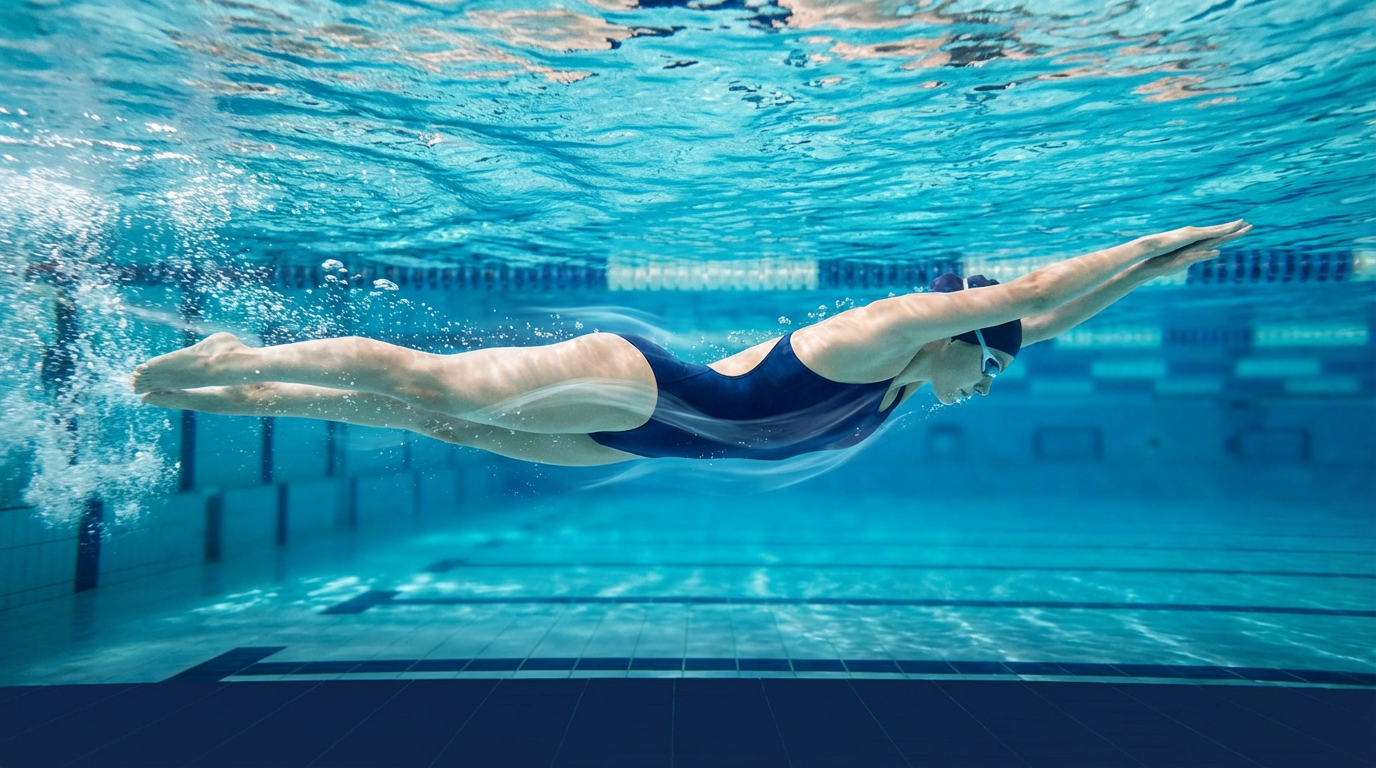
Streamline position is the body posture swimmers adopt to minimize water resistance and maximize glide efficiency. It involves extending your body into a long, narrow, hydrodynamic shape that cuts through water with minimal drag.
The classic streamline position includes arms stretched overhead with biceps pressed against ears, hands stacked one over the other, core engaged, legs together, and toes pointed. This configuration creates the smallest possible frontal surface area, allowing water to flow smoothly around your body rather than creating turbulent resistance.
You use streamline position at critical moments during every swim: off the starting blocks, during every turn push-off, and while underwater after breakouts. These moments represent opportunities to travel at your fastest speeds—if your streamline is tight. Elite swimmers maintain streamline discipline even during fatigue, understanding that these brief moments accumulate into significant time advantages.
The position appears simple, but achieving a truly efficient streamline requires specific body awareness, flexibility, shoulder mobility, and core strength that many swimmers—even competitive ones—haven't fully developed.
Streamline position doesn't generate propulsion like your stroke or kick does, which is precisely why it receives less attention than it deserves. Coaches and swimmers naturally gravitate toward techniques that actively push you forward, overlooking that reducing drag can be equally—or more—effective than increasing propulsion.
Consider this: water is approximately 800 times denser than air. Even small improvements in your body's hydrodynamic profile create exponential reductions in drag force. Research shows that proper streamline can reduce drag by up to 30% compared to a loose body position. That's equivalent to suddenly becoming 30% stronger without any additional training.
During push-offs and underwater phases, swimmers can achieve speeds of 2.5 to 3 meters per second—significantly faster than surface swimming speed. A tight streamline allows you to maintain this speed longer, covering more distance per push-off. Over the course of a 50-meter race with multiple turns, poor streamline can cost 1-2 seconds. In competitive swimming, races are regularly decided by hundredths of a second.
The technique is also universally applicable. Whether you're a SwimSafer student learning proper form or a national-level competitor chasing podium finishes, streamline position offers immediate, measurable improvements. Unlike stroke-specific techniques that require months to refine, streamline improvements can manifest within weeks of focused practice.
Understanding why streamline works requires a basic grasp of drag forces in water. Swimmers face two primary types of drag: form drag (resistance created by your body's shape) and wave drag (resistance from surface waves you create).
Form drag increases exponentially with frontal surface area. When your arms are extended overhead in streamline rather than at your sides, you reduce your frontal profile by approximately 20-25%. Your body becomes more cylindrical—the most hydrodynamically efficient shape for moving through fluid.
Additionally, streamline position promotes laminar flow—smooth water movement around your body. When your posture is tight and aligned, water particles travel in organized layers along your body's surface. Poor streamline creates turbulent flow, where water particles move chaotically, generating additional resistance and literally pulling you backward.
The underwater phase following push-offs provides the ideal environment to maximize streamline benefits. Traveling 30-50cm below the surface eliminates wave drag entirely while leveraging your push-off momentum. Combining this depth with perfect streamline creates the fastest sustainable speed in swimming—faster than Olympic champions can swim on the surface.
Your speed immediately after pushing off the wall is highest, then progressively decreases as drag overcomes your initial momentum. With excellent streamline, you maintain higher speeds longer, covering greater distances before needing to stroke. Research comparing elite versus recreational swimmers shows that technique, not just push-off power, determines glide distance. Elite swimmers with superior streamline can travel 30-40% farther on identical push-off force.
Achieving a competition-quality streamline requires attention to multiple body segments working in coordination. Here's the complete technique breakdown from head to toe:
1. Extend arms fully overhead – Reach your arms straight above your head with elbows locked. Your biceps should press firmly against your ears, creating a narrow profile. Many swimmers leave a gap between arms and head, which significantly increases drag.
2. Stack your hands properly – Place one hand directly over the other, fingers extended and together. The top hand's palm covers the back of the bottom hand. Squeeze your hands together as if trying to make them become one unit. Which hand goes on top is personal preference, though most swimmers place their dominant hand on top for better proprioception.
3. Lock your thumbs – Many elite swimmers hook the top hand's thumb around the bottom hand's palm for additional security. This prevents hands from separating during push-offs and maintains consistent positioning.
4. Position your head neutrally – Your head should align with your spine, looking directly at the pool bottom. Lifting your head even slightly creates drag and causes your hips to drop, destroying your body line. Think of your head as the front tip of an arrow—it sets the direction for everything behind it.
5. Press biceps against ears – This creates that critical narrow profile. Your arms should be squeezed so tightly against your head that you can barely hear pool sounds. If there's space between arms and ears, you're creating unnecessary drag.
6. Engage your core muscles – Draw your belly button toward your spine and engage your abdominal muscles as if bracing for impact. A rigid core maintains body alignment and prevents your hips from sagging. Core engagement is perhaps the most overlooked element of streamline among developing swimmers.
7. Squeeze your glutes – Activate your gluteal muscles to maintain hip position at the surface. This works synergistically with core engagement to create a straight body line from fingertips to toes.
8. Press legs together – Your legs should be completely together with inner thighs, knees, and ankles touching. Even a small gap between legs increases form drag. Imagine your legs are bound together.
9. Point your toes – Extend through your ankles and point your toes backward. This completes your body line and prevents your feet from acting as brakes. Flexible ankles that allow full extension create a more effective streamline.
When executed correctly, your entire body forms one straight, tight line from fingertips through toes. You should feel tension throughout your body—streamline is not a relaxed position. This muscular engagement creates the rigidity necessary to cut through water efficiently. Practice holding this position on deck first, checking alignment in a mirror, before attempting it in water.
Even swimmers who understand streamline theory often make execution errors that undermine their efficiency. Recognizing and correcting these mistakes can yield immediate speed improvements:
Arms too wide or separated from head – This is the most common error. When arms aren't pressed firmly against ears, frontal surface area increases dramatically. The gap acts like a parachute, creating drag and turbulent flow. During fatigue, swimmers unconsciously let arms drift wider, which is precisely when maintaining discipline matters most.
Hands not properly stacked – Crossed hands, side-by-side hands, or loosely overlapped hands all create more drag than properly stacked hands. The leading edge of your streamline must be as narrow as possible. Ensure complete hand-over-hand contact with fingers extended.
Head position too high or low – Looking forward lifts your head, increases drag, and drops your hips. Conversely, tucking your chin too much rounds your upper back and disrupts body alignment. Neutral head position—eyes looking straight down—is critical.
Arched or rounded back – Both excessive arching and rounding break your straight body line. Core disengagement often causes these postural faults. Your spine should maintain its natural curves while your body forms an overall straight line from shoulders to hips.
Hips too low – When hips sink below the surface, you create a V-shape that massively increases drag. This typically results from weak core engagement, poor head position, or insufficient glute activation. Your body should be horizontal, parallel to the pool bottom.
Legs separated or feet flexed – Any gap between legs or non-pointed feet adds drag. During underwater dolphin kicks, maintaining leg contact between kicks preserves streamline integrity. Flexed feet act as brakes, particularly problematic during glide phases.
Releasing streamline too early – Many swimmers break streamline position before necessary, eager to begin stroking. Research shows maintaining streamline until your speed drops below surface swimming speed maximizes distance per push-off. Be patient—let your glide work for you.
Inconsistent execution under fatigue – During late-race fatigue, streamline discipline often deteriorates first. Swimmers abbreviate push-offs, loosen arm position, or skip underwater phases entirely. Training streamline discipline specifically during fatigue sets helps maintain technique when it matters most.
Developing world-class streamline requires dedicated practice separate from regular swimming. Incorporate these drills into your training routine to build the muscle memory, awareness, and strength necessary for consistent execution:
Streamline Push-Offs with Distance Goals – Push off the wall in perfect streamline without kicking or stroking. Measure distance traveled before surfacing. Establish baseline distance, then progressively work to increase it through improved technique. Elite swimmers should achieve 10-12 meters; developing swimmers should target 7-9 meters initially. This drill builds awareness of how technique modifications affect glide distance.
Streamline Kick with Minimal Breathing – Hold streamline position while performing underwater dolphin or flutter kicks for 15-25 meters. Surface only when absolutely necessary for breath, then immediately return to streamline. This builds the endurance and comfort necessary for race-pace streamline execution while training underwater kicking efficiency.
10-Second Streamline Hold – Push off and hold perfect streamline position without kicking for 10 full seconds. Focus entirely on body tension, alignment, and positioning. This static drill develops the muscular endurance and body awareness required for consistent technique. Gradually increase hold duration as strength improves.
Streamline Flutter Kick on Side – Rotate to your side while maintaining streamline arm position and perform flutter kicks. Bottom arm presses against your bottom ear; top arm presses against top ear. This variation challenges core stability and highlights any asymmetries in your streamline. Practice both sides equally.
Vertical Streamline Kick – In deep water, assume streamline position vertically with hands pointing toward pool bottom. Perform vertical flutter or dolphin kicks while maintaining perfect hand, arm, and core positioning. This gravity-challenged variation builds the strength necessary for effortless horizontal streamline.
Wall Streamline Holds – Stand facing a wall with toes touching the base. Extend arms overhead in streamline position, pressing biceps against ears and hands stacked. Lean forward until hands contact the wall, supporting your body weight while maintaining position. Hold 30-60 seconds. This builds shoulder and core endurance specific to streamline positioning.
Overhead Shoulder Stretches – Limited shoulder flexibility often prevents optimal streamline position. Use doorway stretches, resistance bands, and PNF stretching techniques to improve shoulder extension range of motion. Adequate flexibility allows you to press arms against ears without compensation elsewhere in your body.
Plank Variations – Standard planks, side planks, and hollow body holds build the core strength essential for maintaining body alignment in streamline. Aim for 3-4 sets of 45-60 second holds. Strong core muscles prevent hip sagging and maintain the rigid body line necessary for minimal drag.
Streamline Squats – Perform bodyweight squats while maintaining streamline arm position overhead throughout the movement. This challenges shoulder stability and core engagement while building leg strength. Complete 3 sets of 15-20 repetitions.
Here's a focused streamline training set used with competitive swimmers at SPEEDISWIM:
This progression moves from isolated streamline work to integrated stroke swimming while maintaining technical focus. Track improvements in glide distance and underwater speed over training cycles.
In competitive swimming, where races are decided by fingertip touches and hundredths of seconds separate podium positions from consolation finals, streamline mastery provides measurable competitive advantages that compound throughout a race.
Consider a 100-meter freestyle race with three turns. If superior streamline gains just 0.3 seconds per turn through improved push-off distance and underwater efficiency, that's nearly a full second advantage—enough to move up multiple places in most competitive heats. Over a 200-meter event with seven turns, the advantage multiplies to over 2 seconds. These aren't theoretical numbers; they're reality for swimmers who prioritize streamline discipline.
For sprint events like the 50-meter freestyle, where total race times fall under 25 seconds for elite swimmers, the push-off and breakout phase represents 15-20% of the total race. Streamline efficiency directly determines whether you exit this phase ahead or behind competitors. Many 50-meter races are won or lost in the first 15 meters.
Observe any Olympic final and you'll notice elite swimmers maintain impeccable streamline discipline even during the closing meters when fatigue peaks. Athletes like competitive swimmers who train with national-level programs understand that technical breakdown costs races. They've ingrained streamline through thousands of repetitions until perfect execution becomes automatic.
Video analysis of national team swimmers at SPEEDISWIM consistently shows correlation between streamline quality and competitive performance. Athletes who maintain tight, consistent streamline positions across all training and competition situations invariably post faster times than equally fit swimmers with looser technique. The difference isn't fitness—it's hydrodynamic efficiency.
While competitive swimming provides the clearest performance metrics, streamline principles apply across aquatic sports. Water polo players benefit from efficient underwater propulsion during transitions. Artistic swimmers utilize streamline positions during underwater sequences and transitions. Even recreational swimmers in SwimSafer programs develop better body awareness and water confidence through streamline practice.
At SPEEDISWIM's various training locations across Singapore, from international schools to country clubs, streamline fundamentals form part of every level of instruction. Students learn early that swimming faster isn't just about moving more—it's about moving smarter.
Beyond physical advantages, streamline mastery provides psychological benefits. The discipline required to maintain perfect technique under fatigue builds mental toughness. Swimmers who trust their streamline approach walls with confidence, knowing they'll exit efficiently. This confidence translates to better overall race execution and reduced anxiety about technical elements.
For developing swimmers, early streamline success creates positive reinforcement. When young athletes experience the sensation of effortless glide and realize they're traveling faster with less effort, it fundamentally changes their understanding of swimming efficiency. This breakthrough moment often catalyzes broader technical improvements.
Streamline position stands as swimming's most underrated technique precisely because its benefits are hidden beneath the surface—both literally and figuratively. While it doesn't look as impressive as a powerful stroke or generate the obvious propulsion of a strong kick, streamline quietly determines whether you maximize or squander the speed you've worked so hard to develop.
The physics are undeniable: reducing drag provides equivalent benefits to increasing power, but requires far less energy expenditure. A tight streamline can reduce resistance by 30%, translating to measurable time improvements in every race and efficiency gains in every training session. For competitive swimmers, these fractions of seconds accumulate into podium positions. For recreational swimmers, improved streamline means easier, more enjoyable swimming.
Mastering streamline demands attention to specific details—from hand stacking and arm positioning to core engagement and head alignment. It requires shoulder flexibility, core strength, and muscular endurance developed through dedicated drills both in and out of the water. Most importantly, it demands discipline to maintain perfect technique when fatigue tempts you to compromise form.
At SPEEDISWIM, we've spent over two decades refining how we teach streamline principles to swimmers of all levels—from SwimSafer students taking their first strokes to national team athletes competing at the highest levels. The technique is universal, the benefits are immediate, and the competitive advantages are substantial. Yet it remains consistently overlooked in favor of more visible techniques.
If you're serious about swimming faster, dedicate focused training time to streamline mastery. Record baseline measurements, practice the drills outlined in this guide, and ruthlessly maintain technical standards even when tired. Your times will improve—not because you got stronger or developed more endurance, but because you learned to work with the water rather than against it.
The most underrated technique in swimming isn't complicated or exclusive to elite athletes. It's available to anyone willing to prioritize it, practice it deliberately, and execute it consistently. Your next breakthrough might not come from swimming harder—it might come from gliding smarter.
Join SPEEDISWIM and train with professionally qualified coaches who have developed over 50 National Youth and National Team swimmers. Whether you're starting your swimming journey or competing at elite levels, our structured programs deliver results.
Programs available across multiple venues in Singapore | SwimSafer 2.0 certified | 25+ years of excellence