Backstroke is often considered the most relaxing of the four competitive swimming strokes, yet mastering its technique requires precision, coordination, and proper instruction. As one of the fundamental strokes taught in programs like SwimSafer 2.0, backstroke serves as both an essential water safety skill and a competitive discipline that has propelled countless swimmers to excellence.
At SPEEDISWIM, we've spent over two decades refining our teaching methodology for backstroke technique, helping more than 25,000 students develop proficient skills in this elegant stroke. Whether you're a parent seeking quality swimming instruction for your child, an athlete aiming to improve competitive performance, or an adult learner looking to expand your swimming repertoire, understanding proper backstroke mechanics is fundamental to your aquatic development.
This comprehensive guide draws on SPEEDISWIM's extensive coaching experience to break down every element of backstroke swimming. You'll discover the biomechanics behind efficient backstroke technique, learn how to identify and correct common errors, and gain access to proven drills that our coaches use to develop both recreational swimmers and elite athletes. By the end of this guide, you'll have a complete understanding of how to swim backstroke with confidence, efficiency, and proper form.
Backstroke, also known as back crawl, is the only competitive swimming stroke performed on your back. Unlike freestyle, breaststroke, and butterfly where swimmers face the pool bottom, backstroke requires you to navigate while looking upward, making spatial awareness and body positioning uniquely important. This stroke is typically the second stroke taught in structured swimming programs after freestyle, as it shares similar alternating arm movements and flutter kick mechanics.
The stroke involves continuous alternating arm movements in a windmill-like pattern, combined with a flutter kick similar to freestyle but inverted. What distinguishes backstroke from other strokes is the supine body position (face-up), which offers natural breathing advantages since your face remains above water throughout the stroke cycle. This characteristic makes backstroke an excellent stroke for building endurance and confidence, particularly for swimmers still developing breath control skills.
In competitive swimming, backstroke is swum as an individual event at distances of 50m, 100m, and 200m, and it comprises the first leg of medley relay events and individual medley races. For recreational swimmers and those progressing through SwimSafer certifications, backstroke represents an important milestone in becoming a well-rounded, water-safe swimmer capable of efficient movement in multiple positions.
Developing proper backstroke technique offers numerous advantages that extend beyond simply adding another stroke to your swimming skill set. From a water safety perspective, backstroke provides an alternative swimming method that can be less physically demanding than freestyle, allowing swimmers to cover distance while maintaining easy breathing access. This makes it an invaluable survival skill, particularly when fatigue sets in during extended periods in the water.
Physiologically, backstroke offers unique benefits for posture and shoulder health. The stroke naturally encourages shoulder external rotation and scapular retraction, counteracting the forward-rounded shoulder position that many people develop from desk work and daily activities. Swimming backstroke regularly can help improve posture, strengthen the posterior shoulder muscles, and create better muscular balance across the shoulder girdle. These benefits make backstroke particularly valuable for adult learners and fitness swimmers.
For competitive swimmers training with programs like SPEEDISWIM's competitive swimming program, backstroke proficiency is essential for individual medley events and provides strategic racing options. The stroke also develops crucial skills like body awareness and streamlining that transfer positively to other swimming strokes. Additionally, backstroke training helps build a strong, stable core as swimmers must maintain horizontal body position without visual reference to the pool bottom.
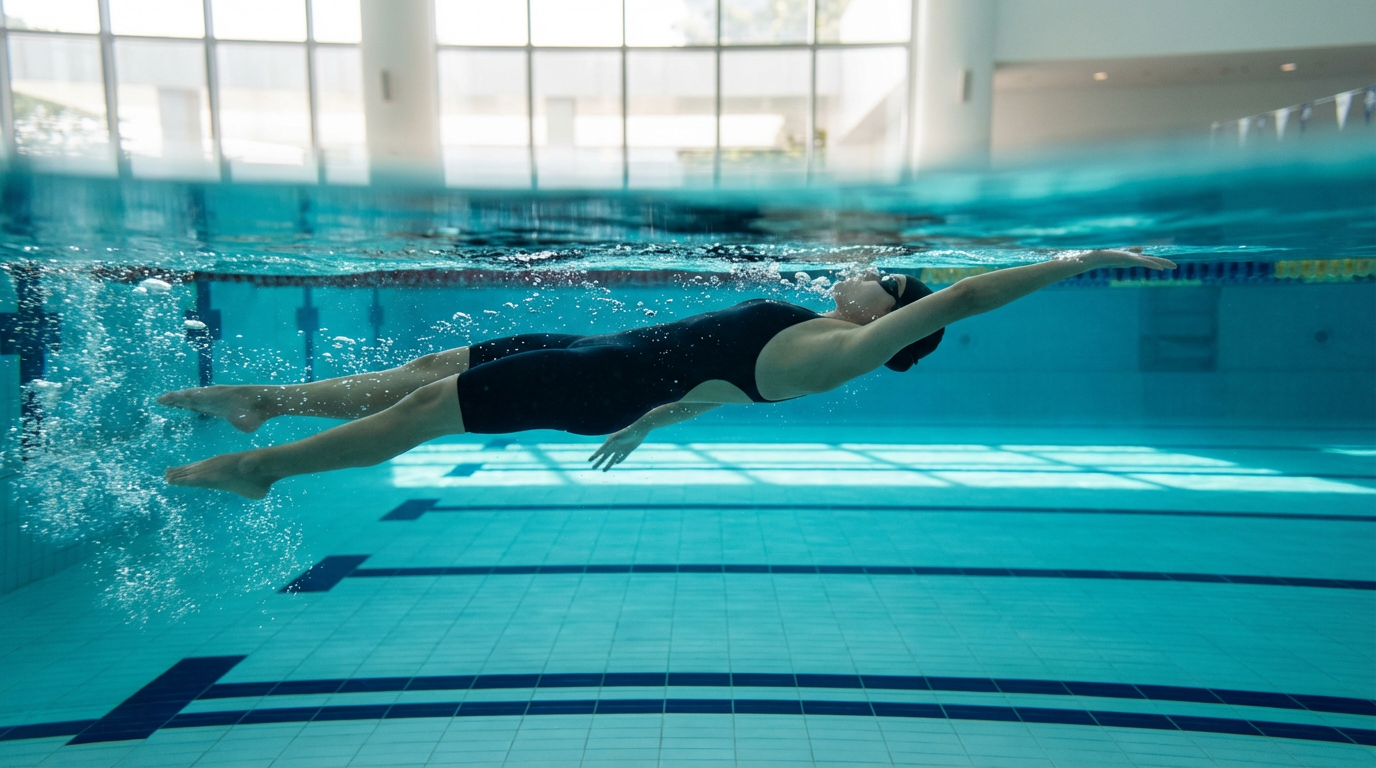
The foundation of efficient backstroke technique begins with optimal body position in the water. Your body should maintain a horizontal position as close to the water surface as possible, with your hips elevated and your head in a neutral position. A common error among developing swimmers is allowing the hips to drop, which creates excessive drag and requires more energy to maintain forward momentum. Proper body position reduces resistance and allows your propulsive movements to translate directly into forward motion.
Your head position critically influences your overall body alignment. The water line should typically run across the middle of your head, approximately from ear to ear, with your eyes looking slightly upward and backward rather than straight up. Tilting your chin too far toward your chest causes your hips to drop, while lifting your chin too high creates a "sitting" position in the water. Think of your head as resting comfortably on a water pillow, with your neck relaxed and your gaze directed at a point on the ceiling or sky behind you.
Body rotation is another essential element of proper backstroke position. Unlike swimming completely flat on your back, efficient backstroke involves rotating along your longitudinal axis (the imaginary line running from your head to your toes) approximately 30-40 degrees to each side. This rotation allows for a more powerful arm pull, reduces shoulder strain, and helps maintain streamlined body position. The rotation should be smooth and rhythmic, driven by your core muscles rather than excessive shoulder movement, with your head remaining relatively stable as your body rolls beneath it.
The backstroke arm movement is a continuous, alternating pattern often described as a windmill motion. While one arm pulls underwater to generate propulsion, the opposite arm recovers over the water, creating the characteristic rhythm of backstroke swimming. Mastering each phase of this arm cycle is essential for developing an efficient, powerful backstroke that minimizes energy expenditure while maximizing speed.
The arm entry occurs when your recovering arm reaches full extension above your shoulder and enters the water. Your hand should enter the water pinky finger first, with your arm straight and positioned directly in line with your shoulder (not crossing the centerline of your body). The entry should be clean and relatively splashless, with your hand slicing into the water at approximately a 45-degree angle. Entering too flat causes splash and disrupts your streamline, while entering too vertically reduces your ability to establish an effective catch.
Once your hand enters the water, the catch phase begins. This involves pitching your hand and forearm downward to "catch" the water, positioning yourself to pull against solid water rather than slipping through it. Your elbow should bend slightly as your hand sweeps downward and outward, creating a high-elbow position underwater similar to freestyle technique. The catch is complete when you feel pressure against your palm and forearm, indicating you're positioned to begin the propulsive phase of the stroke. Developing an effective catch requires proprioceptive awareness that comes with practice and proper coaching feedback.
The pull phase is where you generate the majority of your propulsion in backstroke. From the catch position, pull your hand downward and toward your hip in a slightly curved path, maintaining the high-elbow position established during the catch. Your hand should accelerate throughout the pull, moving faster as it approaches your hip. Think of pulling your body past your anchored hand rather than simply moving your hand through the water. This mental model encourages proper engagement of your larger back and core muscles rather than relying solely on arm strength.
As your hand passes your shoulder and continues toward your hip, you transition into the push phase (also called the finish). This involves pressing the water toward your feet with your palm facing downward and backward. Your elbow straightens progressively during this phase, and your hand should finish the underwater stroke close to your thigh with your palm facing downward. The push phase is often neglected by developing swimmers who release the water too early, but completing this phase fully contributes significantly to stroke efficiency and forward propulsion. The entire underwater pull should follow an S-curve pattern when viewed from above: out-in-out.
The recovery begins as your hand exits the water near your thigh and continues until your hand re-enters the water above your shoulder. Your arm should remain straight (or nearly straight) throughout the recovery, moving in a vertical plane directly over your shoulder. The recovery should be relaxed, allowing the muscles that just completed the underwater pull to rest briefly before the next stroke cycle. Your hand can travel either with the thumb leading upward or with the palm facing outward; both techniques are acceptable, though most coaches prefer the thumb-up position for better shoulder mechanics.
During the recovery, your arm should move steadily and smoothly without rushing or pausing. A common mistake is allowing the recovering arm to cross over the centerline of the body, which causes your body to snake through the water and disrupts efficient forward motion. Keep your recovery arm traveling in line with your shoulder throughout its path. The timing of your recovery relative to your opposite arm's pull is crucial: as one arm finishes its underwater push, the other should be entering the water, creating a continuous propulsive rhythm with no dead spots where neither arm is generating forward motion.
The backstroke kick is essentially an inverted freestyle flutter kick, providing propulsion and helping maintain proper body position and rotation. Your kick originates from the hips rather than the knees, with your legs moving in an alternating up-and-down motion. The upward phase of the kick (toward the surface) is the propulsive phase, where your foot pushes water toward your head, contributing to forward motion. Your legs should remain relatively straight but not rigidly locked, with a slight bend at the knee during the downward phase that straightens during the upward, propulsive kick.
Proper ankle flexibility is essential for an effective backstroke kick. Your feet should be pointed (plantarflexed) throughout the kick cycle, with your toes breaking the surface during the upward phase without causing excessive splash. The kick should be compact, typically with about 12-18 inches of vertical movement between your highest and lowest foot positions. Kicking too deeply creates drag and disrupts body position, while kicking too shallowly reduces propulsion and can cause your hips to drop.
The kick tempo in backstroke is typically six beats per stroke cycle (three kicks per arm stroke), though some distance swimmers use a two-beat or four-beat kick to conserve energy. Regardless of tempo, your kick should be continuous and rhythmic, integrating smoothly with your arm movements and body rotation. The kick not only provides propulsion but also helps stabilize your body position and facilitates the hip-driven rotation essential for efficient backstroke technique. During training sessions at SPEEDISWIM, coaches emphasize kick development through specific drills and isolated kick sets, recognizing that a strong, efficient kick differentiates competent backstrokers from truly proficient ones.
One of backstroke's most significant advantages is the simplified breathing pattern compared to other competitive strokes. Since your face remains above water throughout the stroke cycle, you can breathe freely at any point without the precise timing requirements of freestyle or butterfly. However, establishing a consistent breathing rhythm still contributes to stroke efficiency and relaxation. Most swimmers develop a pattern of breathing in coordination with their arm strokes, such as inhaling during one arm recovery and exhaling during the opposite arm recovery.
Despite the breathing ease, swimmers must still avoid common breathing-related errors. Holding your breath creates unnecessary tension and reduces oxygen delivery to working muscles, while gasping or irregular breathing patterns can disrupt stroke rhythm and body position. A relaxed, rhythmic breathing pattern helps maintain consistent stroke tempo and promotes the relaxation necessary for efficient swimming. Some swimmers prefer breathing every stroke cycle, while others breathe every one-and-a-half cycles; the key is finding a pattern that feels natural and sustainable.
The overall timing and coordination of backstroke brings together body rotation, arm movements, and kick into a synchronized whole. As your right arm pulls underwater, your body rotates toward the right, and your left arm recovers over the water. Your kick continues steadily throughout, with subtle emphasis coordinated with your body rotation. This coordination develops gradually through practice and repetition. In SwimSafer progression and competitive training programs, coaches use specific drills to develop this timing, often starting with isolated movements before gradually combining elements into the complete stroke pattern.
Even experienced swimmers occasionally develop technique flaws that reduce backstroke efficiency. One of the most prevalent errors is insufficient body rotation. Swimming too flat on your back limits your pulling power and can lead to shoulder impingement over time. The solution involves consciously initiating rotation from your hips and core rather than your shoulders, thinking about rolling your body from hip to hip rather than merely moving your shoulders. Rotation drills, such as 6-kick switch drills where you pause in the rotated position, help develop awareness and muscle memory for proper rotation.
Another frequent mistake is crossing over the centerline during arm entry or recovery. When your hand enters the water outside its shoulder line or crosses toward the opposite side of your body, you create a snaking motion that wastes energy and disrupts streamlined body position. To correct this, focus on entering your hand directly above your shoulder, as if your body were lying between two parallel lines that your hands must not cross. Some swimmers benefit from visual cues, such as imagining railroad tracks with each arm moving along its respective track.
Dropped hips represent perhaps the most common body position error, creating significant drag and requiring excessive energy to maintain forward motion. This problem often stems from incorrect head position (chin tucked too far toward chest), insufficient kick, or poor core engagement. The correction involves multiple elements: ensuring your head rests in a neutral position with water at ear level, maintaining a steady, propulsive kick, and engaging your core muscles to keep your body in a straight, horizontal line. Streamline kick sets and body position drills help develop the awareness and strength needed to maintain proper hip elevation.
Many developing swimmers also demonstrate incomplete arm strokes, releasing the water too early in the pull and missing the valuable propulsion from the push phase. This typically results from fatigue or simply not understanding the full stroke pattern. The fix involves focusing on extending each underwater pull all the way to your thigh before beginning the recovery, emphasizing acceleration through the finish of each stroke. Catch-up drills and single-arm backstroke drills help swimmers feel and practice the complete pull pattern.
Deliberate practice through targeted drills accelerates backstroke development more effectively than simply swimming repetitive lengths. At SPEEDISWIM, our certified coaches incorporate specific drills into training sessions to address technique elements and build muscle memory for efficient movement patterns. These drills benefit swimmers at all levels, from SwimSafer participants developing foundational skills to competitive athletes refining technique for racing.
Single-arm backstroke isolates each arm's stroke pattern, allowing you to focus on the complete pull from entry through finish without the distraction of coordinating both arms. Swim backstroke using only your right arm while your left arm remains at your side (or extended overhead), then switch after 25 meters. This drill develops awareness of your pull pattern, helps identify asymmetries between your arms, and allows you to practice complete stroke extension. Focus on maintaining body rotation and steady kick even while using only one arm.
Double-arm backstroke involves pulling with both arms simultaneously rather than alternating. This drill emphasizes the pulling pattern and helps develop power and proper hand pitch. It also challenges your core stability since you lose the balancing effect of alternating arm movements. Perform this drill with a strong, continuous kick to maintain body position, and focus on pulling both hands along the same path simultaneously from entry through finish.
6-3-6 drill develops body rotation awareness and timing. Kick six times on your right side with your right arm extended overhead and left arm at your side, then take three complete stroke cycles of regular backstroke, then kick six times on your left side. During the side-kicking phases, maintain a stable rotated position with your shoulder and hip clearly out of the water. This drill builds the proprioceptive awareness of proper rotation angles while strengthening the core muscles needed to maintain rotated positions.
Streamline kick on back might seem basic, but it's fundamental for developing the body position and kick strength that support efficient backstroke. Push off the wall in a tight streamline position on your back and kick steadily, focusing on maintaining horizontal body position with hips at the surface. This drill develops kick strength, reinforces proper head position, and builds the core stability needed for excellent backstroke swimming. SPEEDISWIM coaches often use this drill as both a warmup element and a specific training set to build foundational skills.
For swimmers advancing to competitive backstroke through programs like SPEEDISWIM's competitive swimming track, mastering race-specific skills becomes essential. The backstroke start is unique among competitive strokes because it begins in the water rather than on the blocks. Swimmers position themselves facing the wall, gripping the starting grips (or gutter) with both hands, and placing their feet on the wall below the surface. When the starting signal sounds, swimmers pull themselves toward the wall, arch backwards over the water, and drive off the wall with their legs while throwing their arms backward in a circular motion.
The trajectory and underwater phase following the start significantly impact race performance. After entering the water, swimmers maintain a tight streamline position while performing underwater dolphin kicks (legal in backstroke since rule changes in the early 1990s). Swimmers may perform underwater kicks up to 15 meters from the wall before breaking the surface, making this phase a crucial component of competitive backstroke. Developing powerful underwater kicking and knowing when to optimally break out to begin stroking represents advanced technical skill that separates recreational backstrokers from competitive athletes.
Backstroke turns require specific technique since swimmers cannot see the wall approaching. Competitive pools feature backstroke flags suspended 5 meters from each wall, providing a visual reference point for counting strokes to the wall. The turn itself is typically a flip turn similar to freestyle: as you approach the wall, take your final stroke, rotate onto your stomach, perform a forward somersault, plant your feet on the wall, and push off on your back in a streamlined position. The transition from backstroke to stomach must begin with an arm pull or simultaneous double-arm pull; simply rotating to your stomach before initiating the turn would constitute a stroke violation.
Competitive swimmers must also master distance judging and stroke counting to execute turns smoothly without gliding into the wall or coming up short. This skill develops through repetition and practice, typically requiring months of training to become consistent. SPEEDISWIM's competitive program emphasizes these race-specific skills alongside stroke technique, recognizing that technical proficiency in starts and turns often determines race outcomes, particularly in sprint events where every tenth of a second matters.
Mastering backstroke technique opens new dimensions in your swimming development, whether you're working toward SwimSafer certification, pursuing competitive excellence, or simply expanding your aquatic capabilities. The stroke's unique combination of continuous breathing access, full-body engagement, and technical precision makes it both accessible for beginners and endlessly refinable for advanced swimmers. By focusing on the fundamental elements covered in this guide—proper body position, efficient arm mechanics, propulsive kick technique, and coordinated timing—you can develop a backstroke that is both effective and enjoyable.
Remember that swimming technique develops progressively through consistent practice and quality instruction. The drills and corrections outlined here provide a roadmap for improvement, but personalized coaching feedback accelerates development significantly. Small adjustments to head position, rotation timing, or pull pattern can create dramatic improvements in efficiency and speed, which is why swimmers at all levels benefit from professional instruction and video analysis.
At SPEEDISWIM, we've witnessed countless swimmers transform their backstroke through dedicated practice and expert coaching. Our two decades of experience developing swimmers from foundational water safety skills through elite competitive performance has refined our teaching methodology to address each swimmer's unique needs and goals. Whether you're just beginning your swimming journey or seeking to refine technique for competitive advantage, proper backstroke instruction provides benefits that extend far beyond the pool—improving posture, building confidence, and developing the complete swimmer profile that defines aquatic competence.
Join SPEEDISWIM's professionally coached programs and experience the difference that expert instruction makes. With over 25,000 students trained since 1998 and a proven track record of developing both recreational swimmers and elite athletes, we provide the structured guidance you need to excel in backstroke and all aquatic disciplines.
Our qualified coaches deliver personalized instruction across SwimSafer programs, competitive swimming training, and specialized aquatic sports at multiple venues including international schools and country clubs throughout Singapore.