Freestyle swimming stands as the fastest, most efficient stroke in competitive swimming, yet mastering its fluid mechanics challenges swimmers at every level. Whether you're taking your first strokes in a learn-to-swim program or refining technique for competition, understanding the biomechanical principles behind efficient freestyle separates struggling swimmers from confident, powerful ones.
At SPEEDISWIM, our professionally qualified coaches have spent over two decades developing systematic approaches to freestyle instruction, training more than 25,000 students from complete beginners through to National Team athletes. This progressive methodology, aligned with SwimSafer 2.0 standards and refined through competitive swimming programs, breaks down freestyle technique into manageable components that build upon each other naturally.
This comprehensive guide presents freestyle swimming as our coaches teach it: starting with fundamental body position and progressing through each technical element with the clarity and structure that has produced over 1,000 athletes across Singapore's aquatic disciplines. You'll discover not just what to do, but why each element matters, how components integrate, and which specific adjustments create breakthrough improvements in efficiency and speed.
Freestyle swimming, technically known as front crawl, earned its designation as the fastest swimming stroke through biomechanical efficiency. The alternating arm motion generates continuous propulsion while the streamlined body position minimizes resistance. This combination explains why freestyle dominates distance swimming, triathlon events, and forms the cornerstone of comprehensive swimming education programs.
The stroke's efficiency stems from three integrated systems working in harmony: the propulsive arm cycle, the stabilizing leg kick, and the rotational breathing pattern. Each system serves distinct purposes while supporting the others. New swimmers often struggle because they attempt to master all three simultaneously rather than building competency progressively. Professional coaching methodology recognizes this challenge and structures learning to develop each component systematically before integration.
Understanding freestyle technique requires recognizing that swimming fundamentally differs from land-based movement. Water's density creates both opportunity and challenge. Swimmers must generate propulsion while minimizing drag, balance power with efficiency, and maintain rhythmic breathing without disrupting body position. These unique demands explain why proper technique instruction proves far more valuable than simply logging pool time with flawed mechanics.
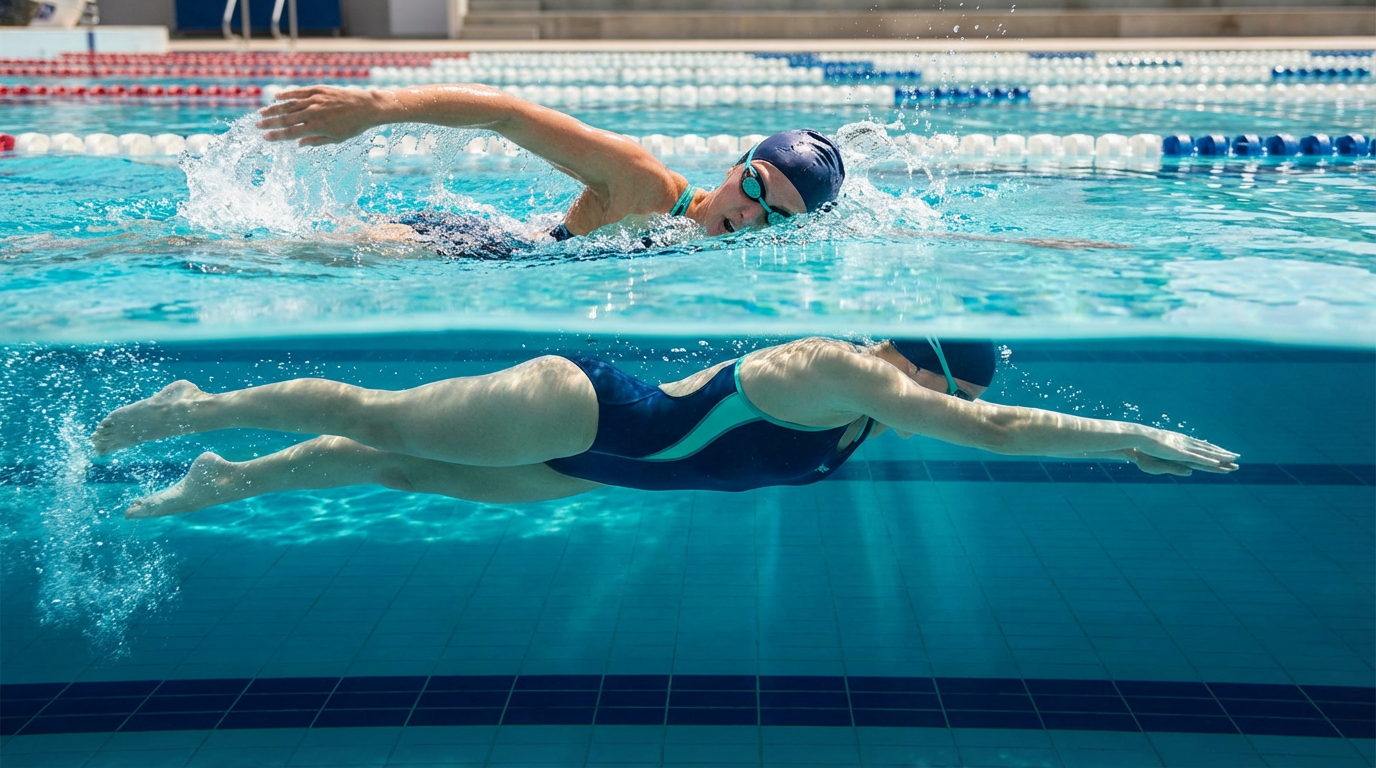
Body position establishes the foundation upon which all other freestyle techniques build. Swimmers with poor body alignment fight constant resistance, exhausting themselves regardless of arm strength or kick power. Conversely, excellent body position allows swimmers to glide efficiently, conserving energy while maintaining speed. This fundamental principle guides the initial stages of our SwimSafer Program, where establishing proper horizontal alignment precedes more complex skill development.
The head position governs entire body alignment in freestyle swimming. When swimmers lift their heads to look forward, their hips and legs inevitably drop, creating drag similar to deploying a parachute. The correct position places the waterline at the swimmer's natural hairline, with eyes directed downward at approximately 45 degrees toward the pool bottom. This neutral head position allows the spine to maintain its natural alignment, keeping the body horizontal and streamlined.
Core engagement plays an equally critical role in maintaining position. Rather than allowing the body to sag in the middle, swimmers must activate their core muscles to create a stable platform. This engagement doesn't require excessive tension but rather a consistent, moderate activation that maintains body alignment throughout the stroke cycle. Think of the torso as a central axis around which the arms and legs operate, remaining stable rather than bending or twisting excessively.
Efficient freestyle incorporates controlled body rotation along the longitudinal axis. Rather than swimming flat, the body rotates approximately 30-45 degrees to each side with every stroke. This rotation serves multiple purposes: it allows deeper, more powerful arm strokes, facilitates natural breathing mechanics, and engages the larger core and back muscles rather than relying solely on shoulder strength. New swimmers often resist this rotation, swimming flat and consequently limiting their potential power and efficiency.
The rotation originates from the core, not the shoulders or head. As one arm extends forward during the recovery phase, the body rotates toward that side naturally. The opposite arm completes its underwater pull, driving the rotation. This coordinated movement creates the characteristic rolling motion of efficient freestyle. Swimmers who master this rotation discover they can swim longer distances with less fatigue because they're recruiting larger, more sustainable muscle groups.
The freestyle arm stroke generates approximately 85-90% of forward propulsion, making arm technique the primary determinant of swimming speed and efficiency. The stroke cycle divides into distinct phases, each requiring specific technical execution for optimal performance. Understanding these phases allows swimmers to identify and correct technique flaws systematically.
The arm cycle begins when the recovering hand enters the water. Proper entry occurs between the head and shoulder line, with the hand angled slightly downward and outward, fingertips entering first. Many swimmers make the critical error of entering their hand directly in front of their head or crossing the centerline, which creates lateral movement and wastes energy. The hand should enter in line with the shoulder, slicing cleanly into the water with minimal splash.
Following entry, the arm extends forward underwater, reaching for maximum distance. This extension phase, often called the glide or stretch, maximizes the stroke's length and efficiency. During extension, the arm remains relatively straight but not locked, with the hand positioned slightly deeper than the elbow. This forward reach occurs while the opposite arm completes its power phase, creating the characteristic alternating pattern that maintains continuous propulsion.
The catch represents the moment when the swimmer transitions from reaching forward to pulling backward. This crucial instant determines how effectively the arm generates propulsion. A proper catch involves bending the elbow to approximately 90-120 degrees while keeping the elbow higher than the hand. The hand and forearm together create a paddle surface that presses backward against the water. Swimmers sometimes describe the sensation as reaching over a barrel or grasping a large ball.
During the pull phase, the hand accelerates backward along a path that sweeps slightly outward, then inward, then outward again toward the hip. This S-curve pattern, though subtle, allows the swimmer to find and press against still water rather than simply pulling through turbulence created by body movement. The pull concludes with the hand exiting near the hip, having traveled the full stroke length. Throughout this phase, maintaining the high elbow position proves essential for maximizing propulsive force.
After the hand exits the water near the hip, it must return to the front to begin another cycle. This recovery phase, while not directly propulsive, significantly impacts overall efficiency. The recovery should follow a relaxed, high-elbow path with the hand swinging forward close to the body's side. The elbow leads this forward swing, remaining higher than the hand until the arm extends forward for entry.
A relaxed recovery conserves energy and allows shoulder muscles to recover partially before the next power phase. Swimmers who maintain tension during recovery, lifting the entire arm high or swinging wide, waste energy and often develop shoulder problems over time. The recovery represents a moment of relative rest within the continuous stroke cycle, and treating it as such contributes to sustainable, efficient swimming.
While the flutter kick contributes less to forward propulsion than arm strokes, particularly for distance swimming, it serves critical functions in maintaining body position, balance, and timing. Competitive sprinters rely heavily on powerful kicking for maximum speed, while distance swimmers often use a more moderate kick primarily for balance and body position maintenance. Both approaches require proper kick mechanics.
The flutter kick originates from the hip, not the knee. This fundamental principle distinguishes efficient kicking from the bicycle-pedaling motion many beginners demonstrate. The leg moves as a relatively unified segment, with the knee bending slightly during the downward kick phase as a natural consequence of water pressure rather than through deliberate bending. The ankle remains relaxed and flexible, allowing the foot to extend into a streamlined position that contributes to propulsion.
Proper kick depth keeps both legs within the body's profile, neither breaking the surface excessively nor dropping too deep. The feet should remain just below the surface, with the heels occasionally just breaking the surface at the top of the kick. Kicks that extend too deep create unnecessary drag, while kicks that break the surface with excessive splashing indicate poor mechanics. The kick width typically spans approximately 30-40 centimeters from the highest to lowest point.
Most freestyle swimmers employ either a six-beat kick (six kicks per arm cycle) or a two-beat kick (two kicks per arm cycle), with variations existing between these patterns. Six-beat kicks provide maximum propulsion and body rotation support, making them standard for sprint swimming and competitive strokes. Two-beat kicks conserve energy for distance swimming while still providing essential balance and timing support.
The kick timing coordinates with arm strokes and body rotation to create integrated, efficient movement. As one arm pulls and the body rotates toward that side, the opposite leg kicks downward, supporting the rotation and maintaining balance. This coordination develops naturally for most swimmers once they establish proper body rotation, though it requires conscious attention during initial learning stages. The integration of kick, pull, and rotation creates the fluid, powerful freestyle technique that characterizes efficient swimming.
Breathing technique often determines whether swimmers progress from struggling beginners to confident, efficient freestyle swimmers. Poor breathing mechanics disrupt body position, interrupt stroke rhythm, and create excessive fatigue. Conversely, proper breathing integrates seamlessly with stroke mechanics, maintaining streamlined position while ensuring adequate oxygen intake. This critical skill receives substantial attention in progressive swimming instruction, including structured programs like SwimSafer 2.0, where breath control development occurs systematically across proficiency stages.
Efficient freestyle breathing occurs through body rotation rather than head lifting. As the body rotates during the stroke cycle, the head rotates with it, maintaining alignment with the spine. The swimmer's face remains in the water looking downward until rotation brings the mouth to the surface naturally. At this point, one eye remains in the water while the other looks toward the sky. The swimmer breathes into the trough created by the bow wave, which provides an air pocket even in choppy conditions.
The breathing motion coordinates precisely with arm movements. Most swimmers breathe as the arm on the breathing side recovers forward, which corresponds to maximum body rotation toward that side. The head begins rotating back to center position as the breathing-side hand enters the water, with the face returning to the downward-looking position before the arm begins its pull phase. This timing ensures breathing doesn't interrupt propulsion or disrupt streamlined position.
Beginning swimmers typically breathe every stroke cycle (every two arm strokes), always to the same side. While this pattern allows frequent breathing, it creates asymmetrical stroke development and limits race strategy options. Breathing every three strokes (bilateral breathing) develops symmetrical technique, allows swimmers to sight on both sides during open water swimming, and typically produces more balanced muscle development.
More experienced swimmers often vary breathing patterns based on training goals and race strategy. Sprint swimmers might breathe every four or five strokes to minimize disruption, while distance swimmers might breathe every two strokes to maximize oxygen intake. The ability to control and vary breathing patterns represents an advanced skill that develops through consistent practice across various training intensities. Through our Competitive Swimming programs, athletes learn to manipulate breathing strategy as a performance tool rather than viewing it as a fixed pattern.
Efficient freestyle emerges when body position, arm strokes, leg kicks, and breathing coordinate into fluid, rhythmic movement. This integration distinguishes swimmers who move efficiently through water from those who fight it. Timing development requires patience and practice, as the neuromuscular system gradually learns complex coordination patterns that eventually become automatic.
Every swimmer has an optimal stroke rate that balances distance per stroke with stroke frequency. Attempting to stroke too quickly often shortens the stroke, reducing efficiency despite higher turnover. Conversely, overly slow strokes with excessive glide can allow momentum to dissipate between strokes. Finding the personal sweet spot requires experimentation and often benefits from coach observation and feedback.
Consistent rhythm throughout the stroke cycle contributes significantly to efficiency and endurance. Rather than pulling hard with one arm then resting, or rushing through certain stroke phases while lingering in others, maintaining steady tempo creates smoother, more sustainable swimming. Many swimmers benefit from using tempo trainers or counting stroke cycles to develop and maintain consistent rhythm during training sessions.
Developing coordination often benefits from temporarily exaggerating certain timing elements. The catch-up drill, where one hand waits at full extension until the opposite hand completes its entire stroke cycle and catches up, emphasizes stroke length and proper extension. While not representing ideal freestyle timing, this drill builds awareness of full stroke length and allows swimmers to focus on one arm's mechanics before beginning the next stroke.
Progressively reducing the delay between strokes helps swimmers transition from catch-up timing toward continuous freestyle. This progression moves through swimming with a slight overlap of strokes, then simultaneous opposition (one arm pulling while the other recovers), and finally the flowing, continuous rhythm where extension, pull, and recovery phases integrate seamlessly across both arms. This systematic progression mirrors the coaching methodology that has helped SPEEDISWIM develop over 1,000 athletes across multiple aquatic disciplines.
Identifying and correcting common technical errors accelerates freestyle development more effectively than simply increasing practice volume. Most swimmers develop compensatory patterns that feel natural but limit efficiency. Recognizing these patterns allows targeted correction that produces dramatic improvements.
The Mistake: Lifting the head to look forward during swimming represents perhaps the most common and problematic error. This seemingly minor adjustment drops the hips and legs, dramatically increasing drag and making the swimmer work exponentially harder for the same speed.
The Correction: Focus on looking directly at the pool bottom during swimming, adjusting head position so the waterline sits at the natural hairline. Many swimmers benefit from the mental cue of swimming downhill, imagining pressing the chest slightly downward, which naturally elevates the hips into proper alignment. For pool swimming, following the black line on the bottom provides adequate guidance without requiring forward vision.
The Mistake: Allowing the recovering hand to cross the body's centerline during entry causes the body to snake through the water rather than tracking straight. This crossover creates lateral movement that wastes energy and significantly increases drag.
The Correction: Focus on entering the hand in direct line with the shoulder, as if swimming between two parallel rails. Using lane lines as visual guides helps develop proper tracking. Some swimmers benefit from the cue of entering their hand into distinct water zones (left hand enters left zone, right hand enters right zone) rather than reaching across their body.
The Mistake: Allowing the elbow to drop below the hand during the underwater pull phase dramatically reduces propulsion. This dropped elbow position prevents the forearm from contributing to propulsion, limiting the pull to hand pressure alone.
The Correction: Focus on maintaining high elbow position throughout the pull phase, with the hand consistently deeper than the elbow. The sensation resembles reaching over a barrel or pulling around a large beach ball. Specific drills like single-arm swimming with the opposite arm extended, or using paddles that provide sensory feedback, help develop proper pull mechanics.
The Mistake: Many swimmers hold their breath while their face remains in the water, then attempt to exhale and inhale during the brief moment their mouth reaches the surface. This pattern creates insufficient air exchange, leading to oxygen debt and panic sensations.
The Correction: Continuously exhale while the face remains in the water, creating a steady stream of bubbles from the nose or mouth. This continuous exhalation empties the lungs before breathing, allowing fresh air intake when the mouth surfaces. The breathing moment becomes purely inhalation rather than attempting both exhalation and inhalation in insufficient time.
Structured drill progressions allow swimmers to isolate and develop specific technical elements before integrating them into complete stroke mechanics. The following drills represent proven methods used in professional coaching to address common technical limitations and build efficient freestyle technique systematically.
Streamline Push and Glide: Begin each practice session with streamline push-offs from the wall, maintaining tight body position with arms extended overhead, hands stacked, and head neutral between the arms. Hold this position while gliding as far as possible before taking the first stroke. This drill reinforces the streamlined position all efficient swimming builds upon and provides immediate feedback about body alignment.
Balance Drill with Fins: Using fins for propulsion, extend one arm forward in streamline position while the other rests at the side. Maintain this position while kicking, focusing on keeping the body horizontal and the extended arm shoulder near the surface. Rotate periodically to practice both sides. This drill isolates body balance and rotation without the complexity of coordinating arm strokes.
Single-Arm Freestyle: Swim using one arm while the opposite arm remains extended forward in streamline position. Focus on complete stroke mechanics for the working arm, including proper entry, high-elbow pull, and relaxed recovery. This drill allows concentration on specific technical elements without the distraction of coordinating both arms simultaneously. Practice both sides equally to develop balanced technique.
Fist Swimming: Swim freestyle with hands in fists rather than open palms. This drill forces swimmers to use their forearms as propulsive surfaces, developing awareness of proper high-elbow pull mechanics. The significant reduction in propulsion when swimming with fists demonstrates how much the forearm contributes to an efficient pull. Alternate sets of fist swimming with regular swimming to reinforce proper mechanics.
Fingertip Drag Drill: During the recovery phase, drag fingertips along the water surface while maintaining high elbow position. This exaggerated recovery reinforces proper relaxed recovery mechanics and high elbow positioning. The drill also develops better awareness of arm position during the recovery phase, when many swimmers allow technique to deteriorate.
Side-Kicking Drill: Kick on one side with the lower arm extended forward and the upper arm at the side. The face rotates just enough to breathe, with one goggle in the water and one out. This position isolates the breathing position used during freestyle, allowing swimmers to practice maintaining proper head alignment while breathing. Alternate sides to develop bilateral breathing comfort.
3-3-3 Breathing Progression: Swim three strokes breathing to the right side, then three strokes breathing to the left side, then three strokes using bilateral breathing (every third stroke). This drill builds breathing versatility and comfort with both sides. Many swimmers discover they have a significantly easier breathing side, and this drill addresses that imbalance systematically.
Once swimmers establish solid fundamental technique, advanced refinements focus on maximizing efficiency, increasing power output, and developing race-specific capabilities. These refinements separate competent swimmers from competitive athletes and receive substantial attention in programs like our Competitive Swimming pathway, which has produced over 50 swimmers selected for National Youth and National Teams.
Elite freestyle technique balances stroke length (distance traveled per stroke) with stroke rate (strokes per minute) to achieve optimal velocity. While beginning swimmers naturally focus on stroke rate, often spinning their arms quickly with minimal distance per stroke, intermediate swimmers sometimes overcorrect by maximizing glide at the expense of stroke continuity. Advanced swimmers learn to maintain long, powerful strokes while sustaining appropriate turnover for their event distance.
Distance swimmers typically employ longer strokes with moderate tempo, perhaps 60-75 strokes per minute, maximizing distance per stroke to conserve energy over prolonged efforts. Sprint swimmers utilize higher stroke rates, sometimes exceeding 100 strokes per minute, accepting slightly shorter stroke length in exchange for maximum power output. Middle-distance swimmers balance these approaches, adjusting strategy based on race tactics and individual strengths. Finding personal optimal ratios requires systematic testing at various combinations of stroke length and rate.
Front quadrant swimming represents an advanced timing concept where one hand begins its pull phase before the opposite hand completes its recovery. This creates a moment when both hands are positioned in the front quadrant (the forward half of the stroke cycle), which enhances body position by maintaining constant forward pressure and support. This timing contrasts with opposition swimming, where one arm pulls while the other simultaneously recovers, creating a moment when both arms are laterally opposed.
Many elite distance swimmers employ front quadrant timing because it promotes better body rotation and more connected, powerful strokes. The extended front arm provides a stable anchor point while the opposite arm completes its recovery and entry. This timing requires excellent core stability and shoulder flexibility but rewards swimmers with improved efficiency and reduced energy cost at sustainable speeds.
For competitive swimming, the underwater phase following starts and turns often determines race outcomes. Modern competitive freestyle incorporates extended underwater dolphin kicking, sometimes covering 10-15 meters underwater before surfacing. While this technique requires specific training and doesn't apply to most recreational swimming, understanding efficient surfacing mechanics benefits swimmers at all levels.
The breakout (transition from underwater to surface swimming) should occur smoothly without abrupt changes in body position or speed. Swimmers initiate their first arm stroke while still slightly submerged, timing it so the recovering arm breaks the surface as the body reaches swimming position. This smooth transition maintains momentum rather than requiring re-acceleration after surfacing. The number of underwater kicks before breakout depends on individual strengths, with swimmers determining their optimal distance through timed comparisons during training.
Advanced freestyle swimming incorporates sophisticated understanding of energy systems and pacing strategy. Sprint events (50-100m) rely heavily on anaerobic energy systems, allowing maximum intensity throughout the race. Middle distance events (200-400m) require careful pacing that balances strong early speed with sustainable mechanics that prevent premature fatigue. Distance events (800m-1500m and beyond) demand aerobic efficiency and precise pacing that may include negative splits (swimming the second half faster than the first).
Competitive swimmers train all energy systems while developing race-specific pacing strategies. This training includes threshold sets that teach the body to process lactate efficiently, tempo sets that develop speed endurance, and over-distance swimming that builds aerobic capacity. The integration of technical efficiency with physiological training distinguishes comprehensive competitive programs from simple lap swimming. Athletes in our competitive pathway learn to manipulate technique variables like stroke rate and breathing patterns according to race demands and individual physiology.
Mastering freestyle swimming technique represents a journey from fundamental body position through increasingly sophisticated refinements that can span years of dedicated practice. The progression from novice to efficient swimmer follows predictable patterns: establishing streamlined body position, developing effective propulsive mechanics, integrating breathing that maintains rather than disrupts position, and finally refining timing and rhythm that create fluid, powerful swimming.
Understanding proper technique intellectually provides important foundation, but transforming knowledge into physical skill requires consistent practice with attention to specific technical elements. Most swimmers benefit substantially from qualified coaching that provides external observation, immediate feedback, and structured progressions that address individual limitations systematically. The difference between self-directed practice and professional instruction often determines whether swimmers struggle for years with the same technical flaws or progress steadily toward their potential.
SPEEDISWIM's experience training over 25,000 students across all ability levels, from complete beginners through National Team athletes, demonstrates that systematic, progressive instruction produces reliable results. Whether your goals involve water safety competency, recreational fitness swimming, or competitive performance, developing efficient freestyle technique provides the foundation for safe, enjoyable, and effective time in the water. The investment in proper technique development pays dividends throughout your swimming journey, making every subsequent lap easier, faster, and more rewarding than swimming with flawed mechanics.
Join SPEEDISWIM's professionally coached programs and experience the difference that expert instruction makes. With over 20 years of proven results and programs for every age and ability level, we'll help you develop efficient, confident freestyle swimming.