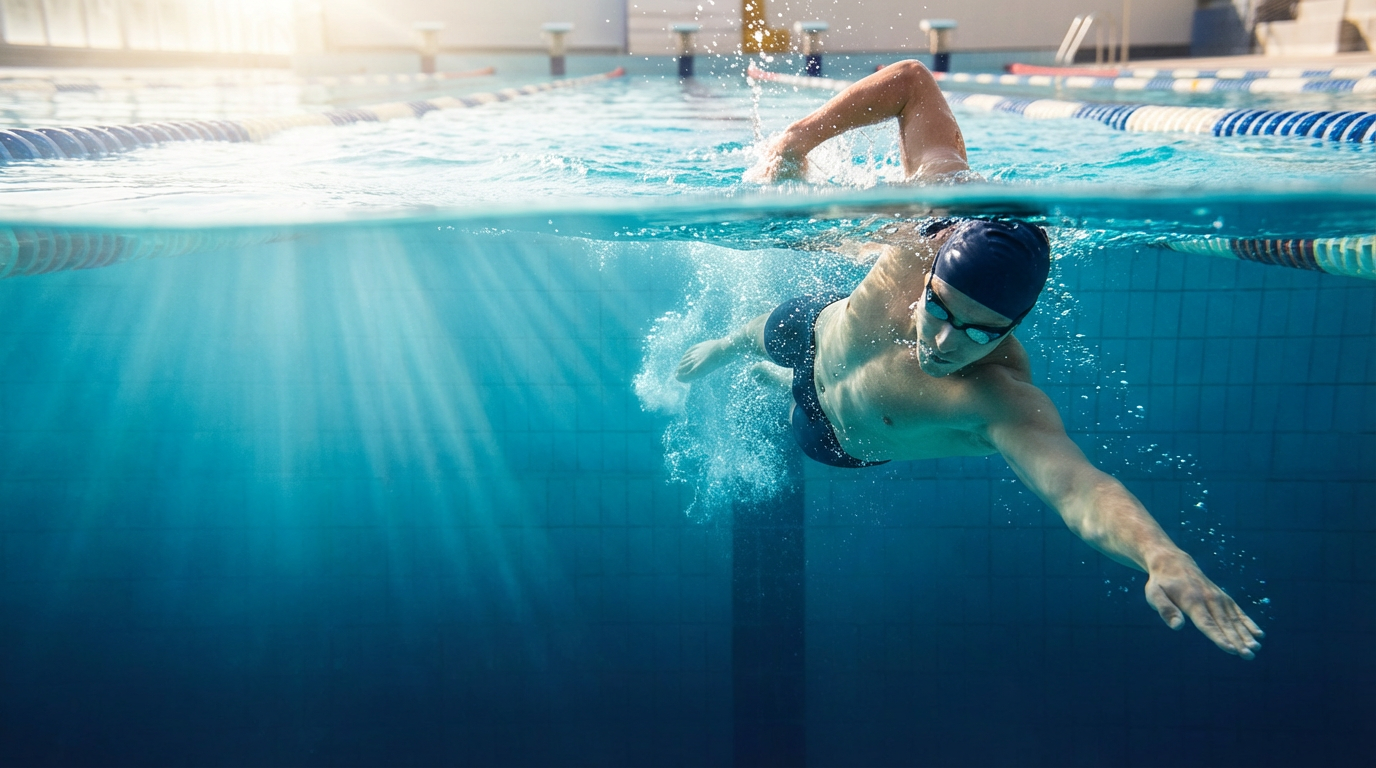
Watch any elite swimmer glide through the water and you'll notice something immediately: they don't swim flat. Their bodies rotate rhythmically from side to side with each stroke, creating a fluid, powerful motion that propels them forward with remarkable efficiency.
Now picture a struggling swimmer. Their body remains stubbornly horizontal, shoulders barely breaking the surface, fighting the water with every movement. They're working harder but moving slower, burning energy without gaining speed.
The difference? Body rotation. It's one of the most fundamental yet frequently misunderstood aspects of efficient swimming technique. At SPEEDISWIM, where we've trained over 25,000 students and developed more than 50 National Youth and National Team swimmers over the past two decades, we've seen firsthand how mastering body rotation transforms swimmers from all backgrounds—whether they're progressing through our SwimSafer program or competing at elite levels.
This comprehensive guide explores why swimming flat is sabotaging your speed, how proper body rotation enhances performance across all competitive strokes, and the specific drills and techniques you can implement immediately to unlock faster, more efficient swimming.
Body rotation in swimming refers to the longitudinal rotation of your torso along the body's central axis as you move through the water. Think of your spine as a rotisserie skewer—your body rotates around this central line with each stroke cycle, shifting from one side to the other in a controlled, rhythmic motion.
In freestyle and backstroke, this rotation typically ranges between 30 to 60 degrees from the horizontal plane, depending on swimming speed, distance, and individual technique. The rotation isn't a dramatic barrel roll; rather, it's a smooth, purposeful tilting that coordinates with your arm stroke, breathing pattern, and kick timing.
This movement pattern is natural and biomechanically efficient. When you walk, your torso rotates slightly with each step. Swimming with proper body rotation applies this same principle to aquatic movement, engaging your core muscles and larger muscle groups rather than relying solely on arm and shoulder strength.
Importantly, body rotation should originate from your core and hips, not just your shoulders. Many swimmers make the mistake of rotating only their upper body while their hips remain flat, creating a disconnected movement pattern that undermines efficiency. True body rotation is a unified movement where your shoulders, torso, and hips work together as a coordinated system.
Swimming completely flat creates a cascade of performance problems that limit your speed and efficiency. When you resist the natural rotation of your body, you're essentially fighting against fundamental principles of hydrodynamics and biomechanics.
The most immediate consequence of flat swimming is increased frontal drag. When your body remains horizontal throughout your stroke, you present a larger surface area to the oncoming water. This creates resistance that you must overcome with additional energy expenditure. By rotating your body, you streamline your profile, slicing through the water more efficiently with a narrower cross-section. It's the difference between pushing a door open with the flat of your hand versus the edge—one requires significantly more force.
Flat swimming forces you to rely primarily on your shoulders and arms for propulsion. These are relatively small muscle groups that fatigue quickly, especially over longer distances. Without proper rotation, you cannot effectively engage your core, back, and chest muscles—the powerhouse muscles that elite swimmers use to generate sustainable force. The result is weaker strokes, faster fatigue, and diminished performance as your swim progresses.
When you swim flat, your shoulders bear the brunt of the workload in an anatomically disadvantaged position. The shoulder joint operates most safely and powerfully through its full range of motion when your body rotates, allowing your arm to enter and exit the water naturally. Flat swimming restricts this range, creating repetitive stress on the rotator cuff and increasing the risk of swimmer's shoulder and other overuse injuries. In our competitive swimming program, we prioritize rotation mechanics precisely because injury prevention is fundamental to long-term athletic development.
Breathing becomes an awkward, disruptive action when you swim flat. Without body rotation, you must lift or crane your head significantly to grab air, which drops your hips, increases drag, and interrupts your stroke rhythm. Proper rotation naturally brings your mouth to the surface in a bow wave pocket, allowing you to breathe easily without disrupting your streamline or timing.
Understanding the biomechanical and hydrodynamic principles underlying body rotation helps clarify why this technique is so crucial for swimming performance. The science reveals that rotation isn't just a stylistic choice but a fundamental requirement for efficient aquatic movement.
Hydrodynamic efficiency: Water is approximately 800 times denser than air, making drag the primary force limiting swimming speed. Research in competitive swimming biomechanics has consistently shown that reducing frontal drag through body rotation can improve swimming velocity by 5-12% at the same energy expenditure. By rotating, you maintain a more streamlined position throughout your stroke cycle, minimizing the cross-sectional area pushing against the water.
Kinetic chain activation: Body rotation enables you to tap into what biomechanists call the kinetic chain—the sequential activation of muscle groups from your core outward to your extremities. When you initiate rotation from your hips and core, this rotational energy transfers through your torso, shoulders, and finally into your pulling arm. This chain reaction allows you to generate significantly more force than isolated arm movement. Elite swimmers can produce up to 40% more propulsive force when properly engaging this kinetic chain through rotation.
Leverage and stroke length: Rotation increases your effective stroke length by allowing your arm to extend further forward during the entry and catch phase, and further back during the finish. This extended reach means fewer strokes per lap, which generally correlates with faster, more efficient swimming. Consider that world-class distance swimmers often take 30-35% fewer strokes per length than recreational swimmers covering the same distance.
Optimal joint mechanics: The shoulder joint is designed to operate most efficiently when the arm moves through a natural arc relative to the body's position. Body rotation positions your shoulder joint optimally during the high-elbow catch and pull-through phases, allowing maximum force application with minimum joint stress. This biomechanical advantage becomes particularly important as training volume increases and during the later stages of races when maintaining technique under fatigue is crucial.
Mastering body rotation delivers tangible performance improvements that swimmers at every level can experience. These benefits compound over time, making rotation one of the highest-return technical investments you can make in your swimming.
1. Increased Swimming Speed: By reducing drag and improving propulsive efficiency, proper rotation directly translates to faster swimming times. Our athletes who master this technique typically see measurable improvements in their race times within 4-8 weeks of focused practice. The speed gains are often most noticeable in the 100-400m range, where sustained efficient technique matters most.
2. Enhanced Endurance: Rotation allows you to swim longer distances with less fatigue by distributing the workload across larger muscle groups and reducing wasted energy fighting drag. Swimmers with efficient rotation can maintain their pace deeper into races and training sets. This endurance benefit is particularly valuable for those working toward SwimSafer certifications or distance events.
3. Better Breathing Mechanics: With proper rotation, breathing becomes a natural extension of your stroke rather than a disruptive action. You can breathe comfortably on both sides (bilateral breathing) without losing body position or momentum. This rhythmic, effortless breathing contributes to better oxygen delivery and reduced anxiety during both training and competition.
4. Reduced Injury Risk: By positioning your shoulders optimally and distributing force across multiple muscle groups, rotation significantly reduces repetitive stress injuries. This injury prevention allows for more consistent training and longer competitive careers. Over two decades at SPEEDISWIM, we've observed that swimmers with proper rotation mechanics experience substantially fewer shoulder problems than those who swim flat.
5. Improved Body Position: Rotation naturally elevates your hips and legs toward the surface, reducing the drag caused by sinking hips—one of the most common technique faults. This improved body position creates a more streamlined profile and makes your kick more effective by keeping your legs within your body's slipstream rather than dragging behind.
Even swimmers who understand the importance of body rotation often struggle with execution. These common mistakes undermine the benefits of rotation and can actually create new problems if left unaddressed.
Many swimmers rotate their shoulders while their hips remain flat, creating a twisted, disconnected position. This incomplete rotation prevents effective power transfer and can strain your lower back. The fix: Focus on initiating rotation from your hips and core. Think about rotating as a single unit from your shoulders through your hips. A useful drill is to place a pull buoy between your thighs and concentrate on rotating the buoy with each stroke, ensuring your hips move with your shoulders.
Some swimmers swing too far onto their sides, approaching 90 degrees of rotation. While this might feel powerful, excessive rotation actually slows you down by increasing the time you spend in a less streamlined position and disrupting your stroke rhythm. The fix: Aim for 30-45 degrees of rotation for sprint freestyle and 45-60 degrees for distance swimming. Your coach can help you find your optimal rotation angle based on your body type, flexibility, and swimming goals. Video analysis is invaluable for identifying over-rotation.
Your head should remain stable and aligned with your spine as your body rotates beneath it. Some swimmers allow their head to roll excessively with their body rotation, which disrupts balance and increases frontal drag. The fix: Practice rotation drills with your face down in the water, keeping your gaze directed at the bottom of the pool. Your head should only rotate when breathing, and even then, it should rotate just enough to clear your mouth from the water. Think "stable head, rotating body."
Rotation timing is critical. If you rotate after your hand has already entered the water and started pulling, you miss the opportunity to use rotation to enhance your catch and propulsion. The fix: Begin rotating as your recovering arm swings forward, reaching maximum rotation just as your hand enters the water. This timing allows you to use your body rotation to drive your arm forward into a powerful catch position. Practice with single-arm drills to isolate and perfect this timing.
Most swimmers have a preferred breathing side and tend to rotate more completely when breathing to that side, creating an asymmetrical stroke. This imbalance reduces efficiency and can lead to swimming off course in open water. The fix: Practice bilateral breathing (breathing on both sides) to develop symmetrical rotation. Even if you prefer breathing on one side during races, training bilaterally develops balanced technique and muscle development.
Developing effective body rotation requires deliberate practice with specific drills designed to isolate and reinforce proper movement patterns. These drills have proven effective with thousands of swimmers across our programs, from SwimSafer students to national-level competitors.
This foundational drill develops the feel for a rotated position and builds core stability. Kick on your side with your bottom arm extended in front and your top arm at your side. Your body should be rotated 90 degrees, with your shoulder, hip, and ankle stacked vertically. Hold this position for 6-8 kicks, then rotate to the other side.
Focus points: Keep your head aligned with your spine, maintain a tight streamline with your extended arm, and engage your core to prevent sagging at the hips. This drill builds the strength and body awareness necessary for maintaining rotation during full stroke swimming.
Building on the side kick drill, this progression adds rotation transitions. Start in the side kick position, complete 6 kicks, then take one arm stroke while rotating to the opposite side. Continue alternating sides with 6 kicks between each rotation.
Focus points: Rotate smoothly and deliberately rather than quickly. Use your core to drive the rotation, not just your arm movement. This drill trains the timing and coordination of rotation with your stroke cycle.
Swim freestyle using only one arm while keeping the other arm extended in front or held at your side. This drill isolates rotation on each side and helps you feel how rotation powers your stroke. Complete 25-50 meters on each arm before switching.
Focus points: Initiate rotation from your hips as your working arm begins its recovery. Notice how rotation helps your arm extend further forward and pull more effectively. Maintain steady, continuous rotation rather than flat periods interrupted by sudden rolls.
Swim freestyle with a catch-up timing where your hands touch or nearly touch in front before one arm begins pulling. This exaggerated pause allows you to focus specifically on rotation during each stroke. The extended glide phase gives you time to feel how rotation affects your body position and streamline.
Focus points: As one arm finishes its stroke and begins recovery, start rotating toward that side. Reach maximum rotation as your recovering arm enters the water and your pulling arm begins its catch. This drill slows down the stroke cycle, making it easier to identify and correct rotation timing issues.
Swim freestyle while lightly dragging your fingertips along the water surface during the recovery phase. This drill encourages higher elbow recovery and naturally promotes better body rotation, since adequate rotation is necessary to keep your fingertips on the surface without strain.
Focus points: Let rotation lift your arm naturally rather than muscling your arm through recovery. If you find your fingertips leaving the water surface, you're likely not rotating enough. This drill provides immediate feedback about your rotation adequacy.
Incorporate these drills into your regular training with intention and focus. At our competitive swimming sessions, we typically dedicate 15-20 minutes of each practice to targeted technique work, including rotation drills. Consistency matters more than volume; practicing these drills correctly three times per week yields better results than daily unfocused repetition.
While body rotation is most associated with freestyle, it plays important roles across all competitive swimming strokes. Understanding how rotation functions in each stroke helps you develop well-rounded technique.
Freestyle features continuous bilateral rotation throughout the stroke cycle. As one arm pulls and the opposite arm recovers, your body rotates toward the pulling side. The degree of rotation varies with distance and speed: sprinters typically rotate 30-45 degrees to maintain faster stroke rates, while distance swimmers often rotate 45-60 degrees for maximum efficiency and breathing ease. The key is smooth, continuous rotation rather than flat periods interrupted by sudden rolls. Your hips should drive the rotation, with your shoulders following naturally.
Backstroke rotation mirrors freestyle mechanics but in the supine position. Your body rotates from side to side as your arms alternate, with similar rotation ranges (30-60 degrees depending on distance and speed). Backstroke rotation is often more pronounced than freestyle because breathing doesn't constrain your movement. Proper rotation in backstroke prevents the common mistake of reaching across your body's centerline, which causes snaking and reduces efficiency. The rotation also naturally positions your shoulder for optimal entry and reduces shoulder strain.
Butterfly doesn't feature side-to-side rotation but rather an undulating motion with rotation occurring through the vertical plane. Your body rotates through a wave-like pattern, with your chest and hips rising and falling rhythmically. This vertical "rotation" reduces frontal drag during the recovery phase and helps generate power for the propulsive phase. The key is maintaining this undulation throughout the stroke rather than swimming flat, which significantly increases resistance.
Breaststroke primarily emphasizes vertical body position changes rather than longitudinal rotation. However, slight rotation (5-15 degrees) during the arm recovery can reduce frontal drag and facilitate the forward glide phase. More importantly, breaststroke requires precise hip and shoulder coordination to minimize drag during the recovery. While this isn't rotation in the traditional sense, the principle of presenting a minimal frontal profile to the water applies equally.
Body rotation is a skill that can and should be developed from the earliest stages of swimming education through elite competition. The approach and emphasis vary by skill level, but the fundamental principles remain constant.
For swimmers in our SwimSafer program, we introduce rotation concepts gradually alongside water safety and fundamental swimming skills. Early-stage swimmers first develop comfort with side positions through simple floating and kicking exercises. As they progress through SwimSafer stages 3-6, we incorporate age-appropriate rotation drills that build body awareness without overwhelming them with technical complexity.
At this level, the focus is on feeling comfortable in a rotated position and understanding that swimming involves movement in three dimensions, not just forward propulsion. Games and playful drills make rotation practice engaging rather than tedious. For example, "torpedo rotations" where swimmers push off the wall in a streamline and slowly rotate 360 degrees help young swimmers develop spatial awareness and comfort with changing positions.
As swimmers advance in technical proficiency and potentially join competitive programs, rotation development becomes more structured and intentional. Video analysis becomes valuable at this stage, allowing swimmers to see their rotation angles and timing. Swimmers learn to feel the difference between adequate and inadequate rotation, developing the proprioceptive awareness that enables self-correction.
Intermediate swimmers benefit from focused technique sets that isolate rotation from other stroke elements. For example, a set might include 8×50 meters where odd repeats focus exclusively on rotation quality while even repeats work on integrating that rotation into full stroke swimming at moderate pace. This alternating focus helps transfer isolated skill work into functional technique.
At the highest levels, rotation refinement focuses on optimization and maintaining technique under race conditions. Elite swimmers work with coaches to identify their optimal rotation angles for different race distances and adjust these angles strategically during races. For instance, many elite 200 and 400 freestyle swimmers increase their rotation angle slightly during the middle portions of races to improve efficiency, then reduce rotation in the final sprint when stroke rate becomes more important than maximum efficiency.
Advanced swimmers also integrate rotation work into race-pace and competition simulation sets. The challenge at this level isn't developing rotation ability but maintaining excellent rotation mechanics when fatigued, under pressure, and swimming at maximum intensity. This is where the years of foundational work pay dividends; swimmers with deeply ingrained rotation habits maintain superior technique when competitors' form deteriorates.
Developing body rotation isn't limited to pool time. Dryland exercises that build core strength, rotational power, and mobility directly support improved rotation mechanics in the water. Exercises like medicine ball rotational throws, planks with rotation, Russian twists, and swimming-specific cable exercises build the strength and neuromuscular patterns that transfer to the pool.
Flexibility work, particularly for shoulders, thoracic spine, and hips, enables more complete, comfortable rotation. Swimmers with restricted mobility in these areas physically cannot achieve optimal rotation angles regardless of technical understanding. We incorporate sport-specific stretching and mobility work into our training programs precisely because physical capacity often limits technical potential.
While understanding body rotation conceptually is valuable, developing this skill effectively almost always requires guidance from experienced coaches. Qualified instructors can identify subtle technique flaws that swimmers cannot feel themselves and provide targeted corrections that accelerate improvement.
At SPEEDISWIM, our professionally qualified coaches bring decades of combined experience developing swimmers from complete beginners to national team representatives. This progression is only possible through consistent, expert instruction that addresses each swimmer's specific needs and challenges. Whether you're working toward SwimSafer certification or pursuing competitive excellence, professional coaching provides the structured progression and personalized feedback that self-coaching cannot replicate.
The investment in quality coaching pays substantial dividends. While group swimming lessons in Singapore typically range from $35 to $55 per session, with private instruction from $60 to $120 per session, this investment in proper technique development prevents years of reinforcing incorrect movement patterns that must later be painstakingly corrected. Developing excellent rotation mechanics from the beginning is far easier than fixing ingrained flat swimming habits later.
Body rotation represents one of the most significant differentiators between efficient, fast swimming and the energy-wasting struggle of flat swimming. The biomechanical and hydrodynamic advantages of proper rotation—reduced drag, increased power, better breathing, injury prevention, and improved body position—compound to create dramatic performance improvements.
Whether you're a SwimSafer student developing fundamental skills, a competitive swimmer pursuing personal bests, or a masters swimmer training for fitness and enjoyment, mastering body rotation will transform your swimming experience. The water will feel less resistant, your strokes will feel more powerful, and your speed will increase noticeably.
The journey from flat swimming to efficient rotation requires patience, deliberate practice, and often professional guidance. It's a technical skill that develops progressively through hundreds of mindful repetitions, each one refining your movement patterns and building the neuromuscular connections that make rotation automatic rather than conscious.
At SPEEDISWIM, we've witnessed this transformation countless times over our 20+ years training swimmers across Singapore. From our SwimSafer program participants discovering the joy of efficient movement to our competitive athletes representing Singapore at national and international levels, the common thread is mastery of fundamental techniques like body rotation. These skills, taught properly and practiced consistently, create the foundation for swimming excellence at every level.
Don't let flat swimming continue killing your speed. Start incorporating rotation-focused drills into your training today, seek feedback from qualified coaches, and commit to the deliberate practice required to make this technique automatic. Your faster, more efficient swimming awaits on the other side of proper body rotation.
Join SPEEDISWIM and learn from professionally qualified coaches with over 20 years of experience developing swimmers from beginners to national champions. Whether you're starting your swimming journey or pursuing competitive excellence, we provide the expert instruction and structured programs to help you reach your goals.