The flip turn, also known as the tumble turn, is one of those swimming techniques that separates casual lap swimmers from serious athletes. If you've ever watched competitive swimmers glide into the wall, execute a lightning-fast somersault, and power off in the opposite direction without missing a beat, you know exactly what we're talking about. That seamless movement isn't just impressive to watch—it's a game-changer for swimming efficiency and speed.
At SPEEDISWIM, we've spent over two decades teaching swimmers of all levels, from beginners taking their first strokes to competitive athletes representing Singapore on national teams. Throughout our experience training more than 25,000 students, we've learned that mastering the flip turn is less about natural athleticism and more about proper progression, patience, and practice. The good news? Anyone can learn this skill with the right approach.
This comprehensive guide will take you through the complete journey from basic open turns to confident, competitive-level flip turns. Whether you're a recreational swimmer looking to level up your technique or a developing athlete preparing for competitive swimming, we'll break down each component into manageable steps. Let's transform your turns from a breather at the wall into a powerful advantage in the pool.
Before diving into technique, it's important to understand what distinguishes these two fundamental turning methods and when each is appropriate. Both turns serve the same basic purpose—changing direction at the wall—but they differ significantly in execution, speed, and application.
The open turn (also called a touch turn) is exactly what it sounds like: you swim to the wall, touch it with your hand, tuck your knees, rotate your body, and push off. Your head stays above water for most of the movement, and you can take a breath during the turn. This turn is required for breaststroke and butterfly under competitive swimming rules, and it's the standard starting point for all swimmers learning proper wall technique.
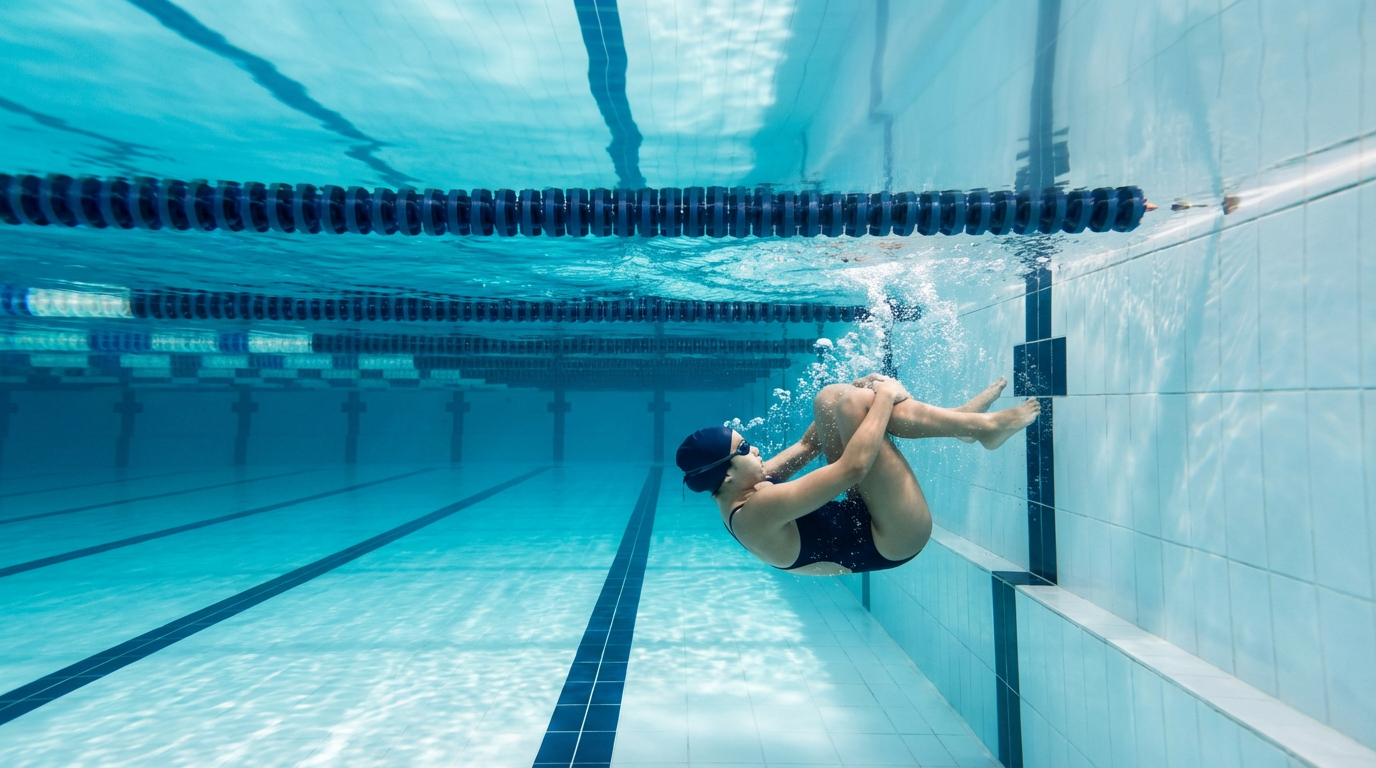
The flip turn or tumble turn, by contrast, involves performing a forward somersault as you approach the wall, planting your feet against it underwater, and pushing off in a streamlined position. Your hands never touch the wall, your head stays underwater throughout, and the entire movement happens in one fluid motion. This turn is used in freestyle and backstroke events and can save swimmers anywhere from 0.5 to 1.0 seconds per turn compared to an open turn—a significant advantage when racing.
Understanding this distinction is crucial because trying to flip turn before mastering open turns is like trying to run before you can walk. The open turn teaches essential skills like judging distance to the wall, timing your breath, and generating powerful push-offs—all of which form the foundation for successful flip turns.
You might be wondering whether the effort of learning flip turns is worth it, especially if you're primarily a fitness swimmer rather than a competitive athlete. The benefits extend far beyond shaving seconds off your lap times, though that's certainly a compelling reason for those with competitive aspirations.
Improved swimming efficiency is perhaps the most immediate benefit. A well-executed flip turn maintains your momentum through the turn, whereas an open turn requires you to stop, reorient, and rebuild speed from nearly zero. Over the course of a workout involving dozens of turns, this efficiency translates to a more effective cardiovascular session and better overall conditioning.
The technique also develops better body awareness and spatial orientation. Learning to somersault in water, orient yourself to the wall, and push off in the correct direction requires significant kinesthetic intelligence. This enhanced body control carries over into all aspects of your swimming, improving your overall coordination and technique.
From a practical standpoint, flip turns allow you to maintain workout rhythm and intensity. When you're doing interval training or trying to maintain a target pace, stopping to touch the wall and reorient breaks your flow. Flip turns keep you moving, making your training more similar to the continuous nature of open-water swimming or competitive racing.
For those enrolled in programs like our SwimSafer 2.0 curriculum, mastering turns is part of developing comprehensive swimming competency. It's a skill that marks your progression from basic water safety to true swimming proficiency. And if you have aspirations toward competitive swimming, flip turns are simply non-negotiable—they're a fundamental technique used in every freestyle and backstroke event.
Not every swimmer is ready to tackle flip turns immediately, and that's perfectly fine. Attempting them before you've built the necessary foundational skills often leads to frustration, disorientation, or even anxiety about turns. Here's what you should be comfortable with before starting flip turn practice:
Confident freestyle swimming is the baseline requirement. You should be able to swim multiple laps continuously with proper breathing technique and body position. If you're still working on basic stroke mechanics or breathing patterns, focus on those fundamentals first. The flip turn adds complexity to an already demanding skill set, so your base swimming needs to be solid.
Comfort with underwater orientation is equally important. Can you somersault in the water without feeling disoriented or panicked? Are you comfortable being upside down underwater? If these scenarios create anxiety, spend time practicing somersaults in the shallow end first. Many swimmers who learned as children are comfortable with inverted positions, but adult learners sometimes need to gradually build this comfort level.
Effective open turns are the most direct prerequisite. You should be proficient at approaching the wall, touching with proper timing, tucking efficiently, and pushing off in a streamlined position. These open turn skills directly transfer to flip turns, so mastering them first creates a much smoother learning curve.
Additionally, having reasonable breath control helps significantly. Flip turns require holding your breath through the approach, turn, and push-off—generally 5-7 seconds. If you need to breathe every stroke or struggle with breath-holding, work on extending your comfortable breath-hold duration through gradual practice.
Before attempting your first flip turn, ensuring your open turn technique is solid will make the transition much smoother. The open turn teaches you critical skills that directly apply to flip turning: wall approach judgment, push-off power, and streamline positioning.
The approach to the wall sets up everything that follows. As you swim toward the wall, you need to judge your distance so you can extend your arm for the touch without being too far away or crashing into the wall. This spatial awareness is crucial. Start counting strokes as you practice—most swimmers find they touch the wall at roughly the same distance each time, usually within the last stroke or stroke-and-a-half.
Keep your final stroke smooth and controlled. New swimmers often panic and either reach desperately or slow down dramatically. Neither approach is ideal. Maintain your swimming rhythm right up to the wall, extending naturally to make contact. Your touch can be with one or both hands depending on the stroke, but it should be firm and deliberate, not a tentative tap.
Once you've touched the wall, immediately tuck your knees toward your chest while dropping your elbow (if touching with one hand). This tucking motion brings your feet toward the wall while rotating your body. Your other arm sweeps across your body to help generate rotation momentum. The entire movement should be compact and quick—think of pulling yourself into a tight ball rather than leisurely repositioning.
As your feet plant against the wall, they should be positioned roughly shoulder-width apart and about 12-18 inches below the surface. Too deep, and you waste energy pushing downward; too shallow, and you risk breaking the surface during your push-off. Your knees should be bent at approximately 90-110 degrees, creating a loaded position that allows for powerful extension.
The push-off is where many swimmers leave free speed on the table. As you extend your legs, focus on explosive power—this isn't a gentle press but a strong drive that propels you away from the wall. Simultaneously, your arms should extend overhead into a tight streamline position: arms straight, biceps squeezing your ears, hands stacked with one on top of the other, head neutral between your arms.
Your body should be straight and horizontal, positioned slightly below the surface (about 12-18 inches down). This streamline position minimizes drag and allows you to maximize the benefit of your push-off. Hold this position as you glide, feeling yourself slice through the water. Only begin your first stroke when your speed drops to roughly your normal swimming pace—most swimmers glide for 3-5 seconds.
The flip turn can seem like a single, complex movement, but breaking it down into distinct phases makes it much more approachable. Understanding each component separately allows you to practice them individually before combining everything into that smooth, continuous motion you're aiming for.
Unlike the open turn where you swim right up to the wall, the flip turn approach requires you to initiate your flip about 3-4 feet (roughly one arm's length) from the wall. This is the single most challenging aspect for beginners—judging this distance while swimming at speed takes practice and repetition. Swimming too close means you'll somersault into the wall; too far away and your feet won't reach the wall for the push-off.
As you approach, take your last breath 2-3 strokes before the wall. Your final stroke is typically slightly shorter than normal, and instead of recovering your arm over the water, you keep both arms down by your sides or in front of your chest. Your head begins to tuck, with your chin moving toward your chest to initiate the rotation.
The somersault itself happens quickly—usually in less than a second. You initiate the flip by tucking your chin hard to your chest and doing a small dolphin kick or pressing your hands downward to drive your hips up and over. Your body rotates forward in a tight tuck position, knees pulled toward your chest, creating a compact ball that spins efficiently.
During the flip, you're essentially doing a forward somersault in the water. Your momentum carries you through the rotation, and you're using your core muscles to maintain the tuck and control the spin. The goal is to rotate just enough that your feet plant on the wall—not so much that you spin past the wall or so little that you don't complete the turn.
As your rotation brings your feet toward the wall, you plant them against it, knees bent, ready to push off. Here's a crucial detail: you're on your back when your feet hit the wall. Many beginners expect to be on their stomach, but in freestyle, you plant on your back and rotate to your stomach during the push-off. This rotation happens as you leave the wall, with your body twisting a quarter turn (90 degrees) to return to a face-down position.
Your feet should contact the wall at roughly the same depth and position as in your open turn—about 12-18 inches below the surface, shoulder-width apart. The wall contact should be solid and brief, just long enough to transfer your momentum into a powerful push-off.
The push-off in a flip turn is essentially identical to your open turn push-off, just approached from a different angle. You drive powerfully through your legs, extending fully while your arms reach forward into a streamline position. As you push off, you simultaneously rotate from your back to your stomach (in freestyle), finishing the quarter-turn that brings you back to swimming position.
The streamline glide is critical—this is where you harvest the benefits of your flip turn. A tight, hydrodynamic streamline allows you to carry speed from the wall. You can add dolphin kicks during this underwater phase to maintain and even build speed, though beginners should focus on the basic turn mechanics before adding this refinement.
Now that you understand the theory, let's work through the practical progression that SPEEDISWIM coaches use with developing swimmers. This step-by-step approach breaks the skill into manageable pieces, allowing you to build confidence and competence gradually.
1. Stationary Somersault Practice – Start in the middle of the pool, away from any walls. From a standing position in chest-deep water, take a breath, tuck your chin to your chest, pull your knees up, and perform a forward somersault. Practice until you can do this smoothly and land on your feet without disorientation. This builds comfort with the rotating sensation and helps you understand the tucking motion needed for the flip.
2. Somersault with Momentum – Now add some movement. Push off the wall and glide on your front for a few feet, then perform your somersault while you still have forward momentum. The goal is to feel how your gliding speed helps carry you through the rotation. You'll notice the somersault happens much faster when you have momentum versus starting from a stationary position. Practice this until the motion feels natural and controlled.
3. Wall Distance Practice – This drill addresses the most challenging aspect: judging your distance. Stand at what you think is the right distance from the wall (about one arm's length or 3-4 feet). Perform your somersault from this standing position and see where your feet end up. They should contact the wall in a bent-knee position. Adjust your starting distance until you consistently hit the sweet spot. This kinesthetic learning helps your body understand the spatial relationship between flip initiation and wall contact.
4. Slow Swimming Approach – Swim slowly toward the wall using freestyle. When you reach your practiced distance (you might want to have a coach or friend signal you initially), perform your somersault and plant your feet on the wall. Don't worry about pushing off yet—just focus on approaching, flipping at the right spot, and getting your feet positioned correctly on the wall. The goal is connecting your swimming approach to your flip mechanics.
5. Add the Push-Off – Once you're consistently flipping at the right distance and planting your feet properly, add the push-off. Remember, you'll be on your back when your feet contact the wall. Push off strongly while bringing your arms into streamline and rotating your body a quarter turn to finish on your stomach. Initially, you can pause briefly with feet on the wall to organize yourself, but gradually work toward making this a continuous motion.
6. Complete the Turn with Breakout – Now execute the full sequence: approach at moderate speed, flip at the appropriate distance, plant your feet, push off in streamline while rotating to your stomach, glide underwater, and begin your first stroke as your speed decreases. This is your complete flip turn. Focus on making each component smooth before worrying about speed.
7. Increase Speed Gradually – As your technique solidifies, gradually increase your approach speed. Faster approaches require earlier flip initiation because your momentum carries you farther during the rotation. This is why flip turns take practice—the timing and spacing change as your speed increases. Work at comfortable speeds until the movement becomes second nature.
8. Refine and Repeat – Flip turns require hundreds of repetitions to become truly smooth and automatic. At SPEEDISWIM, we tell our competitive swimming students that perfecting turns is an ongoing process, not a one-time achievement. Even small refinements to your technique can yield noticeable improvements in efficiency and speed.
Throughout our years teaching flip turns to thousands of swimmers, we've seen certain mistakes appear repeatedly. Recognizing these common errors and understanding how to correct them will accelerate your learning process significantly.
This is the most common mistake and the most frustrating for learners. Flipping too close means you somersault right into the wall, often banging your feet or shins uncomfortably. Flipping too far leaves you floundering with your feet waving in the water, unable to reach the wall for the push-off. The solution is repetition and reference points. Many pools have lane lines, bottom markings, or wall flags that can serve as visual cues. Practice consistently at the same speed, and your body will develop the spatial memory needed to judge distance accurately. Consider having someone watch and signal when you're at the correct distance until your internal sense develops.
Many swimmers instinctively lift their head to see the wall as they approach, then try to flip. This head lift destroys your streamlined body position and makes the flip much harder because your hips sink. Instead, keep your head down and eyes looking at the bottom of the pool. Trust your stroke count and spatial awareness rather than visual confirmation. Your peripheral vision and the increasing brightness from the white wall provide enough information without breaking your body line.
A lazy, wide-legged somersault wastes time and creates drag. Your flip should be tight and compact, with knees pulled close to your chest. Think of gymnasts doing tucked somersaults—they create a tight ball that rotates quickly. The same principle applies in water. Practice your stationary somersaults, focusing on creating the tightest possible tuck. This compact position allows you to rotate faster and more efficiently.
Some swimmers successfully flip and plant their feet but then push off weakly or in a loose body position rather than a tight streamline. Remember that the push-off is where you generate the speed that makes flip turns advantageous. Push explosively, not timidly. Simultaneously snap your arms into streamline and squeeze your core to create a rigid, torpedo-like shape. Your push-off should feel powerful enough that you glide several meters before needing to stroke.
Taking your last breath too close to the wall means you're approaching the turn already oxygen-deprived, which creates anxiety and rushing. Conversely, holding your breath too long after the turn leads to gasping and disrupted rhythm. Take your final breath 2-3 strokes before the wall—early enough that you're comfortable through the turn but not so early that you're desperate for air. After the push-off, plan to surface and breathe within 2-3 strokes of resuming swimming.
Some swimmers flip but don't rotate quite enough, resulting in feet contacting the wall at an awkward angle or having to scramble to get positioned. The flip should bring you to a clear back-lying position with feet flat against the wall. If you're consistently short-rotating, focus on a more aggressive chin tuck and slightly stronger dolphin kick or hand press to initiate the flip. If you're over-rotating and spinning past the wall, ease up on the flip initiation and practice controlling your rotation speed.
Dedicated practice using specific drills will accelerate your flip turn development more effectively than simply doing lap after lap. These drills, used regularly in our competitive swimming training sessions at SPEEDISWIM, isolate and strengthen individual components of the turn.
This drill isn't specific to flip turns, but it's foundational. Push off the wall in perfect streamline position (no swimming approach, no flip—just push off). Focus entirely on creating the tightest, most hydrodynamic position possible. Squeeze your arms against your ears, stack your hands, engage your core, point your toes, and feel yourself glide. Count how many seconds you glide before slowing to normal swimming speed. Work on increasing this time—it directly translates to more effective turns. Aim for 5-7 seconds of quality glide before beginning to stroke.
In deeper water, perform three consecutive somersaults without surfacing. This builds comfort with continuous underwater rotation and helps eliminate any lingering disorientation. Focus on tight tucks and controlled rotation speed. If you feel dizzy, surface and rest before continuing. Over time, this drill significantly improves your spatial orientation and comfort with the inverted position.
Swim toward the wall and execute your flip, planting your feet properly, but instead of pushing off, simply stand up or let yourself float away from the wall. This drill removes the pressure of completing the entire turn, allowing you to focus exclusively on approach timing and flip execution. Do 10-15 repetitions, concentrating on flipping at the same optimal distance each time. This builds the muscle memory for proper distance judgment.
Perform your flip turn but slow down the rotation intentionally, almost doing it in slow motion. This helps you feel each component of the flip and understand how your body position changes throughout the turn. Where exactly are you when your feet first contact the wall? How does your core engagement change? What happens to your arms? This awareness helps you make precise adjustments to your technique.
Execute five consecutive flip turns, starting at 50% speed for the first turn, then progressing to 60%, 70%, 80%, and finally 90% speed by the fifth turn. This controlled progression helps your body adjust to the timing changes that occur at different speeds. You'll notice that faster approaches require earlier flip initiation—this drill helps you calibrate that timing across the speed spectrum.
Once you've mastered the basic flip turn mechanics, there's still room for refinement that can shave tenths or even full seconds off your times. These advanced considerations are what separate competent flip turns from competitive-level turns.
Elite swimmers don't just glide off the wall—they actively propel themselves underwater using dolphin kicks. The rules allow swimmers to remain underwater for up to 15 meters (marked by flags in competition pools). Strong underwater kicking can actually be faster than surface swimming due to reduced drag. Start by adding 2-3 dolphin kicks during your glide phase, maintaining tight streamline throughout. As this becomes comfortable, gradually increase to 4-6 kicks or more, depending on your underwater speed versus surface speed. This skill is fundamental in our competitive swimming program, where we develop athletes for national-level competition.
Every millisecond at the wall matters in racing. Work on making your flip explosively fast. The time between your last stroke and your push-off should be minimal—ideally under 1 second. This requires confidence and aggression. Practice turning at race pace, not just comfortable training pace. The physiological demand is higher, but this is what competition requires. Video yourself if possible; watching in slow motion reveals inefficiencies you can't feel while swimming.
Your flip, plant, and push-off should occur at a consistent depth—deep enough to avoid surface turbulence but not so deep that you waste energy traveling vertically. Most competitive swimmers aim for feet placement about 12-18 inches below the surface, with the push-off trajectory carrying them slightly deeper (18-24 inches) before gradually rising back to surface level. This shallow underwater trajectory minimizes drag while maximizing streamline efficiency.
Advanced swimmers adjust their final strokes based on where they are relative to the wall. If you realize mid-approach that you're slightly off your ideal distance, you can make subtle adjustments: a slightly longer or shorter final stroke, altering your glide time, or adjusting the timing of your flip initiation. This adaptive skill comes with experience and makes your turns reliable even when you don't approach perfectly.
For swimmers serious about competitive development, working with qualified coaches makes a substantial difference. At SPEEDISWIM, our professionally trained coaches provide the feedback and technical analysis that accelerates improvement. With over 50 swimmers selected for National Youth and National Teams over our 20+ year history, we understand the technical refinements that separate good swimmers from elite athletes. Whether you're working toward your first swim meet or aiming for national-level competition, systematic technical training produces measurable results.
In competition, turn execution often suffers because swimmers are fatigued or distracted. Practice your turns when you're tired—do them at the end of hard sets, not just when you're fresh. This builds the mental toughness and physical reliability to execute well under pressure. Additionally, visualization helps: mentally rehearse perfect turns, seeing and feeling each component. This mental practice complements physical training and builds confidence.
Learning to flip turn is a journey that transforms your swimming from recreational to refined. While the technique may seem daunting initially, breaking it down into progressive steps makes it achievable for any swimmer willing to practice consistently. Remember that every elite swimmer once struggled with their first flip turn—the difference is simply persistence and proper technique development.
Start with solid open turns, build your comfort with underwater orientation, and progress through each phase of the flip turn methodically. Don't rush the process or skip steps. The spatial awareness and timing required develop gradually through repetition, not overnight breakthroughs. Most swimmers see significant improvement within 4-6 weeks of focused practice, with turns becoming truly automatic after several months.
Whether you're pursuing swimming for fitness, working through the SwimSafer 2.0 program, or developing skills for competitive racing, mastering flip turns represents an important milestone in your swimming journey. The efficiency, speed, and technical competence they provide are worth the effort invested in learning them properly.
At SPEEDISWIM, we've guided thousands of swimmers through this exact progression over our 20+ years of operation. Our structured approach, professional coaching, and proven track record of developing swimmers from beginners to national athletes reflect our commitment to technical excellence and proper skill development. If you're serious about improving your swimming technique and want expert guidance through your learning journey, our coaching team is here to help.
Join SPEEDISWIM and learn from coaches who have trained over 25,000 students and developed 50+ national-level swimmers. Our structured programs provide the technical guidance and expert feedback you need to master flip turns and elevate your swimming to the next level.