After teaching over 25,000 students at SPEEDISWIM across more than two decades, we've identified one consistent pattern: breathing technique is the single biggest obstacle preventing beginners from swimming freestyle confidently. While arm strokes and leg kicks can be awkward at first, it's the struggle to breathe properly that causes most swimmers to stop mid-lap, gasping and frustrated.
The challenge isn't that breathing in freestyle is inherently difficult. The real issue is that beginners instinctively do something that feels natural on land but creates major problems in water: they lift their head to breathe. This single movement triggers a cascade of issues including sinking legs, disrupted rhythm, water inhalation, and complete loss of streamline position.
In this comprehensive guide, we'll break down exactly why breathing causes such struggles, reveal the fundamental technique error that most beginners make, and provide you with the same progressive drills and methods our certified coaches use in our SwimSafer Program to help swimmers develop efficient, comfortable breathing patterns. Whether you're just starting your swimming journey or you've been struggling with freestyle breathing for months, this guide will transform your understanding and execution of this essential skill.
Breathing during freestyle swimming creates a unique challenge that doesn't exist in any other common physical activity. On land, breathing is completely automatic—your body handles it without conscious thought. In water, however, you must coordinate breathing with precise body movements, timing, and positioning while maintaining forward momentum. This requires overriding deeply ingrained instincts about how to get air.
The psychological dimension compounds the physical challenge. Many beginners experience mild panic when their face is submerged, creating an urgency to breathe that disrupts their technique. This anxiety leads to rushed, inefficient breathing attempts that often result in swallowing water, which reinforces the fear and creates a frustrating cycle. Our coaches at SPEEDISWIM recognize that addressing both the technical and psychological aspects is essential for breakthrough progress.
Additionally, breathing requires precise timing. Unlike running or cycling where you can breathe whenever needed, freestyle breathing must occur within a specific window during your stroke cycle. Miss that window, and you either disrupt your entire stroke pattern or skip the breath altogether. This coordination challenge is especially demanding for beginners who are simultaneously trying to manage arm movements, leg kicks, and body position.
The number one mistake that causes breathing struggles is deceptively simple: beginners lift their head forward and upward to breathe rather than rotating to the side. This feels instinctive because it's how you'd naturally get your face above water if you were standing in the pool. However, this movement is completely counterproductive when swimming freestyle.
When you lift your head forward, several problematic things happen simultaneously. First, basic physics dictates that raising your head causes your hips and legs to sink, destroying your horizontal body position. This creates massive drag that slows you down and requires much more energy to maintain forward motion. Second, lifting your head breaks your streamline, the aerodynamic (or more accurately, hydrodynamic) position that allows efficient movement through water. Third, this movement often causes you to pause or disrupt your arm stroke, breaking the rhythm that makes freestyle swimming smooth and sustainable.
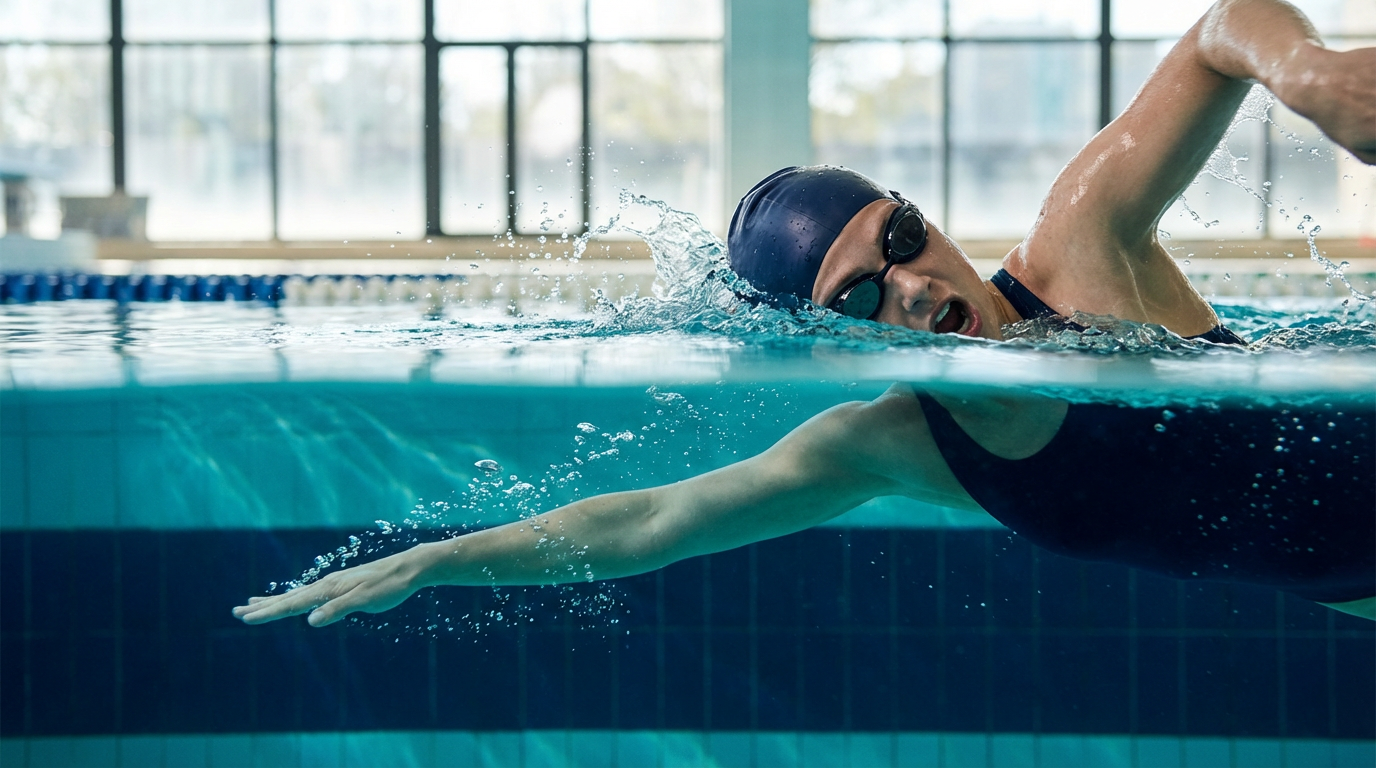
The correct approach involves rotating your entire body as a unit so your head naturally moves to the side, not upward. When executed properly, one side of your face remains in the water while the other side emerges just enough for your mouth to clear the surface. This rotation maintains your streamline position, keeps your body horizontal, and integrates seamlessly with your natural stroke mechanics. Understanding this fundamental difference is the first step toward breathing mastery.
Body rotation is the foundation of efficient freestyle swimming, not just for breathing but for power generation and injury prevention. Many beginners mistakenly think of freestyle as a flat stroke where your body remains face-down throughout. In reality, proper freestyle involves continuous rotation along your longitudinal axis (the imaginary line running from your head to your feet).
As your right arm extends forward and your left arm pulls through the water, your body naturally rotates toward the left side. This rotation typically reaches about 45 to 60 degrees from horizontal. As the arms switch positions, your body rotates back through center and toward the right side. This rotation isn't a separate movement you add to your stroke—it's an integral part of efficient freestyle mechanics that happens naturally when other elements are executed correctly.
The breathing opportunity emerges from this rotation. When your body rotates to your breathing side (let's say the right), your face naturally turns with your body. You're not turning your head independently; you're keeping your head aligned with your spine and allowing the whole-body rotation to bring your mouth above the surface. This is why we emphasize in our Competitive Swimming training that body rotation must be mastered before breathing can truly become efficient.
Think of your body as a rotisserie—rotating around a central axis while moving forward. Your head is essentially skewered on this axis, rotating with your body rather than moving independently. This mental image helps many of our students understand the integrated nature of proper breathing mechanics.
Now that you understand the fundamental principle of body rotation, let's break down the specific technique for breathing during freestyle. Mastering these components will transform your swimming from a struggle into a sustainable, enjoyable activity.
Your head should remain in a neutral position, aligned with your spine, with your waterline typically at your hairline or slightly above your eyebrows. Many beginners swim with their head too high, which immediately causes the hips to drop. Keep your gaze directed downward and slightly forward—you should be looking at the bottom of the pool, not ahead. This neutral head position must be maintained throughout your stroke cycle, including during breathing.
The optimal time to breathe occurs when your breathing-side arm is recovering (moving forward through the air) while your opposite arm is pulling through the water. This is when your body rotation is maximized toward your breathing side. As your body rotates, turn your head just enough so one goggle lens remains underwater while the other emerges. Your mouth should clear the surface in the small trough created by your bow wave—the water displacement created by your head moving forward.
The key phrase our coaches use is: "breathe in the bow wave trough." You're not lifting up to find air above the water surface; you're rotating to find the air pocket that exists alongside your head. This requires much less effort and maintains your streamline position.
When your mouth clears the water, take a quick, moderate breath through your mouth. Don't try to completely fill your lungs—a sharp inhale that fills your lungs about 70-80% is sufficient and allows you to return your face to the water quickly. Many beginners hold their breath underwater, which creates carbon dioxide buildup and increases the urgency to breathe. Instead, exhale gradually through your nose or mouth while your face is submerged, so you're ready to inhale immediately when you rotate to breathe.
After your quick inhale, return your face to the neutral position as your body continues its rotation back toward horizontal and then to the opposite side. The face returns to the water before your arm completes its recovery. This timing ensures that your breathing doesn't disrupt your stroke rhythm. Your head should return smoothly, not snap back quickly, maintaining the connection with your body's rotation.
Even when swimmers understand the correct technique intellectually, certain mistakes persistently appear. Recognizing these patterns helps you self-diagnose and correct issues more quickly.
Holding Your Breath Underwater: This is perhaps the most universal beginner mistake. When you hold your breath while your face is submerged, carbon dioxide accumulates, creating an overwhelming urge to breathe. By the time you rotate to breathe, you're desperate for air, which causes rushed, panicked breathing. The fix is simple but requires conscious practice: exhale continuously and gently through your nose or mouth whenever your face is in the water. This keeps your lungs fresh and makes breathing calm and controlled.
Over-Rotating or Under-Rotating: Some swimmers barely rotate at all, trying to breathe while remaining nearly flat, which requires lifting the head significantly. Others over-rotate, rolling too far onto their side, which disrupts streamline and often causes the body to snake side to side. The proper rotation is approximately 45-60 degrees—enough that breathing feels natural but not so much that you're swimming on your side. Video analysis during coaching sessions can be invaluable for identifying your rotation angle.
Breathing Too Frequently: Anxious beginners often try to breathe every stroke cycle or even more frequently, which doesn't allow enough time to establish rhythm. While breath frequency is somewhat individual, most swimmers benefit from breathing every two or three strokes initially, then progressing to bilateral breathing (alternating sides every three strokes) as comfort increases. This pattern provides adequate oxygen while maintaining consistent stroke mechanics.
Lifting the Head to Look Forward: The instinct to see where you're going causes many swimmers to lift their head to look forward while breathing. This immediately sinks the hips and breaks streamline. Remember, during breathing, one goggle lens should remain underwater, and your gaze should be directed to the side, not forward. You navigate using the pool lane lines visible in your peripheral vision and the lines on the pool bottom, not by looking ahead while breathing.
These drills, used extensively in our SwimSafer 2.0 curriculum, build breathing skills progressively from basic comfort to fully integrated technique. Practice each drill until it feels comfortable before advancing to the next level.
1. Bubble Breathing (Standing): Stand in chest-deep water and practice the exhale-inhale rhythm. Submerge your face and exhale continuously through your nose and mouth, creating a steady stream of bubbles. After 3-4 seconds, lift your face out, take a quick breath through your mouth, and immediately return your face to the water to continue exhaling. Repeat for 2-3 minutes. This establishes the fundamental breathing rhythm without the complexity of swimming movements.
2. Side-Glide Breathing: Push off from the wall on your side with your bottom arm extended forward and your top arm resting along your side. Your face should be in the water in neutral position, with your body rotated about 45-60 degrees. Kick gently to maintain position, exhale underwater for several seconds, then rotate your head slightly (keeping the rotation connected to your body) to breathe. Take a breath, return your face to the water, and continue. This drill isolates the rotation and breathing mechanics without arm movements. Practice on both sides.
3. Single-Arm Freestyle with Breathing: Swim freestyle using only one arm while the other remains extended forward. Breathe on the side of the working arm. This drill reduces the complexity of the full stroke while allowing you to focus intensely on coordinating one arm pull with the breathing rotation. The extended arm provides stability and helps you understand how the pulling arm's movement connects with body rotation and breathing. Complete 25 meters with each arm.
4. 6-3-6 Drill: This classic drill bridges the gap between side-glide and full-stroke swimming. Kick for six counts on your side with your bottom arm extended (as in the side-glide drill), then take three full freestyle strokes while breathing on the appropriate stroke, then return to six kicks on the opposite side. The sustained side-gliding position reinforces proper rotation while the three strokes practice integrating breathing into actual swimming. This drill is particularly effective for understanding how breathing fits into the complete stroke cycle.
5. Breathing Every Five, Then Three: Once you can swim continuous freestyle, practice breathing every five strokes for one length, focusing on staying relaxed despite the longer interval between breaths. This builds comfort with face-down swimming and reinforces continuous exhalation. Then swim back breathing every three strokes, which should feel easy and comfortable by comparison. This contrast helps you recognize when you're adequately relaxed and exhaling properly.
The frequency and pattern of your breathing significantly impacts both your technique and your swimming experience. While individual needs vary based on fitness level, stroke efficiency, and swimming intensity, certain principles apply broadly.
Bilateral Breathing (Every Three Strokes): This pattern, where you breathe alternately to the right and left every three strokes, is generally considered the gold standard for recreational and competitive swimmers. Bilateral breathing develops symmetrical technique, preventing the muscular imbalances and stroke asymmetries that develop when you always breathe to the same side. It also provides tactical advantages in open water and competitive swimming, allowing you to observe competitors or navigate regardless of which side they're on. At SPEEDISWIM, we introduce bilateral breathing in our intermediate SwimSafer levels once students have mastered single-side breathing.
Unilateral Breathing (Every Two Strokes): Breathing to the same side every two strokes provides more frequent air intake, which can be beneficial during high-intensity swimming or for beginners who aren't yet comfortable with longer intervals between breaths. While this pattern is perfectly acceptable, especially when learning, be aware that exclusive unilateral breathing often leads to technique imbalances over time. If you prefer breathing every two strokes, periodically practice swimming with breathing on your non-dominant side to maintain symmetry.
Extended Patterns (Every Four or Five Strokes): More advanced swimmers sometimes use extended patterns to maintain streamline for longer periods during races or to challenge their breath control during training. However, these patterns are generally not recommended for beginners or recreational swimmers, as they can create oxygen debt and encourage breath-holding rather than continuous exhalation.
The pattern you choose should allow comfortable, controlled breathing without gasping or anxiety. As a beginner, start with whatever pattern allows you to swim continuously and comfortably, even if that means breathing every two strokes to your preferred side. As your technique improves and your comfort increases, progressively work toward bilateral breathing every three strokes.
If you've practiced the techniques and drills but still experience specific problems, these targeted solutions address the most persistent issues our coaches encounter.
This frustrating issue usually indicates one of two problems: breathing too late in your rotation (so your mouth isn't fully clear when you inhale) or breathing too early (before your body rotation has created the bow wave trough). Focus on the timing—begin turning your head as your arm on the breathing side begins its recovery, and ensure your body rotation is complete before you inhale. Also, position your mouth slightly behind your head's rotation, creating more distance from the water surface. Some swimmers benefit from angling their mouth slightly upward relative to their head position.
Inadequate air intake almost always stems from holding your breath underwater rather than exhaling continuously. If you hold your breath, your lungs are still partly full of stale air when you rotate to breathe, limiting how much fresh air you can inhale in the brief breathing window. The solution is disciplined exhalation—make a conscious effort to blow bubbles steadily whenever your face is submerged. After several lengths of focused practice, this will become automatic, and you'll notice immediate improvement in how satisfying each breath feels.
Sinking legs during breathing typically result from lifting your head forward or looking forward while breathing, both of which break your horizontal body line. The fix requires maintaining neutral head position—keep the back of your head at the surface and rotate to the side rather than lifting upward. One useful drill is to practice breathing while holding a small kickboard or pull buoy between your thighs, which forces you to maintain body position and prevents you from compensating for poor breathing mechanics with excessive kicking.
When breathing causes your arms to pause or your timing to become erratic, the issue is usually separation between breathing and body rotation. You may be moving your head independently of your body or breathing at the wrong point in your stroke cycle. Return to the single-arm and 6-3-6 drills to re-establish the connection between arm pull, body rotation, and breathing. Your breathing should feel like an integrated component of your natural stroke, not an additional movement you add to it.
While this guide provides comprehensive information about breathing technique, nothing replaces personalized feedback from experienced coaches who can observe your specific mechanics and provide targeted corrections. Many breathing problems involve subtle technical elements that are difficult to self-diagnose—issues like head position variations of just a few centimeters, rotation timing differences of a fraction of a second, or muscular tension patterns you're not consciously aware of.
At SPEEDISWIM, our professionally qualified coaches have refined their teaching methods across more than two decades and 25,000 students, developing an expertise in identifying and correcting the specific breathing patterns that each individual swimmer exhibits. Our structured SwimSafer Program introduces breathing skills progressively, ensuring each student builds a solid foundation before advancing to more complex elements. This systematic approach, combined with small class sizes and personalized attention, accelerates progress significantly compared to self-taught methods.
For swimmers interested in advancing beyond recreational proficiency, our Competitive Swimming program develops the refined breathing techniques required for racing efficiency. The subtle technical optimizations that separate good swimmers from elite athletes—breathing patterns adapted to specific distances, minimal head rotation during sprints, bilateral breathing strategies for open water—require expert coaching to master effectively.
Group swimming lessons in Singapore typically range from $35 to $55 per session, representing an accessible investment in rapidly developing proper technique. Private or semi-private lessons, ranging from $60 to $120 per session, provide intensive personalized attention particularly valuable for adults or swimmers working to correct long-established inefficient patterns. The question isn't whether professional instruction provides value—it's whether you want to struggle through months of trial and error or accelerate your progress with expert guidance.
Mastering freestyle breathing transforms swimming from a frustrating struggle into an enjoyable, sustainable activity that provides lifelong fitness benefits. The fundamental key is understanding that breathing in freestyle isn't about lifting your head to find air above the water—it's about rotating your body to access the air pocket that exists alongside your head. This rotation maintains your streamline, keeps your body horizontal, and integrates seamlessly with efficient stroke mechanics.
The journey from breathing anxiety to breathing mastery follows a predictable path: establishing continuous exhalation underwater, developing comfortable body rotation, coordinating breathing timing with your stroke cycle, and eventually making the entire process automatic and unconscious. The drills and techniques outlined in this guide provide a structured progression that has proven effective for thousands of swimmers at SPEEDISWIM across diverse ages and abilities.
Remember that progress isn't always linear—you'll have breakthrough sessions and frustrating setbacks. What matters is consistent practice with correct technique. Each length you swim with proper breathing mechanics reinforces the neural pathways that eventually make efficient breathing effortless. Be patient with yourself, celebrate incremental improvements, and don't hesitate to seek professional guidance when you need it.
Whether you're learning to swim for water safety, developing skills for recreational fitness, or pursuing competitive ambitions, breathing technique is the foundation upon which everything else builds. Master this essential skill, and you'll unlock the tremendous benefits that swimming offers—low-impact cardiovascular conditioning, full-body strength development, stress reduction, and the pure enjoyment of moving efficiently through water.
Stop struggling with breathing technique and start swimming with confidence. SPEEDISWIM's professionally qualified coaches have helped over 25,000 students develop efficient, comfortable breathing mechanics through our structured SwimSafer 2.0 program. With multiple locations across Singapore including international schools and country clubs, we offer convenient access to expert instruction tailored to your skill level.
Whether you're a complete beginner learning water safety fundamentals or an intermediate swimmer ready to refine your technique for competitive performance, our experienced coaches provide the personalized feedback and progressive skill development that accelerates your progress.