Ask any experienced swimming coach which stroke causes the most persistent technical problems, and the answer is almost always the same: breaststroke. Despite appearing slower and less physically demanding than freestyle or butterfly, breaststroke presents a unique constellation of technical challenges that make it notoriously difficult to learn correctly. The stroke requires precise timing between three distinct movement patterns—the arm pull, leg kick, and breathing cycle—all while maintaining specific body positions that feel counterintuitive to beginners.
At SPEEDISWIM, our coaches have spent over two decades refining teaching methodologies for breaststroke across all skill levels, from SwimSafer students learning their first strokes to competitive swimmers perfecting race techniques. Through training more than 25,000 students, we've identified the exact technical hurdles that separate struggling swimmers from those who achieve genuine mastery. Understanding why breaststroke is inherently difficult helps swimmers approach the learning process with realistic expectations and appropriate coaching support.
This comprehensive guide examines the biomechanical complexities that make breaststroke the most technically demanding stroke, explores common mistakes that become ingrained without proper instruction, and reveals why structured, professional coaching makes the difference between years of frustration and efficient skill development.
Why It's Swimming's Most Technically Challenging Stroke
Of breaststroke propulsion comes from the kick alone—making it the most kick-dependent stroke
Arms sweep outward then inward
Head lifts during arm insweep
Whip kick with flexed feet
Streamlined arrow position
Each phase must complete before the next begins—no overlap allowed
Using alternating legs instead of symmetrical whip kick
Reduces kick effectiveness by 60% or more
Pulling past shoulders disrupts rhythm and recovery
See errors you can't feel yourself
Fix mistakes before they become habits
Build skills systematically with proven methods
Students Trained
Years Experience
Athletes Developed
SwimSafer 2.0 certified programs with professionally qualified coaches
Breaststroke occupies a unique position in swimming instruction because it violates many principles that apply to other strokes. While freestyle, backstroke, and butterfly all emphasize continuous propulsion and streamlined body positions, breaststroke operates on a fundamentally different principle: alternating between propulsive phases and glide phases. This stop-start rhythm requires swimmers to generate power efficiently during brief windows, then immediately transition into hydrodynamic positions that minimize resistance.
The stroke's complexity stems from several distinctive characteristics. Unlike the alternating arm movements in freestyle and backstroke, breaststroke requires perfectly symmetrical arm and leg actions. Any imbalance—even slight differences in hand pitch or knee bend between left and right sides—creates drag and directional drift. The simultaneous coordination of both arms and both legs also means there's no opportunity to isolate and focus on one limb while the other maintains momentum, as swimmers can do in other strokes.
Perhaps most challenging is breaststroke's legal requirement for specific body positions under competitive swimming rules. The hands must push forward (not pulled past the hip line), the head must break the surface during each cycle, and the feet must turn outward during the kick. These technical requirements don't exist in other strokes, where swimmers have more freedom to develop styles that work for their individual body types. In our competitive swimming programs, we see how these regulations add layers of precision that athletes must master for legal, effective breaststroke.
The stroke also demands unusual flexibility, particularly in ankle dorsiflexion and hip rotation. The distinctive breaststroke kick requires ankles to flex in ways that feel unnatural to many swimmers, especially those with limited ankle mobility. Without this flexibility, the feet cannot create the proper surface area and angle to generate propulsion, resulting in a weak, inefficient kick that undermines the entire stroke.
The single greatest difficulty in breaststroke mastery is coordinating three separate movement patterns into one fluid sequence. While other strokes allow some timing flexibility, breaststroke demands precise sequencing: the arm pull initiates, the breath occurs as arms complete their insweep, the hands recover forward as legs draw up, and the kick propels the body forward during the glide. Even experienced swimmers who excel at other strokes often struggle when this timing breaks down.
The teaching phrase "pull, breathe, kick, glide" simplifies this sequence, but executing it correctly requires extraordinary body awareness. Each phase must finish before the next begins, with no overlap. When swimmers kick while their arms are still pulling, or begin their arm recovery before completing the kick, they create opposing forces that cancel out propulsion. The result is exhausting effort with minimal forward movement—a frustrating experience that causes many swimmers to abandon proper technique in favor of inefficient but easier patterns.
Breathing coordination presents its own challenge within this sequence. Unlike freestyle's side breathing or backstroke's face-up position, breaststroke breathing requires lifting the head and chest while the arms sweep inward. This movement must be powerful enough to raise the mouth clear of the water, yet controlled enough to avoid lifting the hips and creating excessive drag. Beginners typically either lift too much (causing the hips to drop and legs to sink) or too little (resulting in water intake and panic). Finding this balance requires dozens of properly coached repetitions.
Through our SwimSafer 2.0 aligned programs, we've found that breaking down this coordination challenge into progressive drills yields better results than attempting full-stroke swimming too early. Students who master the arm pull in isolation, then add breathing, then integrate the kick, develop more reliable technique than those who try to coordinate everything simultaneously from the start.
Certain technical errors appear so consistently in breaststroke that they've become almost universal among self-taught swimmers and those who learned from non-specialist instruction. These mistakes often feel natural and comfortable to swimmers, which is precisely why they're so difficult to correct once established. Understanding these common faults helps swimmers recognize them in their own technique before they become ingrained motor patterns.
The breaststroke kick generates approximately 70% of the stroke's propulsion, making it far more important than the kick in freestyle or backstroke. Yet it's also the component most frequently performed incorrectly. The most common error is the "scissor kick" or "flutter kick" movement, where swimmers use alternating leg actions or straight-leg kicks rather than the proper symmetrical whip kick. This often develops when swimmers unconsciously revert to the more familiar freestyle kick pattern during the learning process.
Equally problematic is the "wedge kick" with pointed toes. The proper breaststroke kick requires flexed feet with toes pointed outward, creating broad surfaces that push water backward. When swimmers point their toes (as in ballet or other strokes), the feet slice through the water with minimal propulsion. This single error can reduce kick effectiveness by 60% or more, forcing swimmers to work much harder for less forward movement.
Knee width during the recovery phase represents another frequent mistake. Drawing the knees too wide creates significant drag and often indicates that swimmers are kicking downward rather than backward. The knees should stay approximately hip-width apart, with the wider separation occurring at the ankles as the feet prepare to push water. Correcting this requires specific awareness that's difficult to develop without video feedback or experienced coaching observation.
The breaststroke arm pull should create an efficient sweeping motion that accelerates water backward, but many swimmers develop a pulling pattern that resembles a freestyle pull or pushes water downward rather than backward. The most common error is pulling too deep and too far back, with hands passing beyond the shoulder line. This extended pull feels powerful but actually creates excessive resistance during the recovery phase and disrupts the stroke's rhythm.
Hand pitch and pathway also cause persistent problems. The hands should pitch outward during the initial catch, then rotate inward during the insweep, creating a keyhole or heart-shaped pattern. Swimmers who pull straight back or use a rounded circular motion miss the most propulsive angles and generate less forward momentum. Without proper coaching feedback, swimmers rarely recognize these pathway errors because the incorrect patterns still produce some forward movement.
The recovery phase, where hands return forward, presents its own challenges. According to competitive swimming regulations, hands must remain at or below the water surface during recovery, pushed forward together in a streamlined position. Many swimmers lift their hands too high or separate them during recovery, creating drag that negates the propulsion they just generated. Our coaches at SPEEDISWIM emphasize that efficient recovery is equally important as powerful propulsion in achieving effective breaststroke.
Maintaining proper body position throughout the breaststroke cycle requires core strength and positional awareness that many swimmers lack. The most detrimental fault is excessive vertical motion—the "bouncing" pattern where swimmers rise high during breathing and sink low during the glide. This up-down movement wastes enormous energy and creates resistance that dramatically slows forward progress.
Hip position particularly affects stroke efficiency. The hips should remain near the surface throughout the stroke cycle, requiring core engagement and proper breathing technique. When swimmers lift their chest too high during breathing, the hips inevitably drop, creating a V-shaped body position with the legs dragging through the water. Correcting this requires reducing the breathing lift and strengthening core muscles to maintain horizontal alignment.
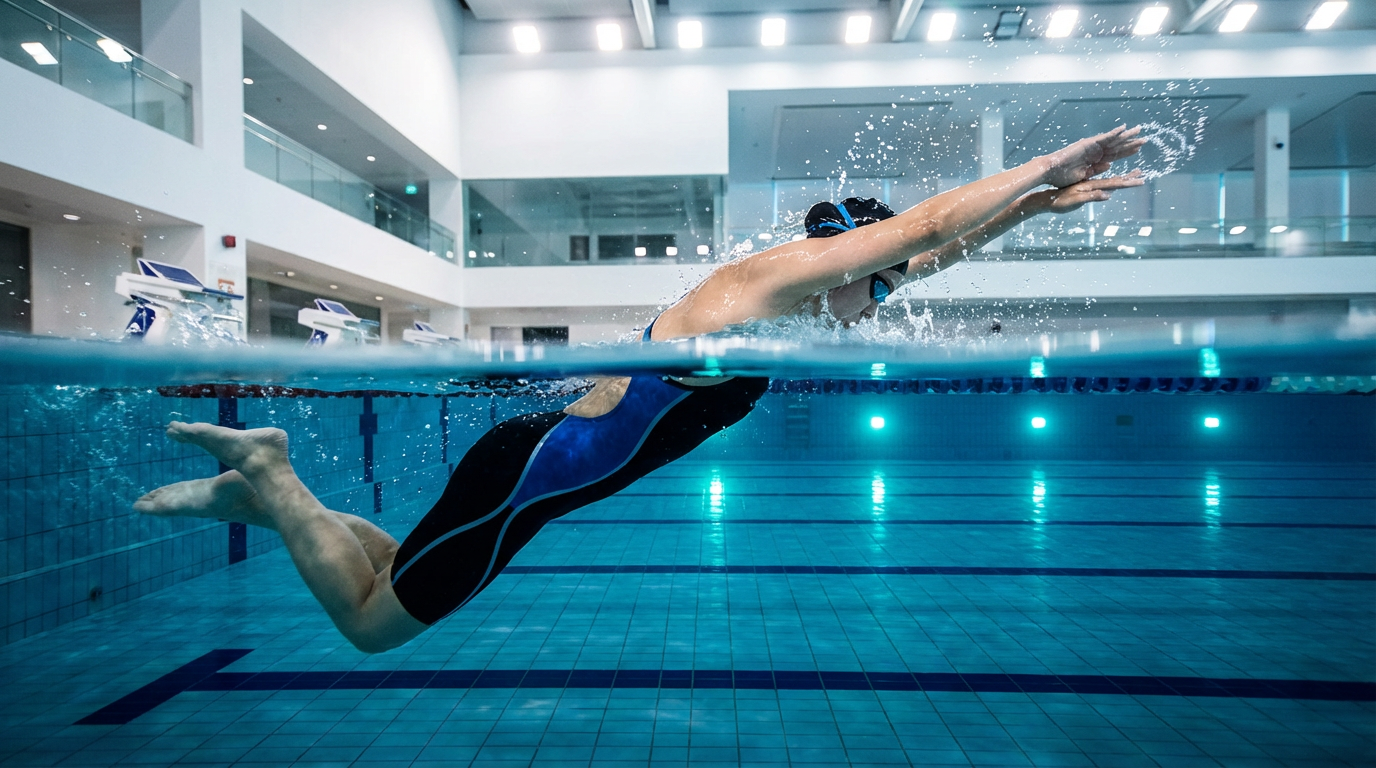
Glide position represents the moment of truth for body streamlining. During the glide phase following the kick, the body should form an arrow-like shape with arms extended, head neutral, and legs together. Swimmers who shorten the glide, keep their head raised, or separate their legs sacrifice the hydrodynamic efficiency that allows the kick's propulsion to translate into distance. This streamlined glide is so critical that competitive breaststrokers often gain more time advantage through superior glide position than through more powerful strokes.
The complexity of breaststroke makes it particularly resistant to self-directed learning. Unlike freestyle, where swimmers can often develop functional technique through experimentation and pool time, breaststroke's interdependent components mean that errors in one area cascade into problems throughout the entire stroke. Without external feedback from qualified coaches or video analysis, swimmers simply cannot see or feel many of the technical faults they're developing.
The stroke's feel is inherently deceptive. Movements that feel powerful and efficient to the swimmer often create excessive drag or mistimed propulsion. For example, the wide, powerful kick that feels effective may actually be pushing water downward rather than backward, or the strong arm pull that seems to generate speed may be disrupting the crucial glide phase. Swimmers locked inside their own proprioceptive feedback cannot access the external perspective necessary to identify these disconnects between feeling and reality.
Online video tutorials and instructional articles provide valuable information, but they cannot replace real-time coaching feedback. A swimmer might watch a perfect breaststroke demonstration and believe they're replicating it, while actually performing significantly different movements. The gap between understanding a concept intellectually and executing it physically is particularly wide in breaststroke, where subtle timing differences of fractions of a second determine success or failure.
Perhaps most problematically, incorrect breaststroke technique becomes deeply ingrained through repetition. Every length swum with poor timing or faulty mechanics reinforces those motor patterns, making them progressively harder to correct. After months or years of self-taught breaststroke, swimmers face the difficult task of unlearning automatic movements and rebuilding technique from scratch. In our two decades at SPEEDISWIM, we've consistently found that swimmers who begin with qualified instruction progress faster and reach higher technical levels than those who attempt self-teaching and later seek coaching to fix problems.
Effective breaststroke instruction follows a developmental progression that builds skills systematically rather than attempting full-stroke swimming immediately. This approach, reflected in Singapore's SwimSafer 2.0 framework, recognizes that swimmers must achieve competency at each technical level before adding complexity. The progression typically begins with body position and breathing control, establishing the foundational elements upon which all other skills depend.
Kick development forms the next critical phase. Because the kick provides most of breaststroke's propulsion, achieving a proper whip kick before integrating arms prevents the common problem of over-relying on arm pull to compensate for weak legs. Swimmers practice kick drills with kickboards, focus on ankle flexibility exercises, and perform kick-only lengths until the movement becomes automatic. This isolated practice allows them to concentrate entirely on foot position, knee width, and timing without the distraction of coordinating arms and breathing.
Arm pull technique is introduced separately, often while swimmers use a pull buoy to maintain leg position without kicking. This isolation allows focus on hand pathway, the keyhole pull pattern, proper depth, and efficient recovery. Only after swimmers demonstrate consistent arm technique in isolation do skilled coaches begin integrating arms and legs into the complete stroke. This integration phase is where timing becomes critical, and where the value of professional coaching is most evident.
The final developmental stage involves refinement through targeted drills and stroke counting. Swimmers work on maximizing distance per stroke cycle, perfecting their streamline position, and eliminating wasted motion. For competitive swimmers in our programs, this phase extends into race-specific skills like underwater pullouts, turn technique, and pacing strategies. The developmental approach may seem slower initially, but it produces swimmers with solid technical foundations rather than those who can complete lengths with fundamentally flawed technique.
Structured swimming programs offer systematic advantages that casual or self-directed practice cannot replicate. Professional coaching provides immediate feedback on technical execution, catching errors before they become established patterns. When a swimmer's kick timing is off by a fraction of a second, an experienced coach identifies and corrects it instantly, while a self-taught swimmer might practice that flawed timing for months without realizing the problem exists.
Progression planning represents another critical advantage. Qualified instructors assess each swimmer's current ability level and design appropriate drills that challenge without overwhelming. They know when a swimmer is ready to add complexity and when more time at the current level is needed. This personalized progression prevents both the frustration of advancing too quickly and the stagnation of remaining at skills already mastered. In group settings, coaches modify drills to accommodate different ability levels, ensuring every participant receives appropriate challenge and support.
Structured programs also provide accountability and consistency that self-directed practice rarely achieves. Regular scheduled sessions ensure swimmers practice frequently enough for skill retention and improvement. The presence of coaches and fellow swimmers creates a learning environment that maintains motivation through plateaus and challenging phases. Singapore's swimming lesson landscape reflects this value, with group lessons typically ranging from $35 to $55 per session, while private or semi-private instruction ranges from $60 to $120 per session based on the individualized attention and accelerated progress they provide.
At SPEEDISWIM, our alignment with SwimSafer 2.0 certification standards ensures that swimmers progress through nationally recognized skill levels with proper documentation of achievement. This structured framework provides clear milestones and goals, transforming the abstract challenge of "learning breaststroke" into concrete, achievable objectives. Our track record of training over 25,000 students and developing more than 1,000 athletes across multiple aquatic disciplines demonstrates the effectiveness of systematic, professionally coached programs.
Certain indicators clearly signal that self-directed practice has reached its limits and professional coaching is necessary for further progress. If you've been practicing breaststroke for several months without noticeable improvement, or if you find the stroke exhausting despite swimming relatively short distances, these are strong signs that technical issues are holding you back. The stroke should feel rhythmic and efficient once proper technique develops; persistent difficulty suggests fundamental problems that require expert diagnosis.
Swimmers who experience physical discomfort during breaststroke should seek coaching immediately. While the stroke does place some stress on knees and lower back, properly executed breaststroke should not cause pain. Persistent knee pain often indicates incorrect kick mechanics, while lower back discomfort typically stems from excessive vertical motion or poor body position. A qualified coach can identify the technical faults causing these problems and provide corrections that eliminate both the discomfort and the underlying inefficiency.
Competitive swimmers and those training for fitness goals face particular pressure to develop efficient technique. Every length swum with poor mechanics builds counterproductive muscle memory and wastes training time. For these swimmers, investing in professional coaching early prevents the frustrating scenario of practicing hard while reinforcing incorrect patterns. The cost of quality instruction—whether group sessions or private lessons—represents a valuable investment in long-term progress and injury prevention.
Parents considering swimming instruction for children should recognize that breaststroke's complexity makes it particularly unsuited to casual teaching by non-specialists. Children who learn improper breaststroke technique as youngsters face years of difficult correction work if they later pursue competitive swimming or simply want to swim efficiently. Starting with qualified instruction through programs like our SwimSafer courses ensures children develop correct patterns from the beginning, avoiding the common mistake of learning "survival breaststroke" that later requires complete technical reconstruction.
Breaststroke's reputation as the most technically challenging stroke to master is well-earned. The precise coordination of symmetrical arm and leg movements, the critical importance of timing between pull, breathe, kick, and glide phases, and the counterintuitive body positions required all combine to create a stroke that resists casual learning attempts. Common technical errors in kick mechanics, arm pathway, and body position become deeply ingrained without proper coaching feedback, often requiring months or years to correct once established.
The complexity that makes breaststroke difficult, however, also makes it deeply rewarding to master. Swimmers who develop proper technique discover an efficient, powerful stroke that's sustainable over long distances and highly effective in open water situations. The journey from struggling beginner to competent breaststroke swimmer requires patience, quality instruction, and consistent practice with proper technique rather than simply accumulating pool time with flawed mechanics.
For swimmers serious about developing correct breaststroke technique, professional coaching through structured programs provides the feedback, progression planning, and systematic skill development that self-teaching cannot replicate. Whether your goals involve water safety competency, fitness swimming, or competitive performance, investing in qualified instruction accelerates progress and prevents the frustrating cycle of practicing incorrect technique that ultimately requires correction.
Don't let breaststroke's technical challenges hold back your swimming progress. With over 20 years of teaching experience and a proven track record of training more than 25,000 students, SPEEDISWIM's professionally qualified coaches provide the expert instruction needed to develop proper breaststroke technique from the foundation up. Our structured programs, aligned with SwimSafer 2.0 national standards, ensure you build correct skills progressively rather than reinforcing common mistakes.
Whether you're a beginner learning your first strokes, an intermediate swimmer struggling with coordination, or a competitive athlete refining race technique, our coaches deliver personalized feedback and systematic progression that accelerates your development.
Contact SPEEDISWIM today to learn how our expert coaching can transform your breaststroke technique and help you swim with confidence and efficiency.